On eBird ↗
Gray-fronted Quail-Dove
Live sightings near you, the range map, bar charts of when it is seen, and Macaulay Library photos and recordings.
Gray-fronted Quail-Dove
Geotrygon caniceps
The grey-fronted quail-dove (Geotrygon caniceps), is a species of bird in the family Columbidae. It is endemic to the island of Cuba. Its natural habitats are subtropical or tropical moist lowland forests, subtropical or tropical swamps, subtropical or tropical moist montane forests, and plantations. It is threatened by habitat loss.
From the article Grey-fronted quail-dove on Wikipedia (CC BY-SA), quoted section by section
Description
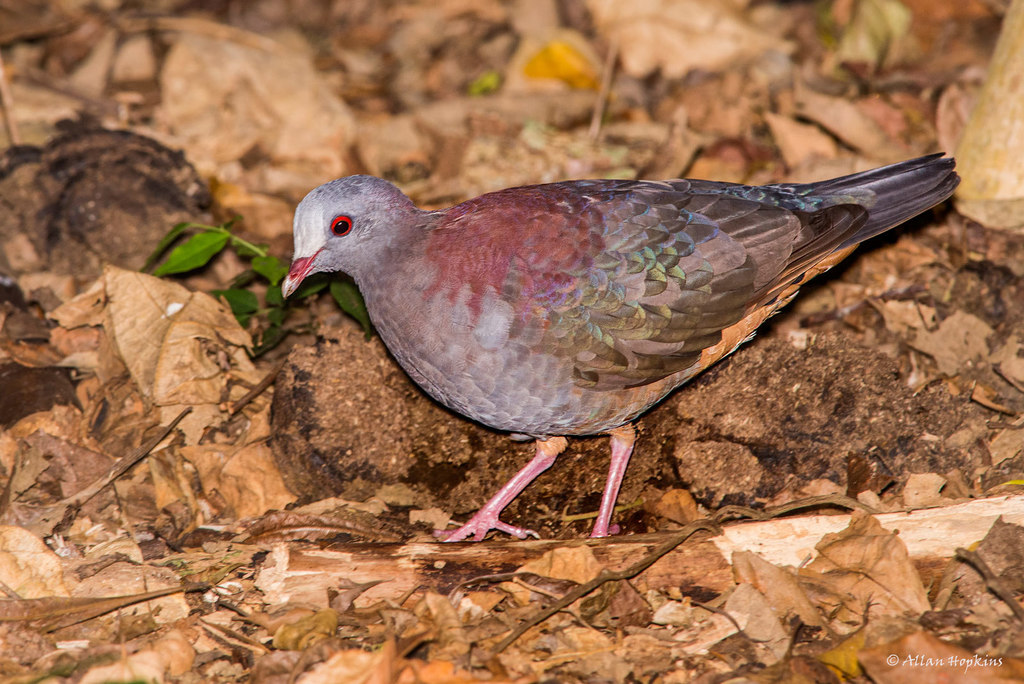
The male grey-fronted quail-dove is 26 to 30 cm (10 to 12 in) long and the female 27 cm (11 in). They weigh 192 to 210 g (6.8 to 7.4 oz). The adult male's forehead ("front") is grayish white darkening to gray on the rest of the head, with slight purplish iridescence on the back of it. The medium gray throat darkens on the breast, whose sides are gossy purple. The belly is cream and the vent area rufous. The shoulders are glossy purple, the lower back and rump bluish purple, and the tail gray. The adult female is very similar but duller. Juveniles have a brownish gray forehead, pale gray throat, dark brown upperparts, and chestnut underparts.
Range & habitat
The grey-fronted quail-dove was formerly found throughout Cuba but is now apparently limited to the island's eastern margin and the Sierra del Rosario in the west. It favors wet primary and secondary forests in the lowlands and at elevations up to 1,200 m (3,900 ft).
Wikipedia: “Distribution and habitat”
What it does
The grey-fronted quail-dove forages on the ground, singly or in pairs, where it feeds on seeds and small invertebrates.
Wikipedia: “Feeding”
Listen
Looking for field recordings…
Where it lives
Recorded sightings
—
geo-referenced records in GBIF, from museums, herbaria and field observers.
Drag the globe to turn it. Dots are where records exist, not a range map; darker means more records.
In the stacks
Searching the stacks…
Every page naming Geotrygon caniceps in the Biodiversity Heritage Library →
This page is assembled live from iNaturalist, GBIF, Wikipedia, the Source Library and the Internet Archive. It is not yet part of the hand-edited codex. iNaturalist taxon 204515.