On eBird ↗
Philippine Scops-Owl
Live sightings near you, the range map, bar charts of when it is seen, and Macaulay Library photos and recordings.
Philippine Scops-Owl
Otus megalotis
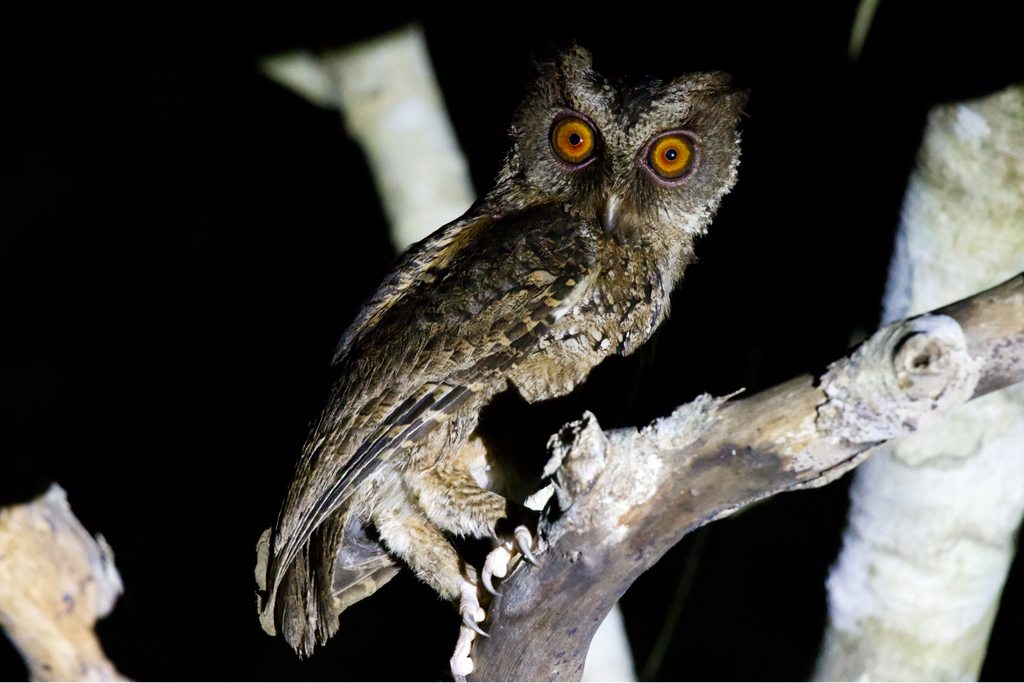
The Philippine scops owl (Otus megalotis), also Luzon lowland scops owl is a common owl, endemic to the Philippines, belonging to the family of the typical owls Strigidae. Other common names include "Otus Whitehead", "Whitehead scops owl" and "Luzon lowland scops owl". Everett's scops owl (O. everetti) and Negros scops owls (O. nigrorum) were formerly considered conspecific but are now classified as separate species.
Distinguishing features of these birds include their large upright ears from which they get their specific name megalotis, Ancient Greek for "large ears". Philippine scops owls are relatively small, sedentary birds that are naturally found in the forest understory. There are three subspecies which show variations in morphology and are distributed among different islands of the Philippine Archipelago. They are a monogamous species that offer parental care and construct their nest in tree cavities. These owls are ferocious nocturnal carnivores that feed on insects and small mammals. The IUCN Red List considers this species as Least Concern but they may be vulnerable to deforestation and fragmentation.
From the article Philippine scops owl on Wikipedia (CC BY-SA), quoted section by section
Description
The Philippine scops owl is a fairly small-to-mid-sized species of owl, but is arguably the largest true species of scops owl. Adults measure from 23 to 28 cm (9.1 to 11.0 in). Their body mass can range from 125 to 310 g (4.4 to 10.9 oz), with females often considerably larger than males. A distinguishing feature of this owl is its large ears that stand upright on its head. They also have big eyes that are dark in the center with a red/orange edge. In general, these owls are covered in dark brown feathers with dark streaks. Their ear-tufts also have a similar pattern. Their forehead is whitish and they have a dark line around their facial disc. There are three subspecies of Philippine scops owl which show three variations in morphology. The smallest subspecies, O. m. nigrorum, has a reddish-brown color, no scapular line, and no feathers on its upper feet. The medium-sized subspecies, O. m. everetti, also lacks a scapular line and feathers on its upper feet but it has a more greyish-brown color. Finally, O. m. megalotis is the largest of all three subspecies and also has a grey-brown color but it shows a scapular line and feathers on its upper feet. Other morphological differences between the subspecies can be seen in the length of the tail, the wings, the culmen and the tarsus. These traits are longer in O. m. megalotis and are shorter in O. m. …
Range & habitat
Rainforests, mature secondary woodland forests and forest edges are typical habitats in which Philippine scops owls can be found. They are mostly observed in the understory and rarely go above 1,000 m altitudes, with the exception of individuals which were reported on Mount Data, Luzon. Researchers caught a Philippine scops owl in a net set up at 2 m above ground during their study, which confirms that they are mostly an understory arboreal species. O. megalotis is endemic to the Philippine Archipelago but the three subspecies are distributed in different locations across the archipelago. O. m. megalotis species is found mostly in the northern islands such as Luzon, Marinduque and Catanduanes. O. m. everetti species exists in the eastern and southern islands including Samar, Biliran, Leyte, Mindanao and Basilan. Finally, O. m. nigrorum species is endemic to Negros Island. These subspecies are not known to migrate and therefore have a limited distribution. Although they are classified as a species of Least Concern, habitat destruction from deforestation and fragmentation is a major threat to their population as they depend on forests for their survival.
Wikipedia: “Habitat and distribution”
What it does
Philippine scops owls are sedentary birds with a limited home range. The fact that different subspecies are found on different islands limits intraspecific competition and allows these birds to have a smaller distribution where all the necessary resources are available.
Vocalizations. Philippine scops owls are a nocturnal species and vocalize more actively at night. Their song corresponds to "oik oik oik ook" with long and powerful notes that are clearly distinguished from one another. The last "ook" is lower than the previous three notes. Their call sounds completely different with a series of three to six escalating notes that are loud and abrupt. From what is known, there is no difference between the call and the songs of females, males and juveniles.
Diet. These carnivorous owls prey upon animals such as insects and small mammals. During nighttime, they perch in trees where the land is relatively open, which offers them a better view of the surrounding preys. They are ferocious feeders and specialize in tearing flesh. Their raptorial claws, curved bill and excellent hearing and sighting skill make them powerful predators. They have been observed to kill their victim by crushing its head, then breaking every other bone of the body to finally swallow the animal whole. This method has cost the lives of many juveniles who suffocate because the prey is too large to swallow. …
Wikipedia: “Behaviour”
Listen
Looking for field recordings…
Where it lives
Recorded sightings
—
geo-referenced records in GBIF, from museums, herbaria and field observers.
Drag the globe to turn it. Dots are where records exist, not a range map; darker means more records.
In the stacks
Searching the stacks…
Every page naming Otus megalotis in the Biodiversity Heritage Library →
This page is assembled live from iNaturalist, GBIF, Wikipedia, the Source Library and the Internet Archive. It is not yet part of the hand-edited codex. iNaturalist taxon 204558.