On eBird ↗
Cinereous Tinamou
Live sightings near you, the range map, bar charts of when it is seen, and Macaulay Library photos and recordings.
Cinereous Tinamou
Crypturellus cinereus
The cinereous tinamou (Crypturellus cinereus), also known as brushland tinamou, is a type of ground bird found in swamp and lowland forests in northern South America. They have some localized names that have been used by the indigenous people such as in Amazonas where they are called inambu-pixuna, and in Pará, Brazil where they are called nambu-sujo. Also, throughout their range they are called inhambu-preto. Cinereous tinamous have been around for many centuries. They are part of the oldest families of the world today and have fossils discovered dating back tens of millions of years. Their quick reflexes play a role in their ability to survive.
From the article Cinereous tinamou on Wikipedia (CC BY-SA), quoted section by section
Description
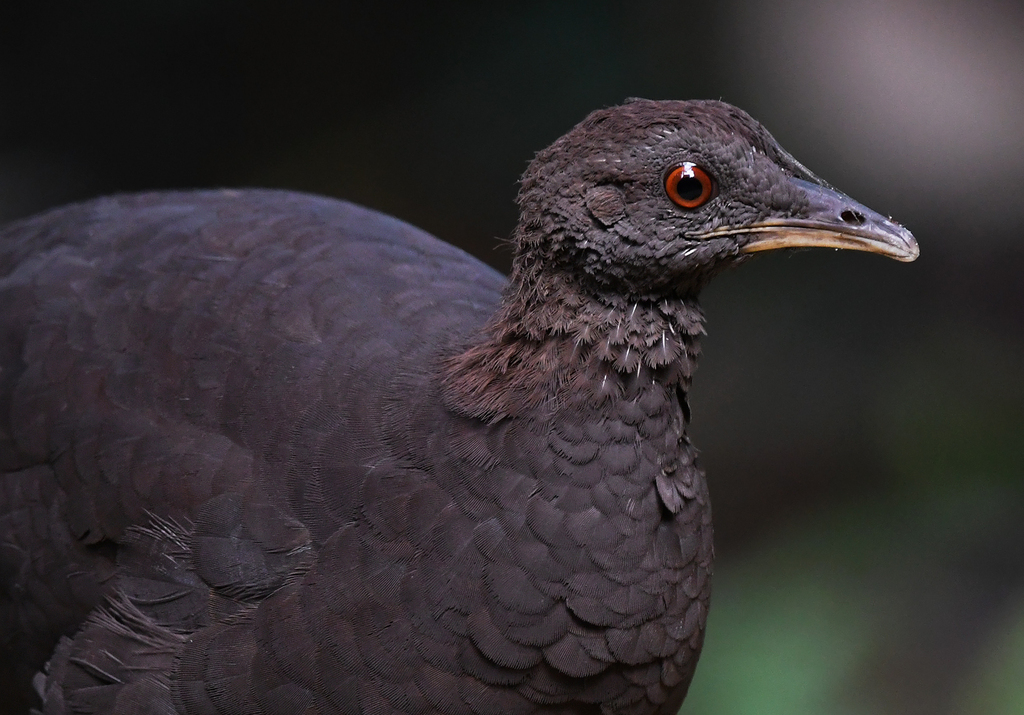
The cinereous tinamou is a shy and secretive bird. It is approximately 29–32 cm (11–13 in) in length, and the male bird weighs around 435 grams (15.3 oz) and the female of the species weighs 549–602 grams (19.4–21.2 oz). It is colored similar to the Berlepsch's tinamou in that it is dark brown to sooty brown or brownish black in coloration. It tends to be slightly more brown than the Berlepsch's tinamou. It is recognized by its smoky-grey with reddish-brown crown and nape. The feather shafts on side of its head are white, which shows through on occasion. Their color helps them blend with the environment making it harder for predators to detect them. The under parts of the bird are only slightly paler than the body, and the legs appear a dull orange to yellow. They have a light-colored eye ring. Their bill has a dark upper mandible and a yellow lower mandible. In general, their bill is very similar to the Berlpesch's tinamou except it trends smaller and thinner. The females are generally slightly larger in size then the males. The cinereous tinamou is specially known to be easy to hear, but very difficult to see. It has a loud distinctive whistle heard mainly at dawn and dusk. The whistle has a unique pitch and last almost two seconds between each whistle. It is mostly heard at dawn and dusk, and are monosyllabic. …
Range & habitat
The cinereous tinamou is a sedentary species. It is native to southern Colombia, southern Venezuela, Suriname, Guyana, French Guiana, northern and western Brazil, eastern Ecuador, eastern Peru, and northern Bolivia. Within Brazil, it occupies the Amazon Basin south to Mato Grosso and east to Pará. It lives in a lowland rainforest or swamp forest, up to 700 m (2,300 ft) altitude. It also occupies second growth forest, along with bushy areas with scattered trees. It has been known to take advantage of coffee and cocoa plantations and, on occasion, will utilize savanna. It prefers to live near streams or thick swamp woods. Its preferred habitat is thick, dark, and dense. It is abundant, within the upper Amazon, in the varzea.
Wikipedia: “Distribution and habitat”
What it does
The cinereous tinamou is diurnal. When they are frightened or surprised they usually run off very quickly. Their instincts have adapted to act quickly since they live their lives on the ground and have to flee quickly to avoid predators so they are rarely seen by humans. They have a tendency to walk or run rather than to fly. They are capable of flight, but it is unusual and short. While the cinereous tinamou may only be in flight for a short duration, their flight is strong and direct. They tend to occur either alone or in pairs, and generally do not travel in groups.
Breeding. The breeding season of the cinereous tinamou is year-round due to the perfect climate that they live in; however there is a period of preferred mating, which is August through October, except in Colombia, where it is in June. Like the majority of the tinamou family, the males practice simultaneous polygyny and the females practice successive polyandry. To initiate courtship, the males will usually call out to attract the females. It is believed that the courtship ritual is similar to that of others in their family. This courtship ritual involves the male lowering their chest to the ground. While doing this, they will stretch their neck forward and raise their posterior. …
Wikipedia: “Behavior”
Listen
Looking for field recordings…
Where it lives
Recorded sightings
—
geo-referenced records in GBIF, from museums, herbaria and field observers.
Drag the globe to turn it. Dots are where records exist, not a range map; darker means more records.
In the stacks
Searching the stacks…
Every page naming Crypturellus cinereus in the Biodiversity Heritage Library →
This page is assembled live from iNaturalist, GBIF, Wikipedia, the Source Library and the Internet Archive. It is not yet part of the hand-edited codex. iNaturalist taxon 20534.