On eBird ↗
Horned Guan
Live sightings near you, the range map, bar charts of when it is seen, and Macaulay Library photos and recordings.
Horned Guan
Oreophasis derbianus
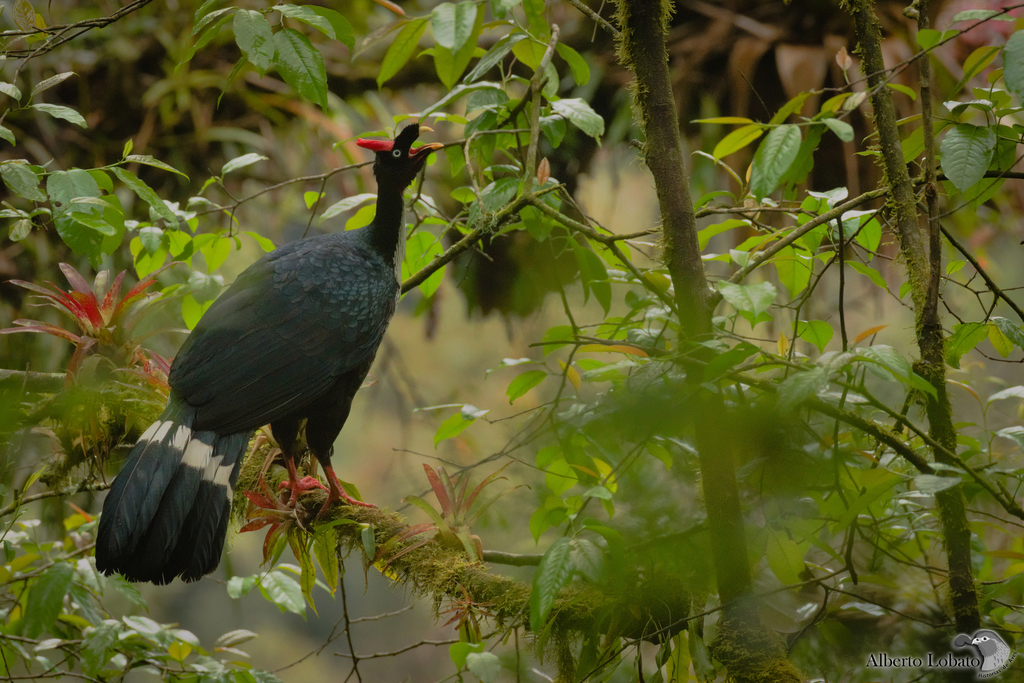
The horned guan (Oreophasis derbianus) is a large, approximately 85 cm long, turkey-like bird with glossed black upperparts plumage, red legs, white iris, yellow bill and a red horn on top of head. The breast and upper belly are white, and its long tail feathers are black with white band near base. Both sexes are similar. The young is duller with smaller horn, and has brown tail and wings.
From the article Horned guan on Wikipedia (CC BY-SA), quoted section by section
Description
The horned guan is 75 to 85 cm (30 to 33 in) long. Its most distinctive feature is the tall, red, fleshy "horn" on its forehead. It has a small head, long strong legs, and a long broad tail. The sexes are alike in plumage but males have a taller horn and longer wings, tail, and legs than females. Adults have a glossy black head, neck, and upperparts with a bluish sheen. Their tail is black with a wide white band near its base. Their throat, breast, and upper belly are whitish with black flecks and their lower belly and flanks are brown. They have a small red dewlap, a white iris, a yellow bill, and red legs and feet. Juveniles resemble adults but are duller and have a smaller horn.
Range & habitat
The horned guan is found in the southern Mexican state of Chiapas, possibly in Oaxaca, and in southern Guatemala. Reports from Honduras have not been confirmed. Its distribution is not continuous but highly local. It inhabits humid subtropical montane evergreen forest, cloudforest, and pine-oak forest. Its habitat is characterized by much undergrowth of tree ferns, epiphytes, mosses, and vines. In elevation it mostly ranges between 2,300 and 3,100 m (7,500 and 10,200 ft) but locally occurs as low as 1,200 m (3,900 ft) and as high as 3,350 m (11,000 ft).
Wikipedia: “Distribution and habitat”
What it does
The horned guan feeds mostly on a very wide variety of fruits; green leaves are a significant part of its diet with flowers and possibly insects eaten in small amounts. It forages singly or in small groups at all levels of the forest including the ground. Many seeds pass intact through its system, which suggests that it might be a significant dispersal agent.
Wikipedia: “Feeding”
Listen
Looking for field recordings…
Where it lives
Recorded sightings
—
geo-referenced records in GBIF, from museums, herbaria and field observers.
Drag the globe to turn it. Dots are where records exist, not a range map; darker means more records.
In the stacks
Searching the stacks…
Every page naming Oreophasis derbianus in the Biodiversity Heritage Library →
This page is assembled live from iNaturalist, GBIF, Wikipedia, the Source Library and the Internet Archive. It is not yet part of the hand-edited codex. iNaturalist taxon 2058.