On eBird ↗
Curve-billed Tinamou
Live sightings near you, the range map, bar charts of when it is seen, and Macaulay Library photos and recordings.
Curve-billed Tinamou
Nothoprocta curvirostris
The curve-billed tinamou (Nothoprocta curvirostris) is a type of tinamou commonly found in high-altitude grassland and shrubland habitats in the Andes of South America.
From the article Curve-billed tinamou on Wikipedia (CC BY-SA), quoted section by section
Description
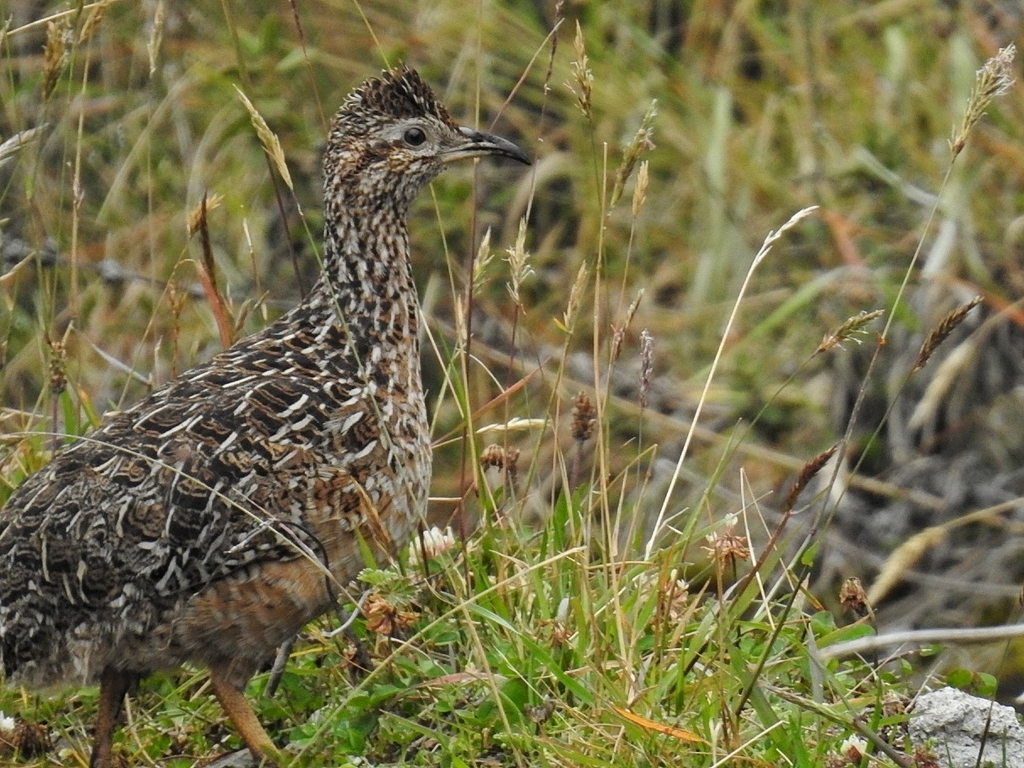
The curve-billed tinamou is approximately 28 cm (11 in) in length. Its upper parts are dark brown streaked with white and spotted with black. Its breast is rufous and spotted with white, its belly is tawny-buff and its crown is black, the sides of its head, and its throat and foreneck are white. Finally, its legs are brown in color.
Wikipedia: “Characteristics”
Range & habitat
This tinamou lives in the Andes of central and southern Colombia, through Ecuador and northern and central Peru. It prefers grassland at 2,800 to 3,700 m (9,200–12,100 ft) in altitude. It also can be found in high-altitude shrubland and pasture.
Wikipedia: “Range and habitat”
What it does
Like other tinamous, the curve-billed tinamou eats fruit off the ground or low-lying bushes. They also eat small amounts of invertebrates, flower buds, tender leaves, seeds, and roots. The male incubates the eggs which may come from as many as 4 different females, and then will raise them until they are ready to be on their own, usually 2–3 weeks. The nest is located on the ground in dense brush or between raised root buttresses.
Wikipedia: “Behavior”
In human culture
Crypturellus is formed from three Latin or Greek words. kruptos meaning covered or hidden, oura meaning tail, and ellus meaning diminutive. Therefore, Crypturellus means small hidden tail.
Wikipedia: “Etymology”
Listen
Looking for field recordings…
Where it lives
Recorded sightings
—
geo-referenced records in GBIF, from museums, herbaria and field observers.
Drag the globe to turn it. Dots are where records exist, not a range map; darker means more records.
In the stacks
Searching the stacks…
Every page naming Nothoprocta curvirostris in the Biodiversity Heritage Library →
This page is assembled live from iNaturalist, GBIF, Wikipedia, the Source Library and the Internet Archive. It is not yet part of the hand-edited codex. iNaturalist taxon 20630.