On eBird ↗
Red-winged Tinamou
Live sightings near you, the range map, bar charts of when it is seen, and Macaulay Library photos and recordings.
Red-winged Tinamou
Rhynchotus rufescens
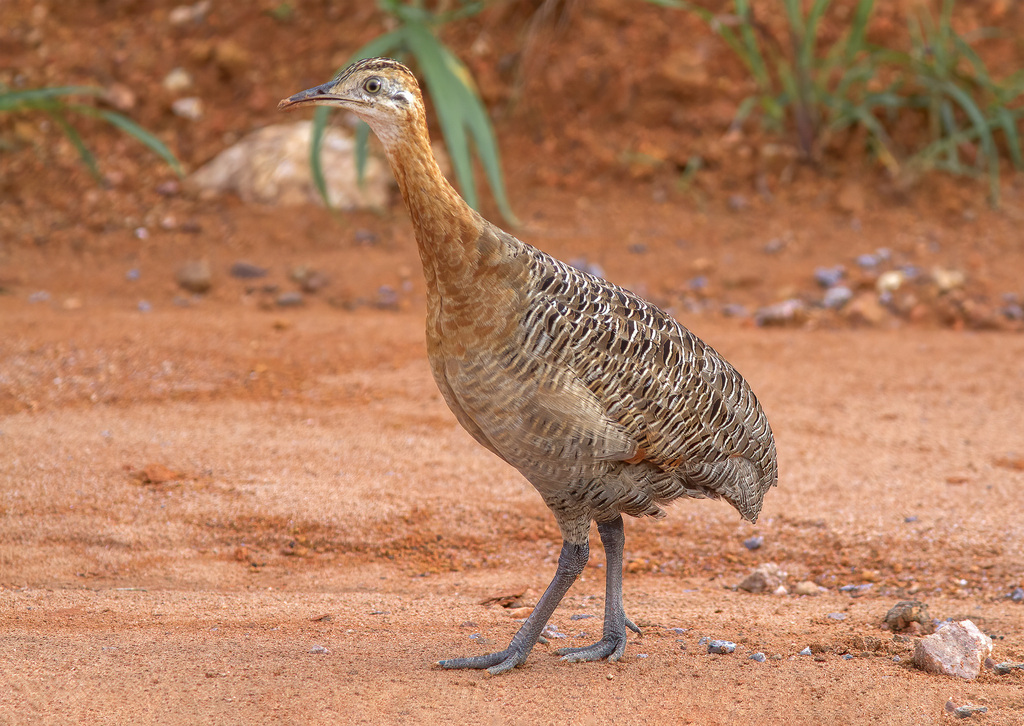
The red-winged tinamou (Rhynchotus rufescens) is a medium-sized ground-living bird from central and eastern South America. Other common names for the species include perdiz grande, rufous tinamou, and ynambu.
From the article Red-winged tinamou on Wikipedia (CC BY-SA), quoted section by section
Description
The red-winged tinamou is 39–42.5 cm (15.4–16.7 in) in overall length. The male weighs 700–920 g (25–32 oz), the female is slightly heavier and weighs 815–1,040 g (28.7–36.7 oz). It has a black crown, rufous primaries, and light gray to brown underneath. It may have black bars on flanks, abdomen and vent. Also, the throat is whitish, the foreneck and breast are cinnamon. The curved bill is horn-coloured with a blackish culmen. Juveniles are duller.
Range & habitat
Its range is southeastern, northeastern and central Brazil, eastern Paraguay, southeastern Peru, Bolivia and eastern Argentina At lower elevations (1,000 m (3,300 ft)), it favours marshy grasslands (seasonally flooded) and forest edges. While, at higher elevations, up to 2,500 m (8,200 ft), it will frequent arid shrubland, pastures, and grain fields. Overall it prefers dry savanna.
Wikipedia: “Distribution and habitat”
What it does
The red-winged tinamou have vocal males that are a longs ringing single whistle followed by shorter sad whistles. The female does not call. This species is most active during the hottest parts of the day.
Food and feeding. Its diet varies by season; it taking insects and other small animals (even small mammals) in the summer, and switching to vegetable matter, such as fruits, shoots, tubers and bulbs, in the winter. It can be an agricultural pest, feeding on cereals, rice and peanuts, as well as being predatory, taking poisonous snakes and even jumping up into the air to snatch an insect on vegetation.
Breeding. The male of the species attracts the female by follow feeding and after the attraction will move to the nest where she lays her eggs that he will incubate only and then raise the chicks. The clutch can contain up to five eggs. These are reddish purple in color.
Wikipedia: “Behavior”
Listen
Looking for field recordings…
Where it lives
Recorded sightings
—
geo-referenced records in GBIF, from museums, herbaria and field observers.
Drag the globe to turn it. Dots are where records exist, not a range map; darker means more records.
In the stacks
Searching the stacks…
Every page naming Rhynchotus rufescens in the Biodiversity Heritage Library →
This page is assembled live from iNaturalist, GBIF, Wikipedia, the Source Library and the Internet Archive. It is not yet part of the hand-edited codex. iNaturalist taxon 20695.