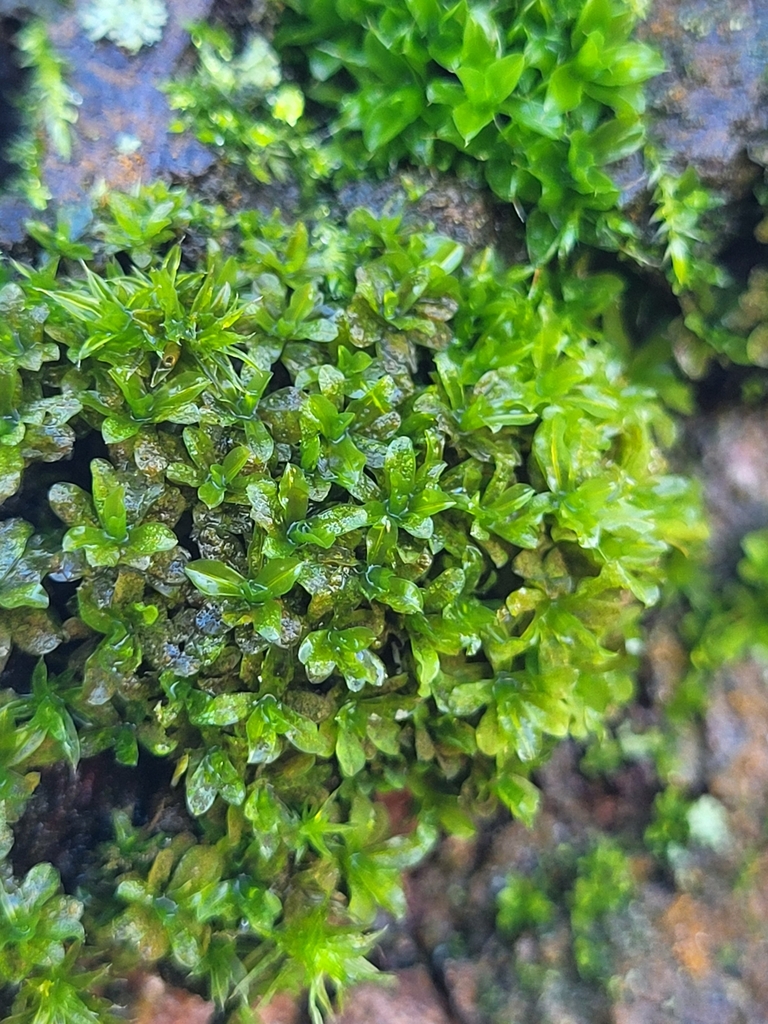
Water Screw-moss
Syntrichia latifolia
Syntrichia latifolia, formerly Tortula latifolia, and commonly known as water screw-moss, is a species of moss belonging to the family Pottiaceae. Syntrichia species differ from members of Tortula due to synapomorphic leaf qualities, such as different basal and distal cells, as well as different costal cross sections where Tortula has an abaxial epidermis and Syntrichia lacks one.
From the article Syntrichia latifolia on Wikipedia (CC BY-SA), quoted section by section
Range & habitat
It is commonly found in Europe and the Pacific Northwest region of North America. Syntrichia latifolia grows on trees, sidewalks, and concrete.
Wikipedia: “Distribution and habitat”
What it does
When a haploid spore or gemmae lands on suitable surface, it will germinate into a haploid gametophytic generation. First it will grow into a protonematal stage, where rhizoids and protonematal filaments develop and anchor to the substratum. Then, leafy gametophytic shoots develop. When the gametophyte is mature, it will either produce antheridia or archegonia, as it is dioicous and thus only produces either female or male structures on one plant. When a haploid sperm cell produced in an antheridia swims down the neck canal of the archegonia, it will fertilize the haploid egg inside, producing a diploid zygote. The sporophyte generation grows from the diploid zygote. The diploid seta elongates and the diploid sporangium matures at the tip. Inside the sporangium, spores undergo meiosis to become haploid before reaching maturity. When they are ready to be released and the outer peristome teeth are dry, they are dispersed into the wind.
== References ==
Wikipedia: “Life cycle”
Where it lives
Recorded sightings
—
geo-referenced records in GBIF, from museums, herbaria and field observers.
Drag the globe to turn it. Dots are where records exist, not a range map; darker means more records.
In the stacks
Searching the stacks…
Every page naming Syntrichia latifolia in the Biodiversity Heritage Library →
This page is assembled live from iNaturalist, GBIF, Wikipedia, the Source Library and the Internet Archive. It is not yet part of the hand-edited codex. iNaturalist taxon 207978.