- Animals
- ›Chordates
- ›Vertebrates
- ›Ray-finned Fishes
- ›Spiny-rayed fishes
- ›Jacks, Flounders, Barracudas, and Allies
- ›Jacks, Remoras, and Allies
- ›Jacks
- ›Amberjacks
- ›Campogramma
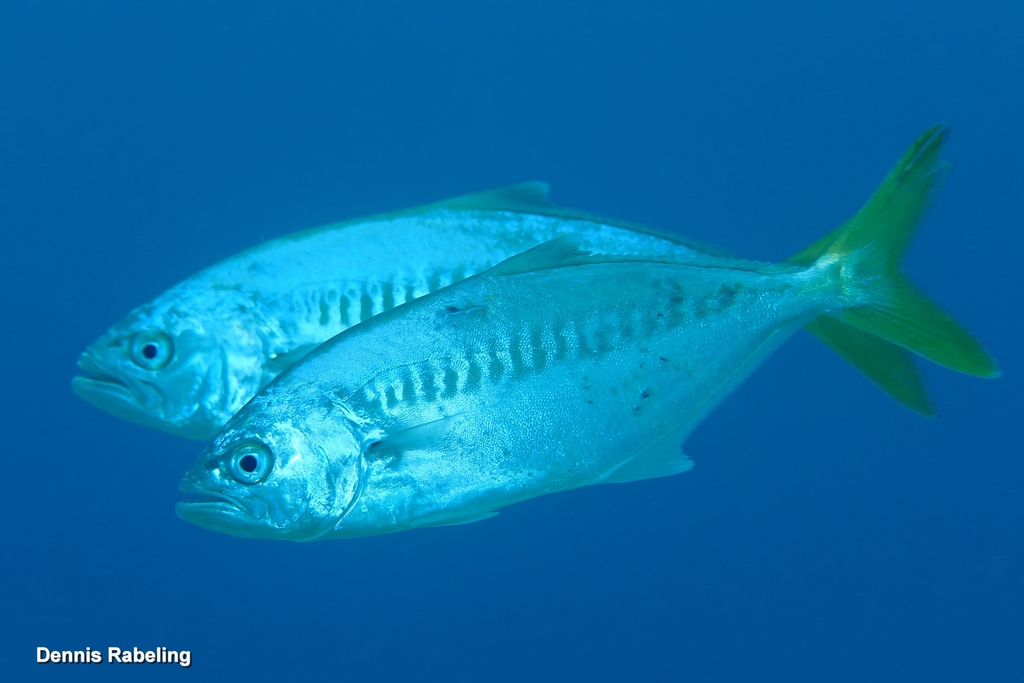
Vadigo
Campogramma glaycos
The vadigo, Campogramma glaycos (also known as the big-toothed pompano, zippered pompano, lexa and lexola), is a species of medium-sized coastal marine fish in the jack family, Carangidae. The species is distributed throughout the eastern Atlantic Ocean from the British Isles in the north to Senegal in the south, also entering the western Mediterranean Sea. The vadigo is similar in form to both the leatherjacks and the queenfish, but can be distinguished by its scaleless chest and a broad, rounded upper jaw. It is a predatory fish, preying mostly on smaller schooling fishes. The species was initially classified under the genus Centronotus before being transferred to its own monotypic genus of Campogramma. The vadigo is of minor commercial importance throughout its range, and is also considered to be a game fish.
From the article Vadigo on Wikipedia (CC BY-SA), quoted section by section
Description
The vadigo is similar in form to other carangids, particularly the genera Oligoplites and Scomberoides, commonly known as queenfish and leatherjacks. It is a moderately large fish growing to 60 cm (24 in), although some less reliable sources state a maximum length of 65 cm (26 in). The maximum published weight of 2.8 kg (6.2 lb). It has an elongate, moderately deep and slightly compressed body, with the dorsal profile slightly more convex than the ventral profile. The upper jaw is broad and rounded at its end with a single row of large, widely spaced canines in both the upper and lower jaw. The dorsal fin is in two parts; the first consisting of 6 or 7 short, often unconnected spines while the second dorsal fin consists of a single spine followed by 26 to 28 sof rays. The anal fin is similar in appearance to the second dorsal fin, having two detached spines followed by one spine attached to 23 to 25 soft rays. Both the ventral and pectoral fins are short, with the ventral consisting of one spine followed by 5 soft rays and the pectoral having 17 rays. The caudal fin is large and highly forked having 30 rays in total. The body is covered in small ctenoid scales except for part of the chest area which is naked. The species has no scutes. …
Range & habitat
The vadigo inhabits the eastern Atlantic Ocean only, distributed from The British Isles in the north to Senegal in the south, with the species also found around distant offshore islands including Madeira and the Canary Islands. The species is also common in the western Mediterranean Sea, where it has recently been found to extend as far north as the Adriatic Sea. The authors who reported this northern capture believe this shows an expansion of the vadigo's range, comparing it to a number of other carangid species who have recently been found outside of their normal range. The adults of the species are pelagic or epibenthic, inhabiting mostly shallow waters between 15 and 30 m in depth. It moves to more coastal waters during the summer in the Mediterranean.
Wikipedia: “Distribution and habitat”
Where it lives
Recorded sightings
—
geo-referenced records in GBIF, from museums, herbaria and field observers.
Drag the globe to turn it. Dots are where records exist, not a range map; darker means more records.
In the stacks
Searching the stacks…
Every page naming Campogramma glaycos in the Biodiversity Heritage Library →
This page is assembled live from iNaturalist, GBIF, Wikipedia, the Source Library and the Internet Archive. It is not yet part of the hand-edited codex. iNaturalist taxon 208576.