On eBird ↗
Gray-headed Chachalaca
Live sightings near you, the range map, bar charts of when it is seen, and Macaulay Library photos and recordings.
Gray-headed Chachalaca
Ortalis cinereiceps
The grey-headed chachalaca (Ortalis cinereiceps) is a member of an ancient group of birds of the Cracidae family, which are related to the Australasian mound builders. It breeds in lowlands from eastern Honduras to northwestern Colombia (from South Chocó to the upper Atrato) at up to 1,100 m (3,600 ft) altitude.
From the article Grey-headed chachalaca on Wikipedia (CC BY-SA), quoted section by section
Description
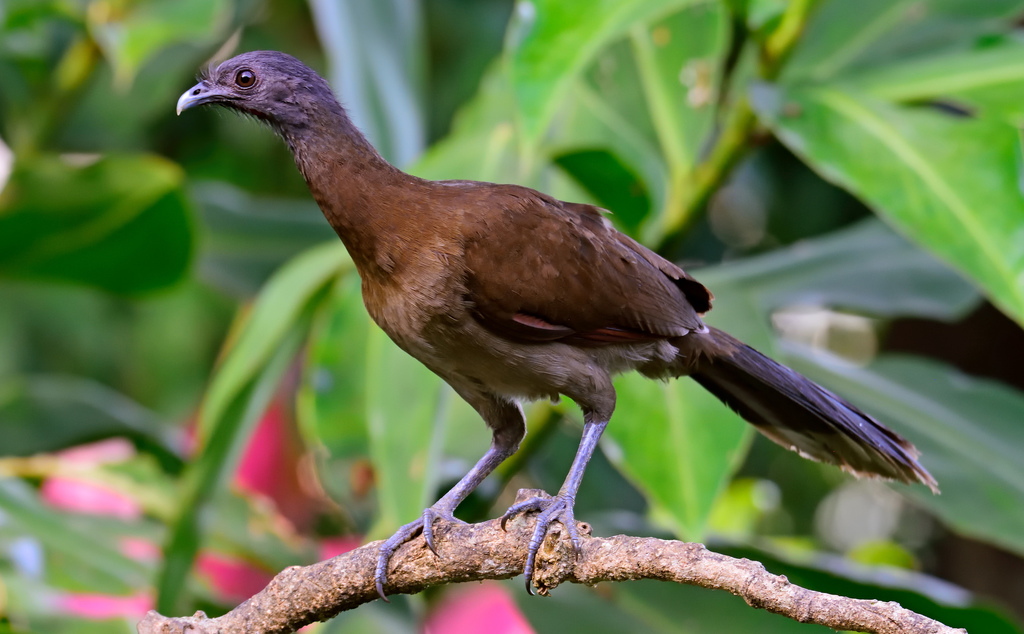
The grey-headed chachalaca is a medium-sized bird, similar in general appearance to turkeys, with a small head, long strong legs, and a long broad tail. They are 48 to 58 cm (1.6 to 1.9 ft) long and weigh 490 to 540 g (1.1 to 1.2 lb). They have fairly dull plumage, grayish brown above and paler below. The head is dark grey with a red dewlap and the blackish tail is tipped with buff. Their primary flight feathers are bright chestnut. Juveniles are browner overall, especially on the head.
Range & habitat
The grey-headed chachalaca is found from Mosquitia in eastern Honduras through eastern Nicaragua and most of Costa Rica and Panama into Colombia's Chocó Department. In addition to mainland Panama it occurs on Isla del Rey, where it might have been introduced by Native Americans. It inhabits a variety of humid landscapes characterized by dense vegetation such as thickets, secondary forest, brushy abandoned fields, and thinned forests. It shuns the interior of dense forest though it can occur in their edges. In elevation it ranges from sea level to 1,700 m (5,600 ft).
Wikipedia: “Distribution and habitat”
What it does
The grey-headed chachalaca forages typically in groups of six to 12 but sometimes up to 20, usually in the vegetation but sometimes on the ground. Its diet is about 75% fruit, 17% leaves, and 8% invertebrates. In the dry season it visits rivers to drink in the morning and evening.
Wikipedia: “Feeding”
Listen
Looking for field recordings…
Where it lives
Recorded sightings
—
geo-referenced records in GBIF, from museums, herbaria and field observers.
Drag the globe to turn it. Dots are where records exist, not a range map; darker means more records.
In the stacks
Searching the stacks…
Every page naming Ortalis cinereiceps in the Biodiversity Heritage Library →
This page is assembled live from iNaturalist, GBIF, Wikipedia, the Source Library and the Internet Archive. It is not yet part of the hand-edited codex. iNaturalist taxon 2087.