On eBird ↗
West Mexican Chachalaca
Live sightings near you, the range map, bar charts of when it is seen, and Macaulay Library photos and recordings.
West Mexican Chachalaca
Ortalis poliocephala
The West Mexican chachalaca (Ortalis poliocephala) is a species of bird in the Cracidae family. It is found only in Mexico, more specifically in Pacific-slope (and adjacent interior) thorn forest from Jalisco to Oaxaca. Its natural habitats are subtropical or tropical dry forests and subtropical or tropical moist lowland forests.
From the article West Mexican chachalaca on Wikipedia (CC BY-SA), quoted section by section
Description
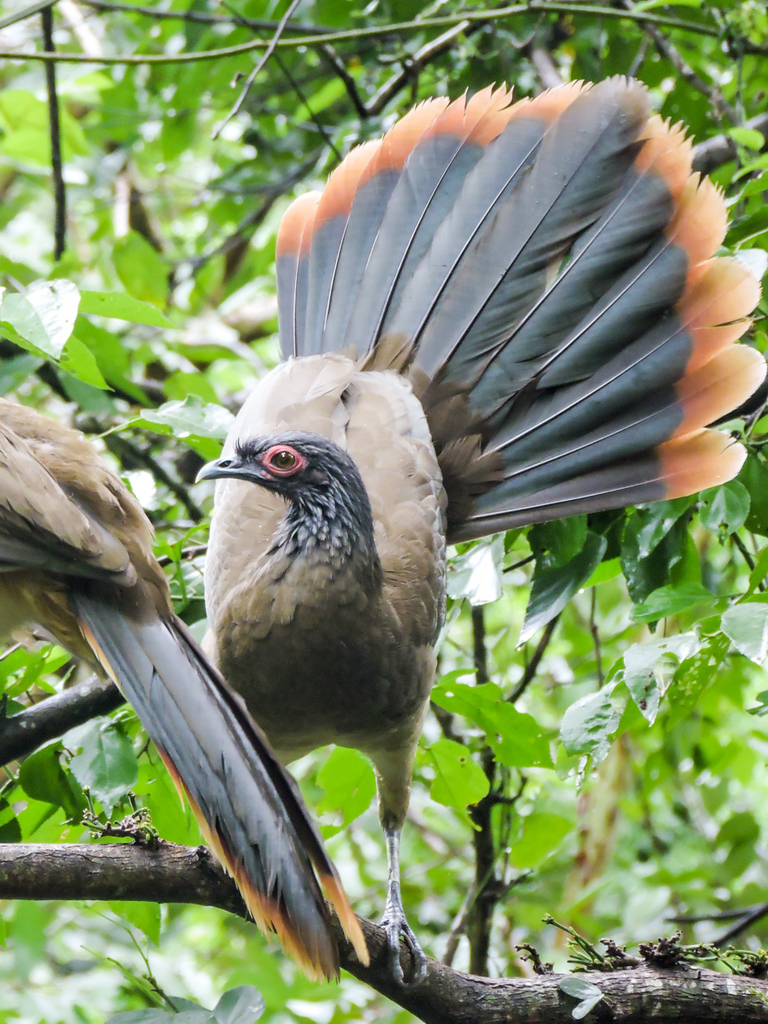
The West Mexican chachalaca is 58.5 to 68.5 cm (1.9 to 2.2 ft) long. One male weighed 760 g (1.7 lb). Its crown and nape are dull brownish gray and the rest of the upperparts pale brownish olive. The tail is slightly grayer and the feathers have broad buff tips. The breast is grayish olive and the belly whitish with a buff wash. The hazel eye is surrounded by bare carmine skin.
Range & habitat
The West Mexican chachalaca is found in a swath of southwestern Mexico between northern Jalisco and southwestern Chiapas and inland as far as southwestern Puebla. It primarily inhabits mature deciduous forest, thorn scrub, and secondary forest. Locally it inhabits pine-oak forest and sometimes is found in mangroves and palm plantations. In elevation it ranges from sea level to 2,400 m (7,900 ft).
Wikipedia: “Distribution and habitat”
What it does
The West Mexican chachalaca forages mostly on the ground but will also ascend into vegetation. About two thirds of its diet is fruit, with flowers, seeds, leaves, and insects making up the rest.
Wikipedia: “Feeding”
Listen
Looking for field recordings…
Where it lives
Recorded sightings
—
geo-referenced records in GBIF, from museums, herbaria and field observers.
Drag the globe to turn it. Dots are where records exist, not a range map; darker means more records.
In the stacks
Searching the stacks…
Every page naming Ortalis poliocephala in the Biodiversity Heritage Library →
This page is assembled live from iNaturalist, GBIF, Wikipedia, the Source Library and the Internet Archive. It is not yet part of the hand-edited codex. iNaturalist taxon 2089.