On eBird ↗
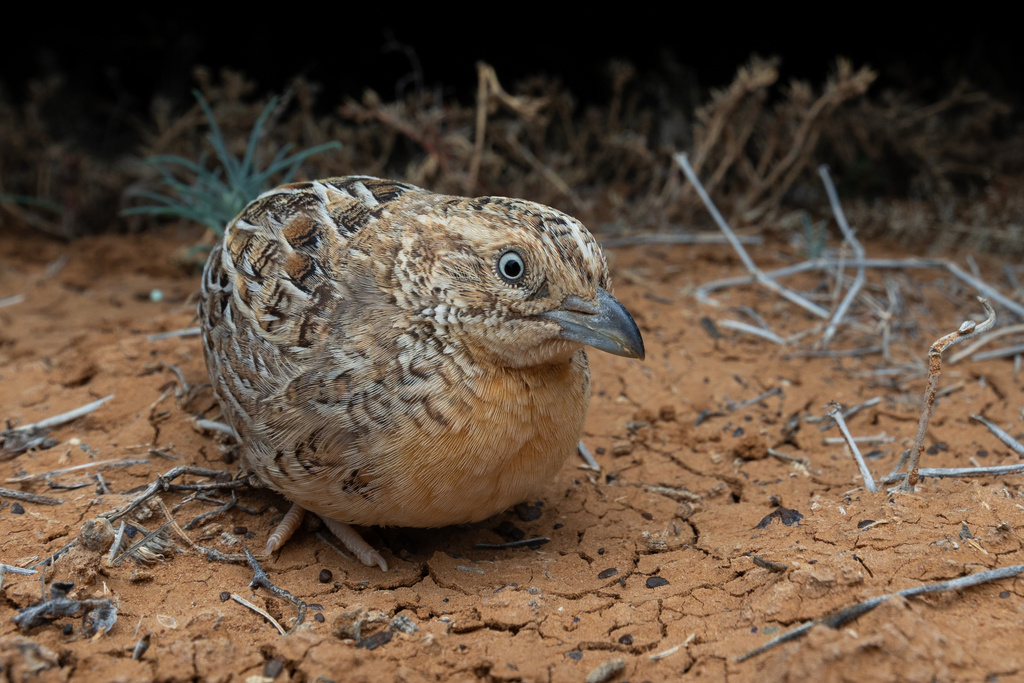
Red-chested Buttonquail
Live sightings near you, the range map, bar charts of when it is seen, and Macaulay Library photos and recordings.
Red-chested Buttonquail
Turnix pyrrhothorax
The red-chested buttonquail (Turnix pyrrhothorax) is a species of bird in the family Turnicidae.
It is endemic to Australia. The species is generally regarded as widespread, although uncommon, in New South Wales, Queensland, northern Western Australia and the Northern Territory, and classified as Vulnerable in Victoria.
From the article Red-chested buttonquail on Wikipedia (CC BY-SA), quoted section by section
Description
Adult red-chested buttonquails are 12–16 cm long with males weighing 27-46 g and females 31-83 g. The species is smaller in size than the painted button-quail. Viewed from behind, red-chested buttonquail look uniformly pale grey across the upper-wings and back. Side-on, the rufous wash on the upper-parts of the red-chested buttonquail is obvious. From close range its thick blue-grey beak, pink legs and feet, and pale eyes can be seen. Females are brighter than males, with rufous of underparts brighter and extending over throat to sides of head, and narrower and denser barring on flanks that rarely extend onto breast as scalloping. Juveniles are smaller, darker above with white streaks and dark barring, bold white spots on wing-coverts, underparts white with rufous-brown gorget and upper breast scalloped. The red-chested buttonquail is more commonly sighted in woodland habitats, than grassland habitats. When disturbed it scuttles through the grass or flies low with whirring wings often showing its white flanks before it drops to cover. The species generally prefers to stay close to the ground and avoids flying.
Similar species. The red-chested buttonquail is most easily distinguished by its uniformed grey-brown tone on its upper side and orange chestnut flakes. …
Range & habitat
Red-chested buttonquails are found along the eastern side of Australia and the top of the Northern Territory and Western Australia. They are not found in Tasmania. The species' preferred habitat is in dense grasslands, and open, grassy, woodland of Acacia (Fabaceae), river red gum (Eucalyptus camaldulensis) and Black box (E. largiflorens) or Melaleuca (Myrtaceae), but also in crops and weedy fields with dense ground cover, and from coastal plains. They occur between sea level and 1000m above sea level. They are generally found in moister, denser vegetation cover than the little buttonquail, but also inhabit semi-arid zones. The common factors in their desired habitat seems to be bare ground and abundant leaf litter, little or no understorey, patches of tussock grass or sedges. The birds normally forage in open area of deep leaf litter, and retreat to the undercover of tussocks or woody debris if threatened.
Wikipedia: “Distribution and habitat”
What it does
The red-chested buttonquail feeds on seeds (grasses, Triticum, Panicum and Malvaceae) and insects (cockroaches, ants, flies and larvae). Foraging occurs throughout the day, although the species has been said to be nocturnal and crepuscular. They make platelets while foraging, which is typical for the genus Turnix. They glean and scratch in leaf litter, while rotating on the spot by pivoting on one foot and raking with the other. Occasionally pecking at the ground, which can sometimes be detected in dry periods by the small puffs of dust they cause while making the platelets. They have been recorded feeding alone, in pairs or small groups of up to five.
Wikipedia: “Feeding”
Listen
Looking for field recordings…
Where it lives
Recorded sightings
—
geo-referenced records in GBIF, from museums, herbaria and field observers.
Drag the globe to turn it. Dots are where records exist, not a range map; darker means more records.
In the stacks
Searching the stacks…
Every page naming Turnix pyrrhothorax in the Biodiversity Heritage Library →
This page is assembled live from iNaturalist, GBIF, Wikipedia, the Source Library and the Internet Archive. It is not yet part of the hand-edited codex. iNaturalist taxon 20901.