On eBird ↗
Trinidad Piping-Guan
Live sightings near you, the range map, bar charts of when it is seen, and Macaulay Library photos and recordings.
Trinidad Piping-Guan
Pipile pipile
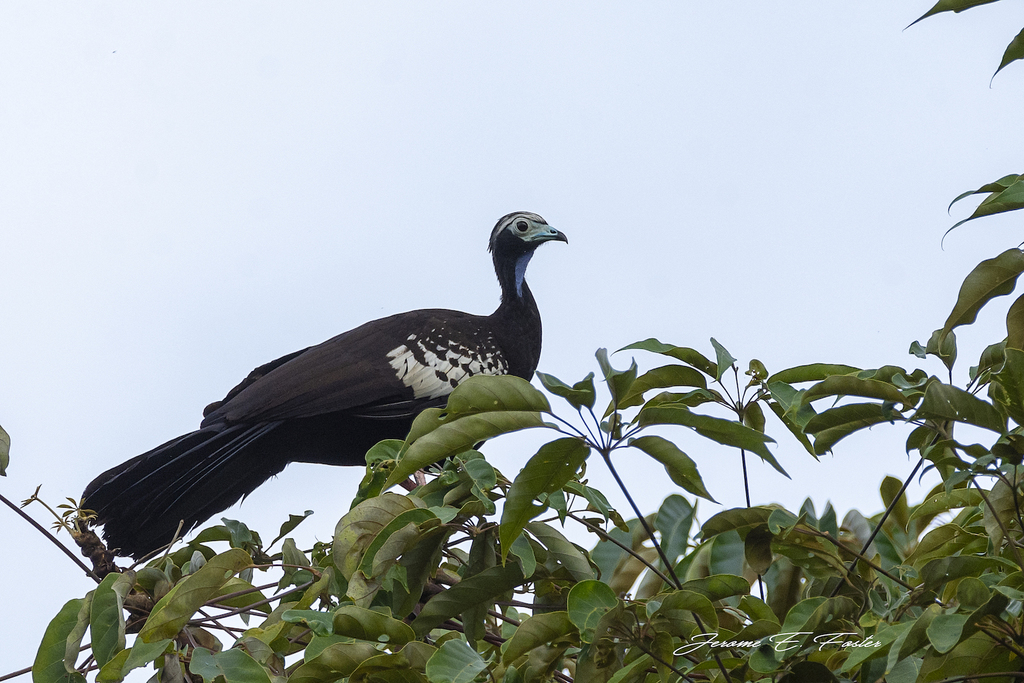
The Trinidad piping guan (Pipile pipile) locally known as the pawi, is a bird in the chachalaca, guan and curassow family Cracidae, endemic to the island of Trinidad. It is a large bird, somewhat resembling a turkey in appearance, and research has shown that its nearest living relative is the blue-throated piping guan from South America. It is a mainly arboreal species feeding mostly on fruit, but also on flowers and leaves. At one time abundant, it has declined in numbers and been extirpated from much of its natural range and the International Union for Conservation of Nature has rated the bird as "critically endangered".
From the article Trinidad piping guan on Wikipedia (CC BY-SA), quoted section by section
Description
This is a medium-sized cracid, 60 cm in length, and similar in general appearance to a turkey, with a thin neck and small head. It is mainly black with a purple gloss. The large crest is blackish, edged with white, and there are large white wing patches. The bare face and wattle are blue, and the legs are red. The Trinidad piping guan's call is a thin piping. The wings whirr in flight.
What it does
They are forest birds, and the nest is built in a tree. Three large white eggs are laid, the female alone incubating. This arboreal species feeds on fruit and berries (such as those from the fragrant nutmeg and baboonwood), as well as flowers and leaves. The confirmation of small insects being a part of their diet has not been made yet.
Wikipedia: “Ecology”
Listen
Looking for field recordings…
Where it lives
Recorded sightings
—
geo-referenced records in GBIF, from museums, herbaria and field observers.
Drag the globe to turn it. Dots are where records exist, not a range map; darker means more records.
In the stacks
Searching the stacks…
Every page naming Pipile pipile in the Biodiversity Heritage Library →
This page is assembled live from iNaturalist, GBIF, Wikipedia, the Source Library and the Internet Archive. It is not yet part of the hand-edited codex. iNaturalist taxon 2107.