On eBird ↗
Broad-billed Tody
Live sightings near you, the range map, bar charts of when it is seen, and Macaulay Library photos and recordings.
Broad-billed Tody
Todus subulatus
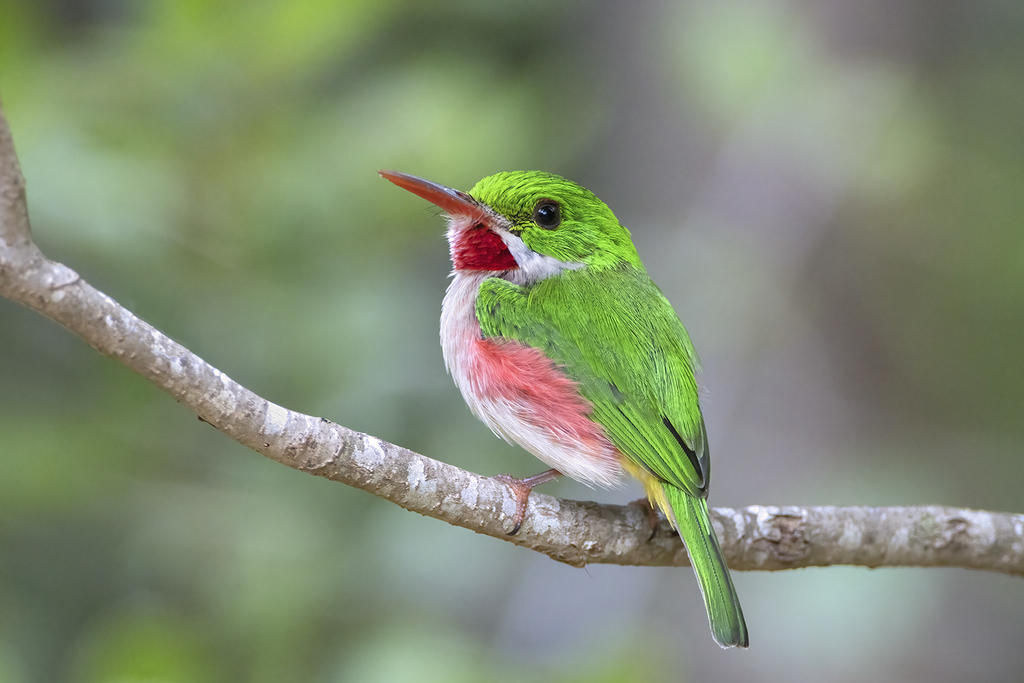
The broad-billed tody (Todus subulatus) is a species of bird in the family Todidae, and one of two Todus species found on Hispaniola, along with the narrow-billed tody. They are small insectivorous birds, characterized by their bright green feathers, pink flanks and red throats.
They occur at elevations lower than 1700 meters and prefer drier habitats to that of wet rainforests. The broad-billed tody does not migrate and occupies very small territories.
From the article Broad-billed tody on Wikipedia (CC BY-SA), quoted section by section
Description
The broad-billed tody is a small, rotund bird with a short tail, distinctive bright green feathers on its back, head and wings, as well as a plain white breast tinged with yellow. Additionally, it has a striking red throat, pale pink flanks, slate-colored irises and bright yellow on its underside, where its body meets its tail. The broad-billed tody has the widest bill of the tody family, measuring 0.6 centimeters wide and 2.1 centimeters long, the upper part of which is black, while its lower part is entirely red. The broad-billed tody has short, rounded feathers that are not streamlined for efficient flight. Its body measures 11.5 centimeters tall and it weighs approximately 7.5 grams, making it the largest bird in the genus Todus. The females and males are nearly indistinguishable, though the juveniles can be distinguished by the absence of the red throat, instead having pale yellow throats somewhat tinged with red, as well as shorter bills and gray-streaked breasts. Tody eggs are the smallest eggs of the Coraciiformes, measuring 1.6 centimeters by 1.4 centimeters and weighing approximately 1.4 grams. The eggs are glossy white, with no markings, though they often pick up a reddish tint from dirt stains, as well as a rosy tinge from the large orange/red yolk inside, necessary to sustain their unusually long incubation time.
Range & habitat
The broad-billed tody is endemic to the island of Hispaniola, which is split between Dominican Republic and Haiti. It shares the island with the narrow-billed tody, although the two species are geographically separated for much of the island, excluding specific pine forests and mangroves, where the two species can be seen flocking together. The broad-billed tody inhabits primarily low elevations, ranging from sea level to 1700 meters, and is also more prevalent in the Dominican Republic than Haiti. It prefers arid habitats containing low-land scrubs, sub-desert habitats with plentiful cacti and agave, as well as shaded coffee plantations and pine forests. Despite being a tropical bird, it is rarely seen in dense rainforest and dislikes wet conditions. The broad-billed tody is not a migratory species, and is instead completely sedentary. During the breeding season, the breeding pair will remain within the same territory for the duration of the season, though during the non-breeding months, the tody will forage slightly further from its home range and may join a mixed flock with the narrow-billed tody temporarily. When the breeding season begins again, the tody will stay close to its original territory and maintain it year to year. The juveniles also do not travel far once they leave the next. …
Wikipedia: “Habitat and distribution”
What it does
Similar to other Coraciiformes, the broad-billed tody will dig burrows within embankments to house their nests, which are 3.7 centimeters wide and 4.0 centimeters high, while the burrow can be as deep as 60 centimeters. Males and females will both participate in the creation of burrows, with their construction beginning as early as September and continuing until June. The breeding season begins in April and extends to July, which will begin with the male tody attempting to court the female tody using a variety of techniques. The male may chase the female in mid-air and perform a series of flights and tumbles as the female chases the male back, it may also hop around on perches, seemingly agitated, while fluffing its feathers. A very important component of the courtship is the 'flank display'. This is where the male puffs up its pink flank feathers to varying degrees of intensity. At the height of his display, he will completely inflate, appearing as a round green puffball with no wings, and his pink flank feathers will seemingly extend over his back. The most attractive male will be the male with the most flank feathers, as the extension of the pink color over the back is what most impresses the female. Finally, the male will also flick its wings to generate a 'rattling' sound, which is a courtship trait unique to the tody. …
Wikipedia: “Reproduction”
Listen
Looking for field recordings…
Where it lives
Recorded sightings
—
geo-referenced records in GBIF, from museums, herbaria and field observers.
Drag the globe to turn it. Dots are where records exist, not a range map; darker means more records.
In the stacks
Searching the stacks…
Every page naming Todus subulatus in the Biodiversity Heritage Library →
This page is assembled live from iNaturalist, GBIF, Wikipedia, the Source Library and the Internet Archive. It is not yet part of the hand-edited codex. iNaturalist taxon 2118.