- Animals
- ›Chordates
- ›Vertebrates
- ›Amphibians
- ›Frogs and Toads
- ›Poison Frogs
- ›Cryptic Forest Frogs
- ›Aromobatinae
- ›Mannophryne
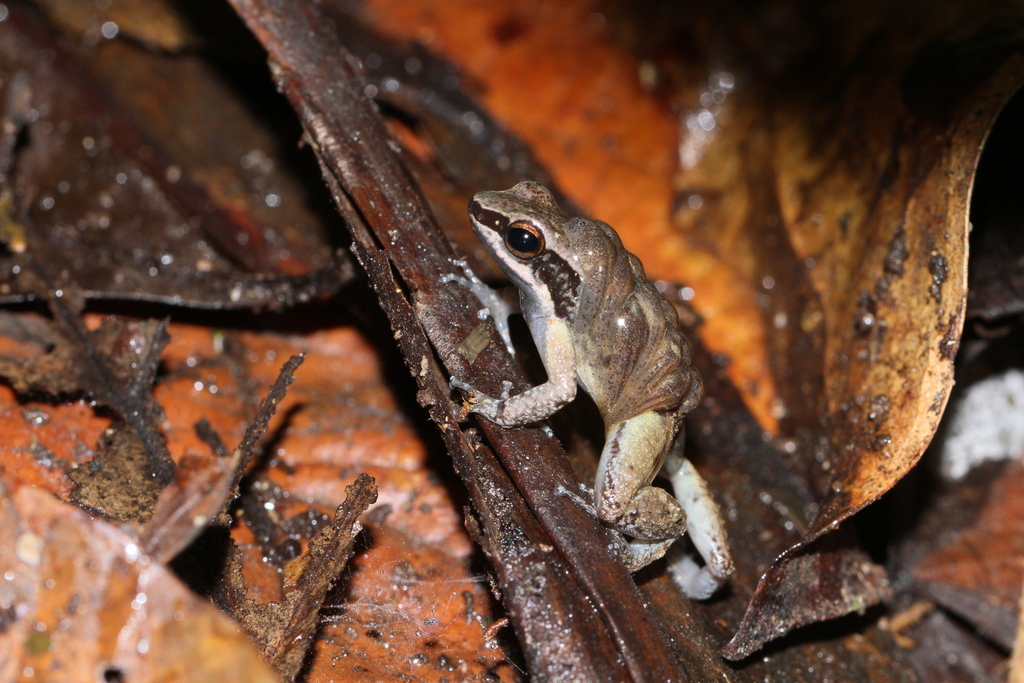
Yellow-throated Frog
Mannophryne trinitatis
The yellow-throated frog, Trinidadian stream frog, or Trinidad poison frog (Mannophryne trinitatis) is a diurnal species of frog in the family Aromobatidae that is endemic to the island of Trinidad in the Republic of Trinidad and Tobago. Trinidad poison frogs can be found in rocky streams in moist montane forests. The species has cryptic coloration and is sexually dimorphic. Mannophryne venezuelensis from the Paria Peninsula in Venezuela were also formerly included in this species. Currently this species is listed as of "Least Concern" on IUCN, but there is a general lack of understanding of its distribution. The frog experiences habitat loss. Both sexes are territorial and provide parental care together.
From the article Mannophryne trinitatis on Wikipedia (CC BY-SA), quoted section by section
Description
Adult Trinidad poison frogs are a relatively small and diurnal species. Their dorsal surface is brown and dark and their flanks are mottled. The Trinidad poison frog is sexually dimorphic. Adult males have grey throats and average 25 mm in snout-vent length. Females have bright yellow throats and average 28 mm. Adult males can also change their skin color from pale brown to jet black when they engage in mate-calling to attract females. Tadpoles, in contrast, start around 14 mm to 16 mm in length and later grow to around 37 mm after metamorphosing. The Trinidad poison frog has a well-defined and solid pigmented collar and a solid brown dorsum. It has well defined pale dorsolateral stripes and dark pigmentation around the external margin of its soles and palms. It also has a well-defined pale inguinal stripe, bandlike concentrations of melanophores along the anterior arms, and dark pigmentation on the metatarsal and subarticular tubercles of its toes.
Range & habitat
The Trinidad poison frog is only found in the Paria Peninsula of Northern Venezuela and the Northern and Central Ranges of Trinidad, West Indies. The frog can live anywhere ranging from sea level to extremely high elevations and prefers to reside around rocky streams in valleys, mountain slopes, or undisturbed moist montane forests. The streams are typically narrow and shallow with slow, clear running waters and contain deeper pools where frogs can deposit and develop their tadpoles. Frogs will sometimes transport their tadpoles from these streams to live in other pools such as phytotelmata if a large number of predators exist nearby.
Wikipedia: “Habitat and distribution”
What it does
Adult Trinidad poison frogs often feed on arthropods and small insects such as Drosophila (D. hydei and D. melanogaster) and Callosobruchus chinensis. In contrast, tadpoles are usually herbivorous and feed on algae and leaf litter. Frogs and tadpoles also consume bat guano and invertebrate infauna as food.
Wikipedia: “Diet”
Listen
Looking for field recordings…
Where it lives
Recorded sightings
—
geo-referenced records in GBIF, from museums, herbaria and field observers.
Drag the globe to turn it. Dots are where records exist, not a range map; darker means more records.
In the stacks
Searching the stacks…
Every page naming Mannophryne trinitatis in the Biodiversity Heritage Library →
This page is assembled live from iNaturalist, GBIF, Wikipedia, the Source Library and the Internet Archive. It is not yet part of the hand-edited codex. iNaturalist taxon 21192.