- Animals
- ›Chordates
- ›Vertebrates
- ›Amphibians
- ›Frogs and Toads
- ›Poison Frogs
- ›Poison Dart Frogs
- ›Dendrobatinae
- ›Phyllobates
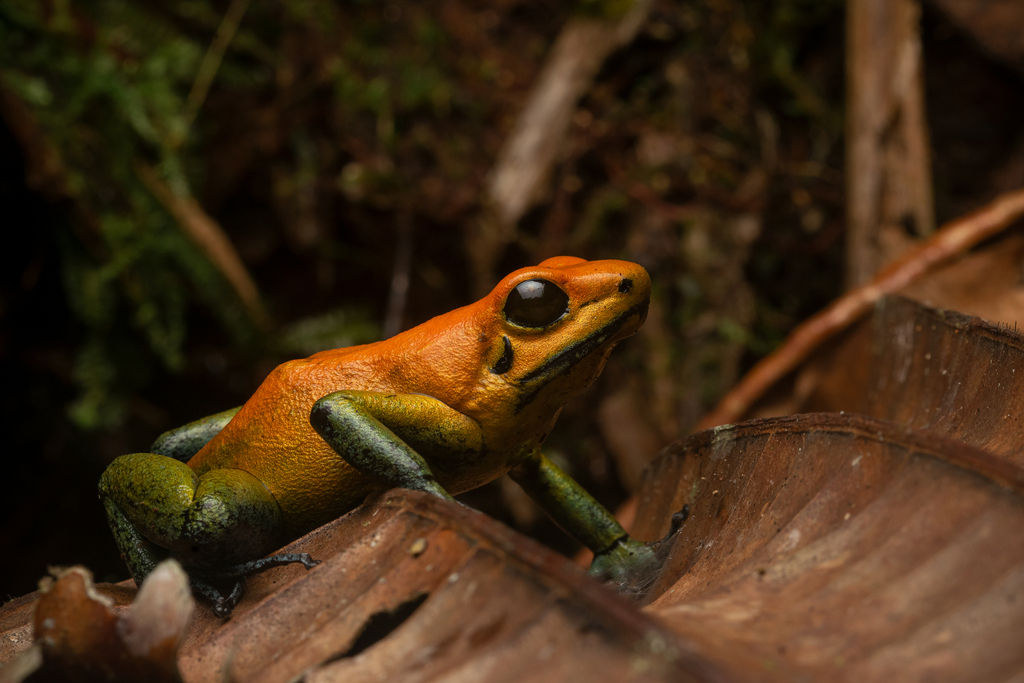
Black-legged Poison Frog
Phyllobates bicolor
Phyllobates bicolor, or more commonly referred to as the black-legged poison dart frog, is the world's second-most toxic dart frog. Under the genus Phyllobates, this organism is often mistaken as Phyllobates terribilis, the golden poison frog, as both are morphologically similar. However, Phyllobates bicolor is identifiable by the yellow or orange body and black or dark blue forelimbs and hindlegs, hence the name black-legged dart frog. Phyllobates bicolor are commonly found in tropical forests of the Chocó region of Colombia. The diurnal frogs live along the rainforest ground near streams or puddles that form. Notably, P. bicolor is a member of the family Dendrobatidae, or poison dart frog. P. bicolor, along with the rest of the Phyllobates species, produce a neurotoxin known as a batrachotoxin that inhibits specific transmembrane channels in cells. Due to this highly deadly toxin that the frogs secrete, many indigenous groups of the Colombian rainforest have extracted the toxins to create poison tipped darts used for hunting. During the breeding period, P. bicolor emits high pitched single notes as a mating call. As in all poison dart frogs, it is common for the father of tadpoles to carry the offspring on his back until they reach a suitable location for the tadpoles to develop. P. bicolor is an endangered species according to the IUCN red list. Currently, deforestation, habitat loss, and pollution pose the biggest threat to the species. Limited conservation efforts have been attempted to prevent further damage to the species.
From the article Phyllobates bicolor on Wikipedia (CC BY-SA), quoted section by section
Toxicity
Poisons from P. bicolor, P. terribilis, and Phyllobates aurotaenia are often extracted by humans to create poison tipped darts. The Chocó Natives primarily use the blowguns to hunt animals. Other tribes in the Río San Juan basin use a poison derived from plants, however the Chocó Indians are the only tribe who acquire poisons from the Phyllobates species. Of the Phyllobates species, the Chocó choose P. bicolor, P. terribilis and P. aurotaenia to extract poison in one of two methods. In the first method, Chocó Indians rub the tips of the darts against the skin of a live P. terribilis individual. In the second, Chocó Indians extract the poison from the skin of P. bicolor and P. aurotaenia frogs by skewering them with a special stick and held over a fire. This process releases the toxins from within the frog's skin and the tips of the darts are rubbed against the secretion. While this is quite a different approach to poison extraction, the methods are not based upon cultural values. Instead, the methods for extraction are designed with the individual frog's poison concentration in mind, as P. terribilis excretes more concentrated batrachotoxin than P. bicolor or P. aurotaenia.
Wikipedia: “Poison darts”
Listen
Looking for field recordings…
Where it lives
Recorded sightings
—
geo-referenced records in GBIF, from museums, herbaria and field observers.
Drag the globe to turn it. Dots are where records exist, not a range map; darker means more records.
In the stacks
Searching the stacks…
Every page naming Phyllobates bicolor in the Biodiversity Heritage Library →
This page is assembled live from iNaturalist, GBIF, Wikipedia, the Source Library and the Internet Archive. It is not yet part of the hand-edited codex. iNaturalist taxon 21213.