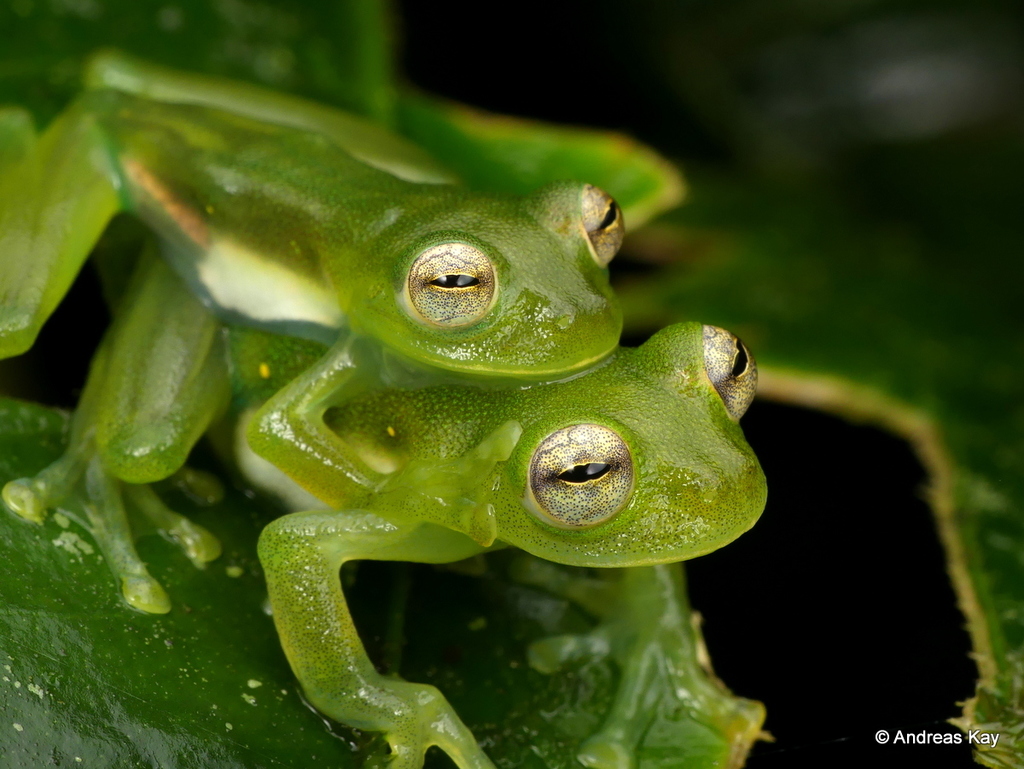
Santa Cecilia Glass Frog
Teratohyla midas
Teratohyla midas (common name: Santa Cecilia Cochran frog) is a species of frog in the family Centrolenidae, which are also known as glass frogs. The species Teratohyla midas was first recorded in 1973 by Lynch, J. D., & Duellman, W. E. This Amazonian species appears to be semi-transparent with gold flecks on its back. Though many species of the glass frog, Centrolendidae, are similar in terms of diet and habitats, they vary greatly among limbs and other physiologies. Because of the similarities between T. midas and other glass frogs, Centrolendidae, researchers often group T. midas together with other species within the same family.
From the article Teratohyla midas on Wikipedia (CC BY-SA), quoted section by section
Description
T. midas is arboreal, meaning that they mainly live in trees. Through their semi-opaque skins, one can see the green bones and if the specimen is female, the humerus spine. Their snout has a truncated shape from the dorsal view leading to an angled appearance around the lateral nostril region. Adult snout-vent length is around 17.4 millimetres (0.69 in) to 19.2 mm (0.76 in) in males and 20.6 mm (0.81 in) to 25.6 mm (1.01 in) in females. The shape of the finger discs of T. midas is rounded and truncated, and all discs are around the same size. The fingers do not bear narrow lateral fringes. Both hands and feet have median levels of webbing. Webbing completely encloses all toes but only encloses the third and fourth fingers. The ground colors of T. midas have a darker lavender shade. T. midas have bright yellow-colored flecks on the dorsal side, which are similar to the unique fingerprints among humans. Researchers often use these flecks to distinguish between different samples. In preservatives, these yellow flecks turn white. Both hands and feet are dull greenish yellow. The heart is not visible, and the organs are unpigmented. The iris is silvery brown with black reticulation. Teratohyla Midas differs from other species of glass frogs due to their unique internal viscera structures. Their livers are covered by a transparent membrane called the heptadic peritoneum. …
Wikipedia: “Characteristics”
Range & habitat
T. midas is mostly found in the lowlands of South America, with highly diverse vegetation, including both humid and dry forests. T. midas is mostly found in lowland areas of northern South America, usually at heights between 190 and 1050 m above sea level. The newest record is around twelve hundred kilometers southeast of the Crique, Grand Leblond French Guiana, which is the easternmost record of the species. The wide range of T. midas leads researchers to consider T. midas may be a possible species complex due to its widespread population.
Habitat destruction. Tadpoles develop in streams. It is locally suffering from habitat loss, but there are large areas of suitable habitat remaining. Though there are records of glass frogs, Centrolenidae, being kept as pets worldwide, there is no specific data on T. midas being kept in captivity.
Wikipedia: “Habitat”
In human culture
Its common name "Santa Cecilia" is named after the province of Napo, Ecuador, which had the most historical record of the species. The Latin root for its species name Midas is inspired by a Greek King who has the ability to turn everything he touches into gold. Thus, Teratohyla Midas' name refers to the golden specks on the specie's dorsal side.
Wikipedia: “Etymology”
Listen
Looking for field recordings…
Where it lives
Recorded sightings
—
geo-referenced records in GBIF, from museums, herbaria and field observers.
Drag the globe to turn it. Dots are where records exist, not a range map; darker means more records.
In the stacks
Searching the stacks…
Every page naming Teratohyla midas in the Biodiversity Heritage Library →
This page is assembled live from iNaturalist, GBIF, Wikipedia, the Source Library and the Internet Archive. It is not yet part of the hand-edited codex. iNaturalist taxon 21231.