On eBird ↗
Russet-crowned Motmot
Live sightings near you, the range map, bar charts of when it is seen, and Macaulay Library photos and recordings.
Russet-crowned Motmot
Momotus mexicanus
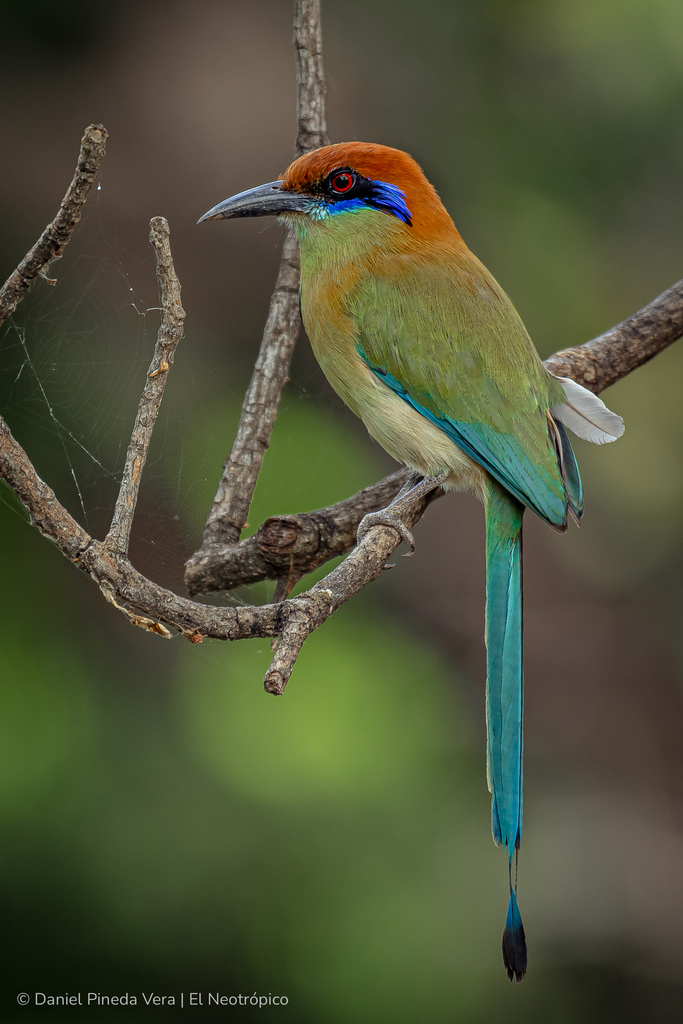
The russet-crowned motmot (Momotus mexicanus) is a species of motmot native to north-western Mexico and central Guatemala.
It is a year-round resident of the tropical and subtropical dry broadleaf forests and scrubland. The russet-crowned motmot is the most understudied species of motmot in the family Momotidae.
From the article Russet-crowned motmot on Wikipedia (CC BY-SA), quoted section by section
Description
Russet-crowned motmots are relatively small motmots that measure 30.5 to 35.5 cm long and weigh 74 to 104 g. Like most motmots, russet-crowned motmots are not sexually dimorphic in plumage. However, females have shorter tail feathers (10 to 15 cm) than males (11 to 22 cm). Russet-crowned motmots have a rufous crown and nape. They have a green back and green wings with blue-green primary feathers. Their chest is pale green with a black spot, and they have an even paler underbelly. Russet-crowned motmots have a long blue tail with a bare section near the tip of the longest central feathers, which creates a dark racket-shaped tip. Their black bills have a slightly serrated edge and curve downwards. Like most motmots, russet-crowned motmots have a black eye-mask which is lined by blue & violet feathers. They have reddish eyes and grey legs and feet. Juveniles have brown eyes and duller plumage. The four subspecies vary in morphology; in comparison to M.m. mexicanus, M.m. vanrossemi is paler, M.m. saturates is larger and darker, and M.m. castaneiceps has a darker chestnut crown and its black eye-mask is more extensive.
Wikipedia: “Morphology”
Range & habitat
Russet-crowned motmots prefer old-growth forests with closed canopy but they are also found in secondary forests with a lot of canopy coverage. They live in dry and humid tropical forests and clearings up to 1800m in altitude. Russet-crowned motmots are found along the western coast of Mexico and in an isolated population in central Guatemala. They are common along their range. The subspecies M.m. vanrossemi can be observed in north-western Mexico in Sonora, Sinaloas and Chihuahua. M.m. mexicanus can be found from Sinaloa to Oaxaca along the west coast and M.m. saturates can be found in south-western Mexico and Guatemala. M.m. castaneiceps is an isolated population only found in the Motagua Valley of central Guatemala until recently. In 2018, the distribution of M.m. castaneiceps expanded to the Nentón valley in Huehuetenango which suggests that their range might be growing to western Guatemala.
Wikipedia: “Distribution and habitat”
What it does
Russet-crowned motmots feeds on large invertebrates (i.e. grasshoppers, etc.), fruits, and small vertebrates (i.e. snakes, lizards, etc.). They have the typical feeding strategy of the Momotidae family known as "flycatching"; russet-crowned motmots perch on low branches and dart out to catch prey or bite fruit. They return to their perches to eat their catch and they hit their live prey against branches before swallowing it.
Wikipedia: “Diet and foraging”
Listen
Looking for field recordings…
Where it lives
Recorded sightings
—
geo-referenced records in GBIF, from museums, herbaria and field observers.
Drag the globe to turn it. Dots are where records exist, not a range map; darker means more records.
In the stacks
Searching the stacks…
Every page naming Momotus mexicanus in the Biodiversity Heritage Library →
This page is assembled live from iNaturalist, GBIF, Wikipedia, the Source Library and the Internet Archive. It is not yet part of the hand-edited codex. iNaturalist taxon 2124.