- Animals
- ›Chordates
- ›Vertebrates
- ›Ray-finned Fishes
- ›Spiny-rayed fishes
- ›Wrasses and allies
- ›Uranoscopoidei
- ›Stargazers
- ›Astroscopus
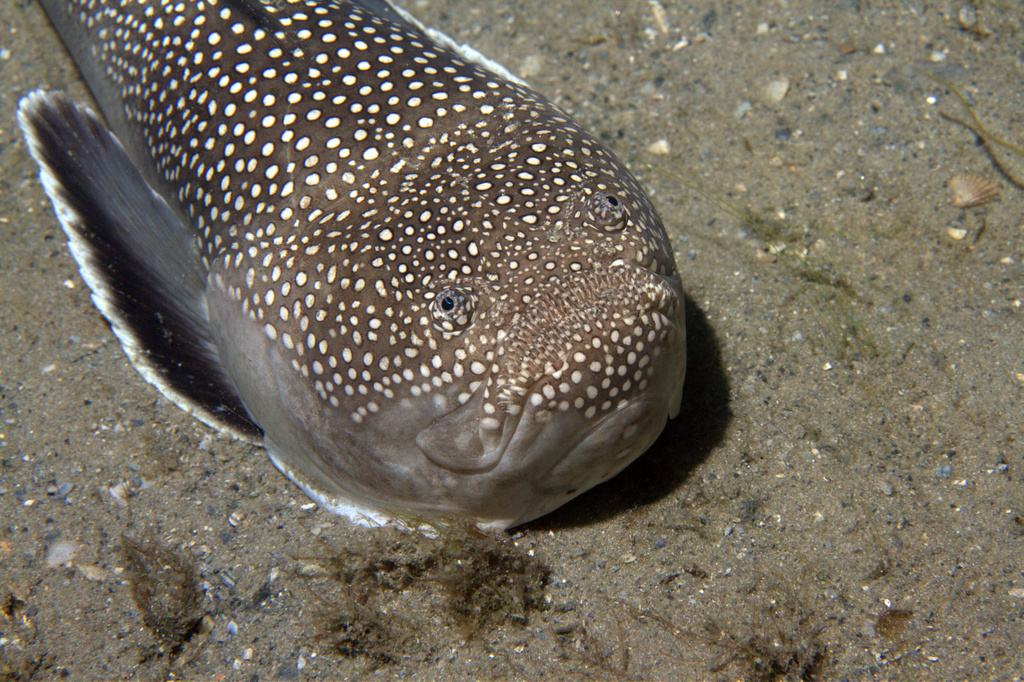
Northern Stargazer
Astroscopus guttatus
Astroscopus guttatus or the northern stargazer is a species of fish belonging to the Uranoscopidae family and was first described by Charles Conrad Abbott in 1860. Members of the Uranoscopidae family are characterized by dorsally or dorsolaterally directed eyes placed on or near the top of a large, flattened cuboid head, an oblique to vertical mouth often lined with cutaneous cirri, and an elongated, sub-compressed body. Typically found on the Atlantic shores between the states of North Carolina and New York in the United States, the northern stargazer can sometimes be confused with its sister species the southern stargazer, Astroscopus y-graecum. Both A. guttatus and A. y-graecum overlap in their distributions in Cape Hatteras One way to distinguish the northern stargazer from the southern stargazer is by the presence of numerous small white spots closely spaced along its head and back, whereas the southern stargazer has fewer, larger spots on its back. The northern stargazer is a moderately sized fish that can reach lengths of 22 inches (56 cm). The northern stargazer can be found buried in sandy substrate at depths up to 120 feet (37 m) where the species remains buried awaiting prey. Stargazers have a flat forehead with a lot of body mass near the mouth creating a body plane optimal for remaining buried under sandy substrate.
From the article Astroscopus guttatus on Wikipedia (CC BY-SA), quoted section by section
Description
The northern stargazer has a blackish brown body covered in white spots that gradually increase in size towards the rear of the body. It has three dark horizontal stripes on its (white) tail. Another identifying feature for stargazers is the location of the lateral line. In most fish species the lateral line follows a straight direction or gentle curve on the side of the body. But in Astroscopus, the lateral lines that begin on the gill opening then run upward at a sharp angle until the two lines lie almost together, one on each side of the dorsal fin. This adaptation allows the fish to remain buried while keeping the lateral line operational. The southern stargazer, A. y-graecum, closely resembles the northern stargazer in appearance and life history. Two ways to tell the two species apart look at the size and density of white spots on the back of the fish. The northern stargazer possesses more closely set white spots compared to the southern stargazers large more spaced spots. Another way to tell the difference between the two is to look at the difference in tail striping among the two. The northern stargazer's middle tail stripe extends on the rear portion of the body. Whereas on the southern stargazer, the stripe does not extend past the tail. Northern stargazers have a robust body filled with small scales that becomes slender posteriorly. …
Range & habitat
Astroscopus guttatus is typically found in coastal waters from New York to Virginia. But there have been sightings of the northern stargazer in the waters of South Carolina. Northern stargazers can be found in deep ocean water at depths up to 120 feet or 37 meters. The northern stargazer enjoys rocky reef and soft bottom habitats. In places lacking natural reefs, scientists experimented with placing oyster cages on the bottom of the ocean floor. These scientists observed an increase in fish diversity including an increase in northern stargazer sightings following the addition of the oyster cage as the cage created additional reef like habitat for fish.
Wikipedia: “Distribution”
What it does
Northern stargazers live primarily along the eastern seaboard of the United States. They do not swim much except when migrating as they swim clumsily and slowly. Instead, northern stargazers bury themselves in the sand using short side to side motions of their ventral fins and tail to bury themselves until three quarters of their body plane is covered by sandy substrate. If disturbed, stargazers can bury themselves beneath as many as 12 inches of sand to hide from predators. Stargazers utilize their camouflaged location in the sand to wait for prey to swim by. Northern stargazers primarily feed on small fish that swim above them in the sand. Their eyes are situated on top of the head and poke up through the sand, hence the name stargazer. The eyes of the northern stargazer are also home to an electrical organ that sits under each eye. The electrical apparatus is composed of 200 thin layers of electric tissue which gives it a jelly or mucus like appearance. The origin of this organ is still undetermined with the best logical supposition that the electric organ was derived by an unusual modification of a portion of one or more of the eye muscles. The organ is believed to not only threaten predators from above as the fish lies buried in the sand, but also to stun prey. …
Wikipedia: “Ecology”
Where it lives
Recorded sightings
—
geo-referenced records in GBIF, from museums, herbaria and field observers.
Drag the globe to turn it. Dots are where records exist, not a range map; darker means more records.
In the stacks
Searching the stacks…
Every page naming Astroscopus guttatus in the Biodiversity Heritage Library →
This page is assembled live from iNaturalist, GBIF, Wikipedia, the Source Library and the Internet Archive. It is not yet part of the hand-edited codex. iNaturalist taxon 214509.