- Animals
- ›Chordates
- ›Vertebrates
- ›Ray-finned Fishes
- ›Spiny-rayed fishes
- ›Sawbellies and squirrelfishes
- ›Alfonsinos and Bigscales
- ›Alfonsinos
- ›Beryx
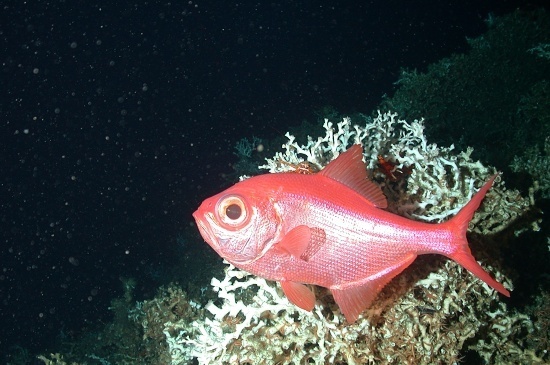
Imperador
Beryx decadactylus
The alfonsino (Beryx decadactylus), also known as the alfonsin, longfinned beryx, red bream, or imperador, is a species of deepwater berycid fish of the order Beryciformes. It can be found in temperate and subtropical ocean waters nearly worldwide, though it is uncommon. It is typically associated with deep-sea corals, and schools are known to form over seamounts. Adults are demersal and search for prey along the ocean floor, primarily fish, cephalopods, and crustaceans. Like other members of its family, it is remarkably long-lived, with individuals reaching ages of up to 69 years, and possibly longer. It can reach sizes of up to 1 m (3.3 ft) in length and 2.5 kg (5.5 lb) in weight and is targeted by commercial fisheries. Its low reproductive rate and the time it takes for juveniles to mature make it vulnerable to expanding deep-sea fisheries, but it is listed as Least Concern by the International Union for Conservation of Nature (IUCN) due to its extensive range.
From the article Alfonsino on Wikipedia (CC BY-SA), quoted section by section
Description
The alfonsino has large eyes and a deep, compressed body, 1.9–2.5 times its standard length at the greatest depth. It is a rose red color dorsally and orange ventrally. The rest of its body is silvery-pink, and the breast is yellow-white in color. Fins and the inside of the mouth are bright red. The anal fin is distinctly larger than in many fish species and its caudal fin is deeply forked. Its bright red color is a common adaptation to deepwater surroundings, where red is filtered out of the light spectrum. Although the most common size is 35.0 cm (13.8 in), it can reach lengths of up to 100.0 cm (39.4 in) TL. The maximum published weight for an alfonsino is 2.5 kg (5.5 lb). Juveniles have heavy head spines, while adults do not.
Range & habitat
The alfonsino is found worldwide in subtropical and temperate waters, with a latitudinal range extending from 70°N to 48°S. It is found from as far north as Greenland and Iceland south to Brazil in the western Atlantic and South Africa in the eastern Atlantic. In the Indo-Pacific it is found from South Africa east to Japan, Australia, and New Zealand. It has also been reported off the coasts of Argentina and Hawaii. It is likely more common in the western Pacific than records indicate due to lack of fishing in its depth range in the region. With an extensive depth range 110–1,000 m (360–3,280 ft) below the surface, the alfonsino occurs in localized aggregations over deep-sea coral habitats on the continental shelf and continental slope. By day it stays in deeper water and vertically migrates to shallower waters at night. It is most commonly found 200–400 m (660–1,310 ft) deep in waters around 24 °C (75 °F) in temperature, however depth range varies by region. In the eastern Atlantic its depth range is 350–600 m (1,150–1,970 ft), while in the western Atlantic its depth range is 100–972 m (328–3,189 ft), common depth range 400–600 m (1,300–2,000 ft). …
Wikipedia: “Distribution and habitat”
What it does
The splendid alfonsino is the far more studied species of Beryx, but the alfonsino's biology is very similar to that of its congener. Alfonsinos are benthopelagic and aggregate over deep-ocean seamounts, typically near deep-sea corals. At night, they migrate vertically into shallower waters. Their primary food sources are crustaceans, cephalopods, and small fish, with the last being the most abundant prey in its diet. In this it is quite dissimilar from the splendid alfonsino, which appears to have a slower digestion and wider dietary breadth. Spawning occurs in the summer months, June through September, though males can reproduce year-round. Alfonsinos are batch spawners, that is they release eggs multiple times over an extended spawning season rather in a short period. Eggs and larvae are epipelagic, staying near the ocean's surface. Eggs hatch after around 27 hours and larvae are initially 1.5–3.0 mm (0.059–0.118 in) SL in size, identifiable by pigment near the brain. Flexion, when the larva bends upwards prior to development of the caudal fin, occurs at 3.7–6.0 mm (0.15–0.24 in) SL. Fin rays and scales are fully formed by 15 mm (0.59 in) SL. They are distinguished by elongated pelvic rays and anterior dorsal spines as well as pigment near the gas bladder, though they are very similar to the larvae of the splendid alfonsino. …
Wikipedia: “Biology and ecology”
Where it lives
Recorded sightings
—
geo-referenced records in GBIF, from museums, herbaria and field observers.
Drag the globe to turn it. Dots are where records exist, not a range map; darker means more records.
In the stacks
Searching the stacks…
Every page naming Beryx decadactylus in the Biodiversity Heritage Library →
This page is assembled live from iNaturalist, GBIF, Wikipedia, the Source Library and the Internet Archive. It is not yet part of the hand-edited codex. iNaturalist taxon 215166.