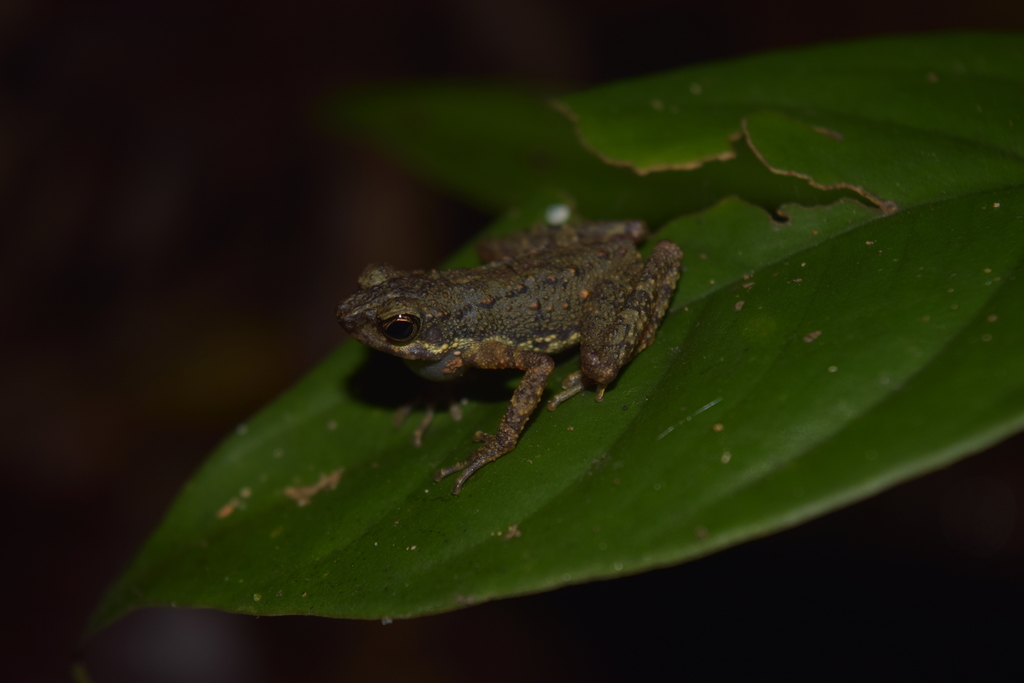
Whitebelly Stream Toad
Ansonia albomaculata
Ansonia albomaculata is a species of toad in the family Bufonidae. It is endemic to the island of Borneo, and can be found in Brunei, Indonesia, and Malaysia. Its natural habitats are subtropical or tropical moist lowland forests and rivers. It is threatened by habitat loss.
From the article Ansonia albomaculata on Wikipedia (CC BY-SA), quoted section by section
Description
Males grow to 30 mm (1.2 in) and females to 35 mm (1.4 in) in snout–vent length. The overall appearance is slender. The head is wider than it is long. The snout is truncate. The tympanum is visible but partly concealed by skin. The finger tips are rounded. The fingers are long and have rudimentary webbing. The toes are webbed and have small rounded disks at their tips. A distinct ridge runs along inner margin of the tarsus. The dorsum is dark brown and warty, albeit the warts being low. There is a light spot on the upper jaw, below the eye. Tadpoles probably belonging to this species are small, total length 10–14 mm (0.4–0.6 in). They have an oval body that is dorsoventrally depressed and a bluntly rounded tail.
Range & habitat
Ansonia albomaculata is a lowland stream-associated species that is known from elevations between 150 and 500 m (490 and 1,640 ft) above sea level. Adults are mostly terrestrial and disperse widely over the rainforest floor. They breed in small, clear, rocky-bottomed streams. The tadpoles live in torrents where they cling to rocks and feed on lithophytes. Ansonia albomaculata is known from widely scattered localities and is generally considered rare, although it can be abundant at some places. It does not adapt to habitat modification and is threatened by forest loss and fragmentation caused by conversion of forests to rubber and oil palm plantations. These also negatively affect the larval habitat through siltation and through eutrophication caused by chemical fertilizers. However, it is present in several protected areas.
== References ==
Wikipedia: “Habitat and conservation”
Listen
Looking for field recordings…
Where it lives
Recorded sightings
—
geo-referenced records in GBIF, from museums, herbaria and field observers.
Drag the globe to turn it. Dots are where records exist, not a range map; darker means more records.
In the stacks
Searching the stacks…
Every page naming Ansonia albomaculata in the Biodiversity Heritage Library →
This page is assembled live from iNaturalist, GBIF, Wikipedia, the Source Library and the Internet Archive. It is not yet part of the hand-edited codex. iNaturalist taxon 21642.