Scrawny Stubfoot Toad
Atelopus longirostris
Atelopus longirostris is a species of harlequin frog, a member of the family of true toads (Bufonidae). It has been recorded only in northern Ecuador. Records from Colombia probably represent different species. As of mid-2017, it is listed as extinct by the IUCN, but was rediscovered in 2016 after more than two decade with no sightings. The scientific name of this species means "long-snout" and the species has been named in Spanish as the jambato hocicudo...
From the article Atelopus longirostris on Wikipedia (CC BY-SA), quoted section by section
Description
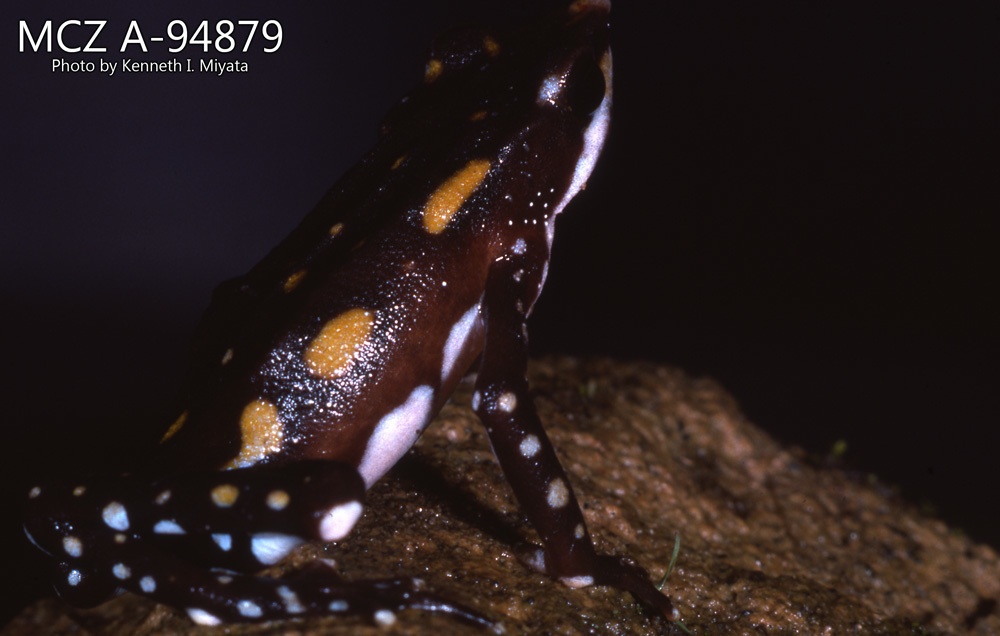
Adult males measure 30–35 mm (1.2–1.4 in) and females 41–47 mm (1.6–1.9 in) in snout–vent length. However, Tapia and colleagues report two smaller adult females, measuring 37 and 39 mm (1.5 and 1.5 in) SVL. Atelopus longirostris has a slender body with long limbs. The snout is pronounced and has a comparatively sharp point. The fingers are fleshy and have some basal webbing; the toes are more heavily webbed. The dorsum is brown with yellow or cream rounded spots. The flanks are dark brown or black. The venter is whitish with some brown suffusion in the throat and chest.
Range & habitat
Atelopus longirostris is historically known from the western slopes of the northern Ecuadorian Andes in the provinces of Esmeraldas, Imbabura, Pichincha, and Cotopaxi, at elevations between 200–2,500 m (660–8,200 ft) above sea level. Tapia and colleagues give a slightly different historic range that includes Imbabura, Cotopaxi, Pichincha, and Santo Domingo de los Tsáchilas Provinces and a narrower altitudinal range, 900–1,925 m (2,953–6,316 ft). Atelopus longirostris inhabits lowland (but see above) and montane tropical rainforests. Breeding takes place in streams. Populations discovered in 2016 were in isolated, small patches of native forest within a heavily modified landscape. They were all found at night, perched on leaves about half a metre above the ground, some distance away from the nearest rivers.
== References ==
Wikipedia: “Distribution and habitat”
Listen
Looking for field recordings…
Where it lives
Recorded sightings
—
geo-referenced records in GBIF, from museums, herbaria and field observers.
Drag the globe to turn it. Dots are where records exist, not a range map; darker means more records.
In the stacks
Searching the stacks…
Every page naming Atelopus longirostris in the Biodiversity Heritage Library →
This page is assembled live from iNaturalist, GBIF, Wikipedia, the Source Library and the Internet Archive. It is not yet part of the hand-edited codex. iNaturalist taxon 21698.