- Animals
- ›Chordates
- ›Vertebrates
- ›Ray-finned Fishes
- ›Salmons, Pikes and Mudminnows
- ›Pikes and Mudminnows
- ›Pikes and Allied Mudminnows
- ›Blackfishes
- ›Dallia
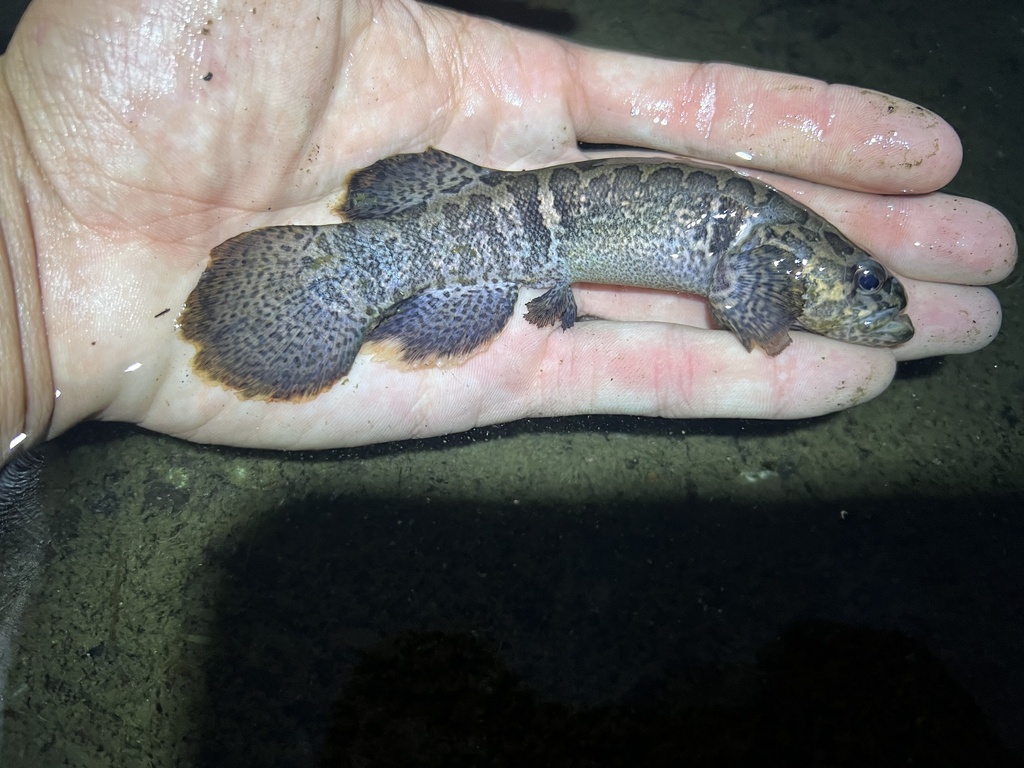
Alaska Blackfish
Dallia pectoralis
The Alaska blackfish (Dallia pectoralis) is a species of freshwater fish in the esocid family (family Esocidae) of order Esociformes. It inhabits Arctic regions of Alaska as well as Siberia and the Bering Sea islands.
From the article Alaska blackfish on Wikipedia (CC BY-SA), quoted section by section
Description
Alaska blackfish are small, with an average length of 108 mm (4.3 in), but have been known to reach 330 mm (13 in). They have an easily distinguishable morphology (a branch of biology dealing with the study of the form and structure of organisms and their specific structural features), with relatively large, posterior dorsal fin and anal fins, large, lobed pectoral fins located just posterior to the operculum, a diphycercal caudal fin, and small, pointy pelvic fins. The head is broad and flat, with the trunk being long and slender. The color is dark green to brown on the dorsal side, pale below, with light-colored blotches appearing laterally. Males can be distinguished from females by the presence of a reddish fringe along the dorsal, caudal, and anal fins; also, the tips of the ventral fins extend beyond the anal fin in males, whereas in females they do not. The Alaska blackfish is famous for its ability to breathe atmospheric oxygen through a modified esophagus. Specifically, the esophagus of a blackfish can be subdivided into a non-respiratory and a respiratory section. The respiratory section can be identified by its extensive mucosal folding and vascularization, as well as widespread capillaries throughout the epithelium. This respiratory structure implies selection pressures for the development of a purely respiratory organ and a purely hydrostatic organ. …
Range & habitat
Alaska blackfish can be found in the Bering Sea islands, Siberia, and Alaska. In Alaska, they inhabit the Colville Delta south to the central Alaska Peninsula near Chignik as well as the upstream Yukon-Tanana drainage to near Fairbanks. Blackfish are found in highly vegetated swamps and ponds, occasionally residing in rivers and densely-vegetated lakes, where in summer, water is frequently stagnant. Spawning migrations are limited to inshore and upstream movements in the spring, and reverse migrations to deeper water in the fall. In the winter-time, blackfish tend to reside in the benthic regions of lakes, although when oxygen availability reaches a certain minimum, blackfish move to the surface, grouping around breathing holes. These breathing areas can be preexisting holes, such as those created by muskrats, beavers, and fishers, or simply thin layers of ice. Blackfish have been observed schooling below the ice, and when swimming upwards to breathe, eat away at the ice and creating an audible snapping or sucking sound. The Alaska blackfish is known for its tolerance of cold water, and has been reported to survive exposure to −20 °C (−4 °F) for 40 minutes. Despite its hardiness, Alaska blackfish have been observed to suffer edema and mass mortality events during the winter.
Wikipedia: “Distribution, location and habitat”
What it does
The principal source of food for blackfish is aquatic insects and invertebrates, although in Bristol Bay, larger blackfish have been observed to be cannibalistic, as well as predators of young pike. Blackfish are generalist feeders, and have been analyzed to have contained algae, snails, dipteran larvae, ostracods, copepods, and caddisfly larvae in their stomachs.
Wikipedia: “Feeding and diet”
Where it lives
Recorded sightings
—
geo-referenced records in GBIF, from museums, herbaria and field observers.
Drag the globe to turn it. Dots are where records exist, not a range map; darker means more records.
In the stacks
Searching the stacks…
Every page naming Dallia pectoralis in the Biodiversity Heritage Library →
This page is assembled live from iNaturalist, GBIF, Wikipedia, the Source Library and the Internet Archive. It is not yet part of the hand-edited codex. iNaturalist taxon 218120.