On eBird ↗
Blue-throated Motmot
Live sightings near you, the range map, bar charts of when it is seen, and Macaulay Library photos and recordings.
Blue-throated Motmot
Aspatha gularis
The blue-throated motmot (Aspatha gularis) is a species of bird in the Momotidae family. It is monotypic within the genus Aspatha. It is found in El Salvador, Guatemala, Honduras, and Mexico, where its natural habitat is subtropical or tropical moist montane forests.
From the article Blue-throated motmot on Wikipedia (CC BY-SA), quoted section by section
Description
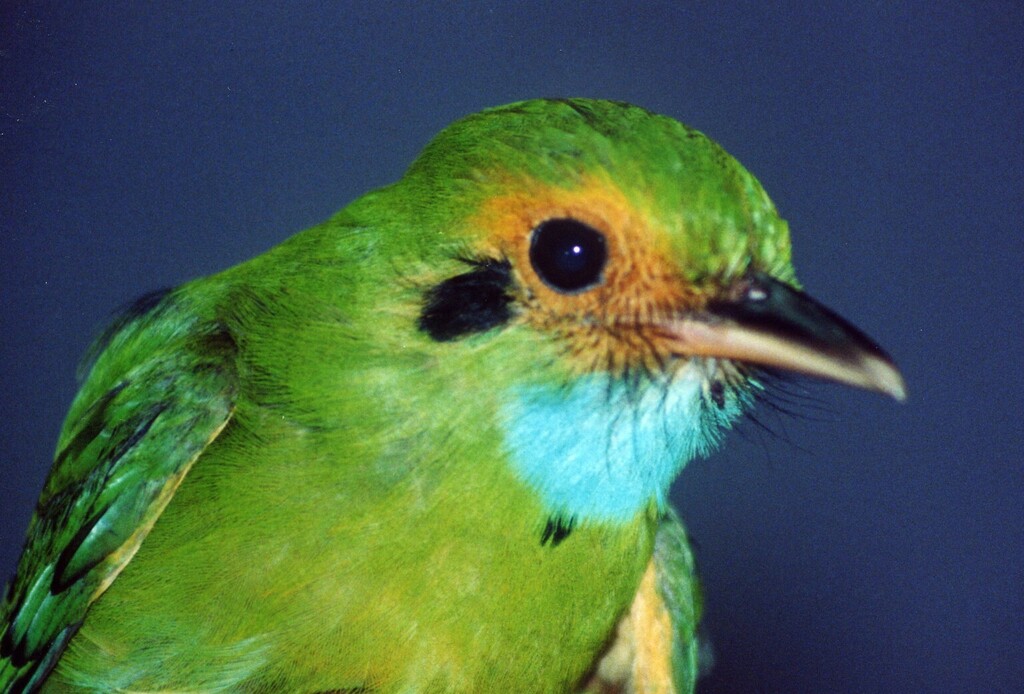
The blue-throated motmot is 25.5 to 28.0 cm (10.0 to 11.0 in) long and weighs 56.0 to 67.3 g (1.98 to 2.37 oz). It has a long, graduated, tail that in contrast to that of most other motmots does not have racquet tips. The side of the adult's head is ochre with a black "ear" spot. It is mostly green above and paler green below. The throat is blue with a black spot just below it. The juvenile is duller and the green of the back is washed with olive.
Range & habitat
The blue-throated motmot is found from Oaxaca and Chiapas in Mexico south and east through Guatemala and a bit of El Salvador to Honduras. It inhabits montane evergreen and pine forest of medium to high humidity. In elevation it ranges from 1,300 to 3,000 m (4,300 to 9,800 ft) in Mexico but in Honduras it is not found below 1,800 m (5,900 ft).
Wikipedia: “Distribution and habitat”
What it does
The blue-throated motmot forages by plucking insects, especially beetles, from foliage while flying. It also eats some fruit and apparently feeds fruit to nestlings.
Wikipedia: “Feeding”
Listen
Looking for field recordings…
Where it lives
Recorded sightings
—
geo-referenced records in GBIF, from museums, herbaria and field observers.
Drag the globe to turn it. Dots are where records exist, not a range map; darker means more records.
In the stacks
Searching the stacks…
Every page naming Aspatha gularis in the Biodiversity Heritage Library →
This page is assembled live from iNaturalist, GBIF, Wikipedia, the Source Library and the Internet Archive. It is not yet part of the hand-edited codex. iNaturalist taxon 2182.