- Animals
- ›Chordates
- ›Vertebrates
- ›Ray-finned Fishes
- ›Spiny-rayed fishes
- ›Jacks, Flounders, Barracudas, and Allies
- ›Flatfishes
- ›Righteye Flounders
- ›Microstominae
- ›Glyptocephalus
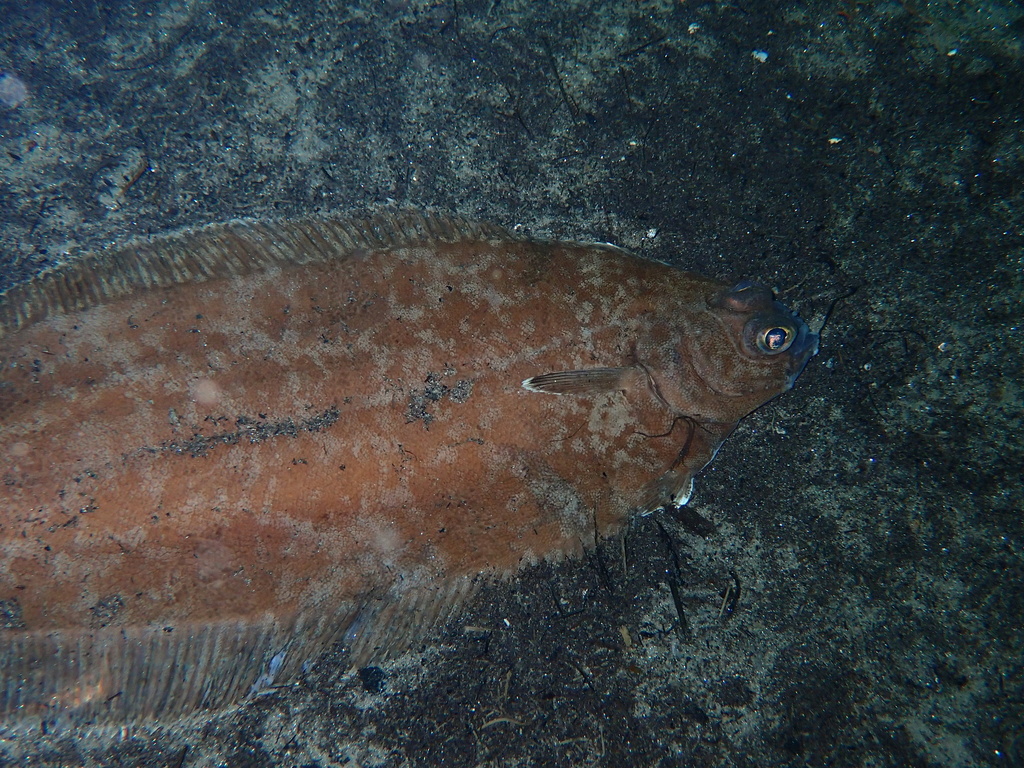
Witch Flounder
Glyptocephalus cynoglossus
The witch (Glyptocephalus cynoglossus), known in English by a variety of other common names including the witch flounder, pole flounder, craig fluke, Torbay sole, and grey sole, is a species of flatfish from the family Pleuronectidae. It occurs on both sides of the North Atlantic Ocean on muddy sea beds in quite deep water. In northern Europe it has some importance in fisheries as a food fish.
From the article Witch (righteye flounder) on Wikipedia (CC BY-SA), quoted section by section
Description
The witch is a right-eyed flatfish with a small mouth which reaches the forward edge of the lower eye. The mouth contains a single series of small, incisor like teeth. It has a small head which takes up a fifth of the total length with large, open blister-like mucous pits on its blind side Its body is strongly, dorsally compressed and oval in shape. The body is elongated and has a standard length which is 2.5–3.5 times longer than it is broad. The lateral line is relatively straight and runs the length of its body with 110–140 scales. The dorsal fin has 95–120 rays and the anal fin has 85–102 rays, and there is a short, sharp spine pointing forward in front of the anal fin, which is created by an elongated first interhaemal spine of the post-abdominal bone, although this is sometimes so small that it is hidden. The pectoral fin on the eyed side is shorter than the head and the pectoral fins are blackish towards their tips. Almost all of the head and body, apart from the tip of the snout and the lower jaw is covered in smooth scales which make the fish slippery when held. They are brownish grey to greyish brown in colour on their eyed side, with less variation in colour than other flatfish, with the body and fins densely spotted with muted black spots; the median fins become duskier towards their margins. …
Range & habitat
The witch occurs on both sides of the North Atlantic Ocean. In the northeastern Atlantic Ocean it is found from the northernmost part of the Bay of Biscay to the Kattegat and into the westernmost part of the Baltic Sea, northwards along the entire coast of Norway and east in to the Murmansk region of Russia and west to the southern and western coasts of Iceland. In the western North Atlantic their range runs from Newfoundland and Labrador south as far as North Carolina, including the Grand Banks, Gulf of Maine, Gulf of St Lawrence and the Scotian Shelf.
Wikipedia: “Distribution”
Where it lives
Recorded sightings
—
geo-referenced records in GBIF, from museums, herbaria and field observers.
Drag the globe to turn it. Dots are where records exist, not a range map; darker means more records.
In the stacks
Searching the stacks…
Every page naming Glyptocephalus cynoglossus in the Biodiversity Heritage Library →
This page is assembled live from iNaturalist, GBIF, Wikipedia, the Source Library and the Internet Archive. It is not yet part of the hand-edited codex. iNaturalist taxon 220480.