- Animals
- ›Chordates
- ›Vertebrates
- ›Ray-finned Fishes
- ›Spiny-rayed fishes
- ›Blennies, Damselfishes and Allies
- ›Blennies
- ›Combtooth Blennies
- ›Salariin Blennies
- ›Hypsoblennius
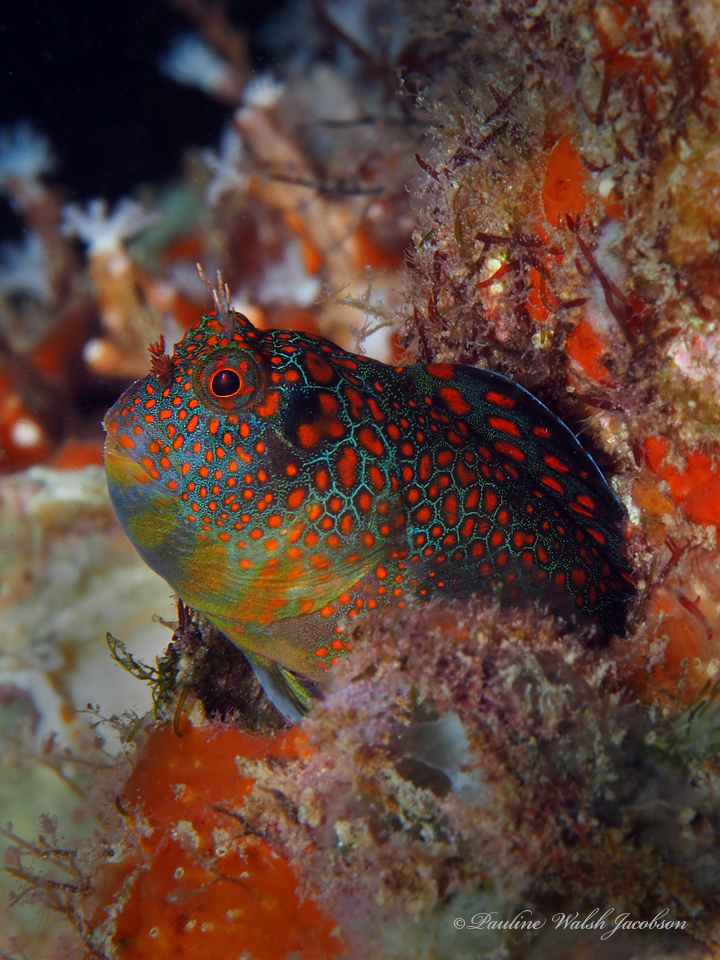
Tessellated Blenny
Hypsoblennius invemar
Hypsoblennius invemar, commonly known as the tessellated blenny, is a species of combtooth blenny found in the western Atlantic Ocean.
From the article Hypsoblennius invemar on Wikipedia (CC BY-SA), quoted section by section
Description
The tessellated blenny can reach a maximum length of 5.8 centimetres (2.3 in) TL. The head and front half of the body are bright blue covered with small brick red spots each rimmed in black. On the top of the head the spots often merge to give a net-like pattern. There is a black spot on the head just behind the eye. The dorsal fin has 12 spines and 12 soft rays. The anal fin has 2 spines and 15 soft rays. This fish can be confused with Springer's blenny (Scartella springeri) but that species lacks a black rim to the orange spots that cover its body.
Range & habitat
The tessellated blenny is found in shallow waters off the coasts of Brazil, Colombia, Venezuela and the Lesser Antilles. Since about 1979, it has also appeared sporadically off the coasts of Texas, Alabama and Florida in the United States. It is seldom found below about 4.5 metres (15 ft) but occasionally occurs down to 18 metres (59 ft). It has become common round the legs of oil platforms in the Gulf of Mexico. It has probably been brought to the region while inside barnacle shells that were fouling the legs of rigs towed there from South America or in barnacles on the hulls of ships.
Wikipedia: “Distribution”
In human culture
The specific name is an acronym, standing for the Instituto de Investigaciones Marinas de Punta de Betin in Santa Marta, Colombia, which holds some of the paratypes.
== References ==
Wikipedia: “Etymology”
Where it lives
Recorded sightings
—
geo-referenced records in GBIF, from museums, herbaria and field observers.
Drag the globe to turn it. Dots are where records exist, not a range map; darker means more records.
In the stacks
Searching the stacks…
Every page naming Hypsoblennius invemar in the Biodiversity Heritage Library →
This page is assembled live from iNaturalist, GBIF, Wikipedia, the Source Library and the Internet Archive. It is not yet part of the hand-edited codex. iNaturalist taxon 222115.