- Animals
- ›Chordates
- ›Vertebrates
- ›Ray-finned Fishes
- ›Spiny-rayed fishes
- ›Perches, Scorpionfishes, Sticklebacks, and Allies
- ›Sculpins and Allies
- ›Fathead Sculpins
- ›Icelus
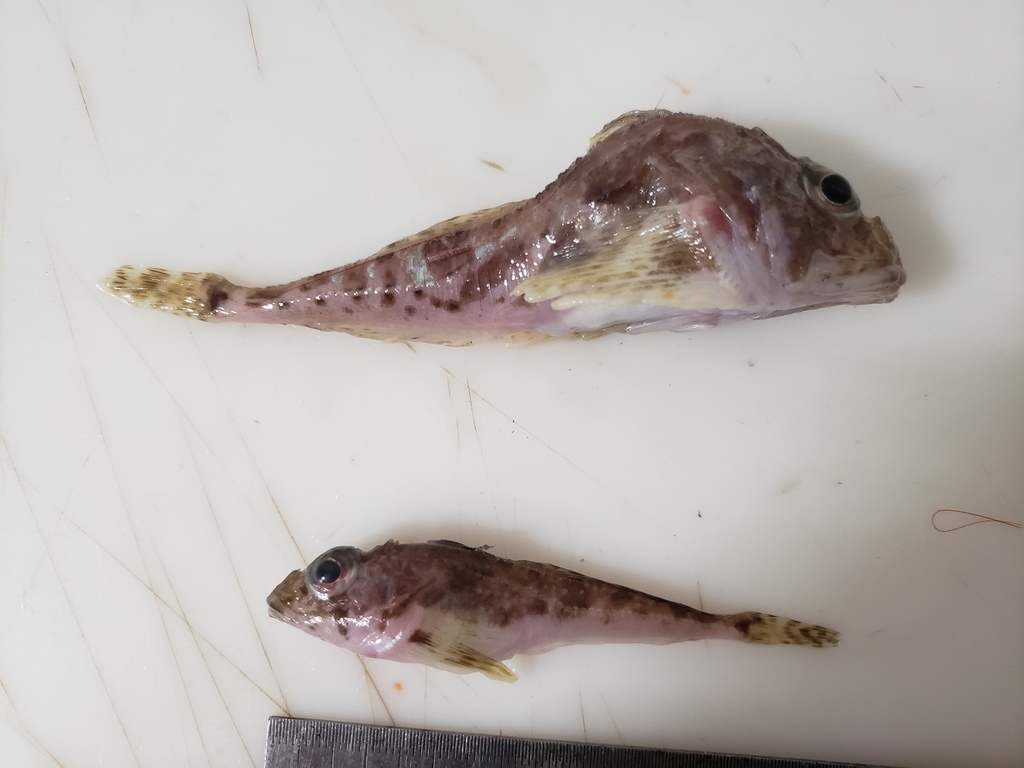
Twohorn Sculpin
Icelus bicornis
The twohorn sculpin (Icelus bicornis) is an Arctic benthic fish species of the order Scorpaeniformes.
From the article Twohorn sculpin on Wikipedia (CC BY-SA), quoted section by section
Description
The twohorn sculpin is typically 5–12 cm long and may reach 15 cm. It has a thin caudal peduncle, one sharp spine located in front of each eye and two spines behind, hence its common name. Like other sculpins, this species has two dorsal fins (the first is spiny while the second is soft-rayed), large pectoral fins and slender pelvics. The caudal fin is slightly rounded and has dark, vertical bars and a black spot at the base. The body is yellowish, with many dark blotches on the back and sides.
Range & habitat
In Canada, this fish occurs as far north as the northern tip of Ellesmere Island. Elsewhere, it is distributed along Norwegian coasts up to Spitzbergen and the Barents Sea (as far north as 82 degrees), and west to Iceland and Greenland. It is typically found at depths between 40 and 180 metres on sand, mud or rocky substrates.
Wikipedia: “Distribution”
What it does
Spawning apparently occurs from August to October. Females produce from 100 to 400 eggs, in function of their body size.
== References ==
Wikipedia: “Reproduction”
Where it lives
Recorded sightings
—
geo-referenced records in GBIF, from museums, herbaria and field observers.
Drag the globe to turn it. Dots are where records exist, not a range map; darker means more records.
In the stacks
Searching the stacks…
Every page naming Icelus bicornis in the Biodiversity Heritage Library →
This page is assembled live from iNaturalist, GBIF, Wikipedia, the Source Library and the Internet Archive. It is not yet part of the hand-edited codex. iNaturalist taxon 222147.