On eBird ↗
Red-throated Bee-eater
Live sightings near you, the range map, bar charts of when it is seen, and Macaulay Library photos and recordings.
Red-throated Bee-eater
Merops bulocki
The red-throated bee-eater (Merops bulocki) is a species of bird in the family Meropidae. This species is found in tropical Africa, in Benin, Burkina Faso, Cameroon, Central African Republic, Chad, Democratic Republic of the Congo, Ivory Coast, Ethiopia, Gambia, Ghana, Guinea, Guinea-Bissau, Mali, Mauritania, Niger, Nigeria, Senegal, Sierra Leone, Sudan, Togo, and Uganda. It has a wide range and large total population, and the International Union for Conservation of Nature has assessed its conservation status as...
From the article Red-throated bee-eater on Wikipedia (CC BY-SA), quoted section by section
Description
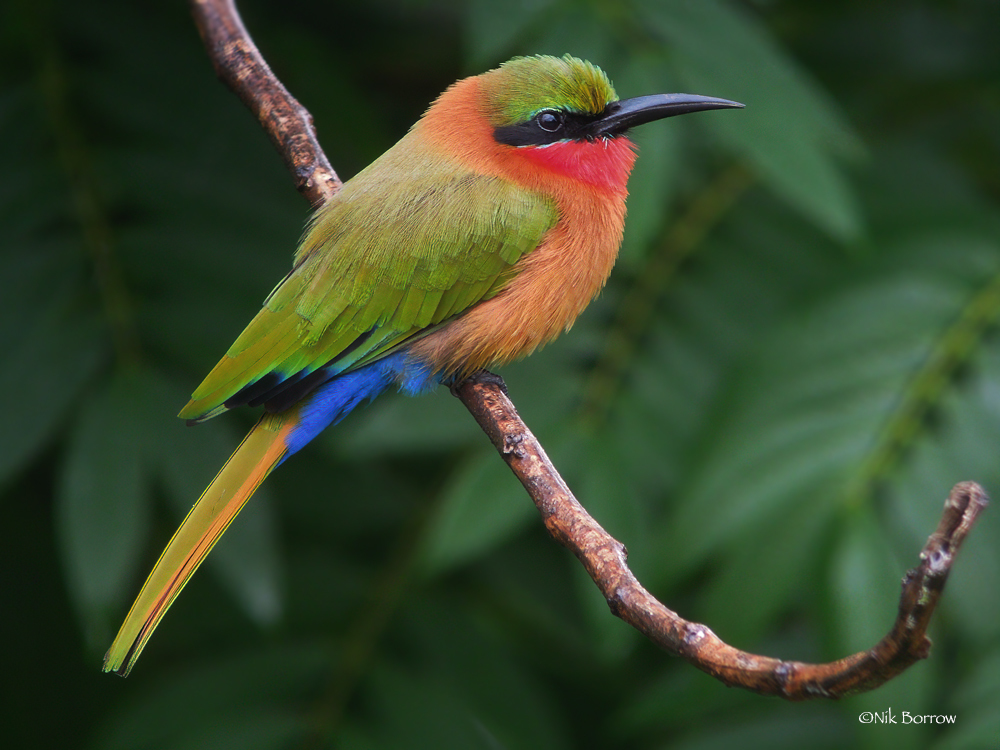
The adult red-throated bee eater grows to about 20 to 22 cm (8 to 9 in) in length with a moderately long tail, but no streamers. The upper parts are green and the red chin and throat are distinctive, though about 1% of individuals have a yellow throat. The hind neck, breast and underparts are buff, and the under-tail coverts and thighs are bright blue. To the east of the Central African Republic, the birds have blue facial features while to the west these features are green.
Range & habitat
The red-throated bee-eater has a wide distribution across tropical Africa, its range extending from Senegal and Gambia in the west to Uganda, southern Sudan, and Ethiopia in the east. Its typical habitat is savannah with scattered trees, farmland with trees, the edges of marshes, bushy pastures and gardens, but the birds are rarely to be found far from the erosion gullies, streams and small rivers, in the banks of which they nest.
Wikipedia: “Distribution and habitat”
What it does
The red-throated bee-eater is a colonial species, nesting in groups and remaining in the nesting area all year round. The nests are tunnels, excavated before the ground dries after the rainy season, the colony having up to about fifty nests. The diet of these birds consists mostly of honey-bees and stingless bees, as well as other insects. When foraging, a pair or a few individuals move around together, and can sometimes be seen perched in a row side by side. The species epithet is after William Bullock from whose collection the species was described.
== References ==
Wikipedia: “Ecology”
Listen
Looking for field recordings…
Where it lives
Recorded sightings
—
geo-referenced records in GBIF, from museums, herbaria and field observers.
Drag the globe to turn it. Dots are where records exist, not a range map; darker means more records.
In the stacks
Searching the stacks…
Every page naming Merops bulocki in the Biodiversity Heritage Library →
This page is assembled live from iNaturalist, GBIF, Wikipedia, the Source Library and the Internet Archive. It is not yet part of the hand-edited codex. iNaturalist taxon 2223.