- Animals
- ›Chordates
- ›Vertebrates
- ›Mammals
- ›Therians
- ›Placental Mammals
- ›Primates, Rodents, and Allies
- ›Rodents
- ›Squirrels, Dormice, and Mountain Beavers
- ›Squirrels
- ›Ground and African Tree Squirrels
- ›Chipmunks
- ›Neotamias
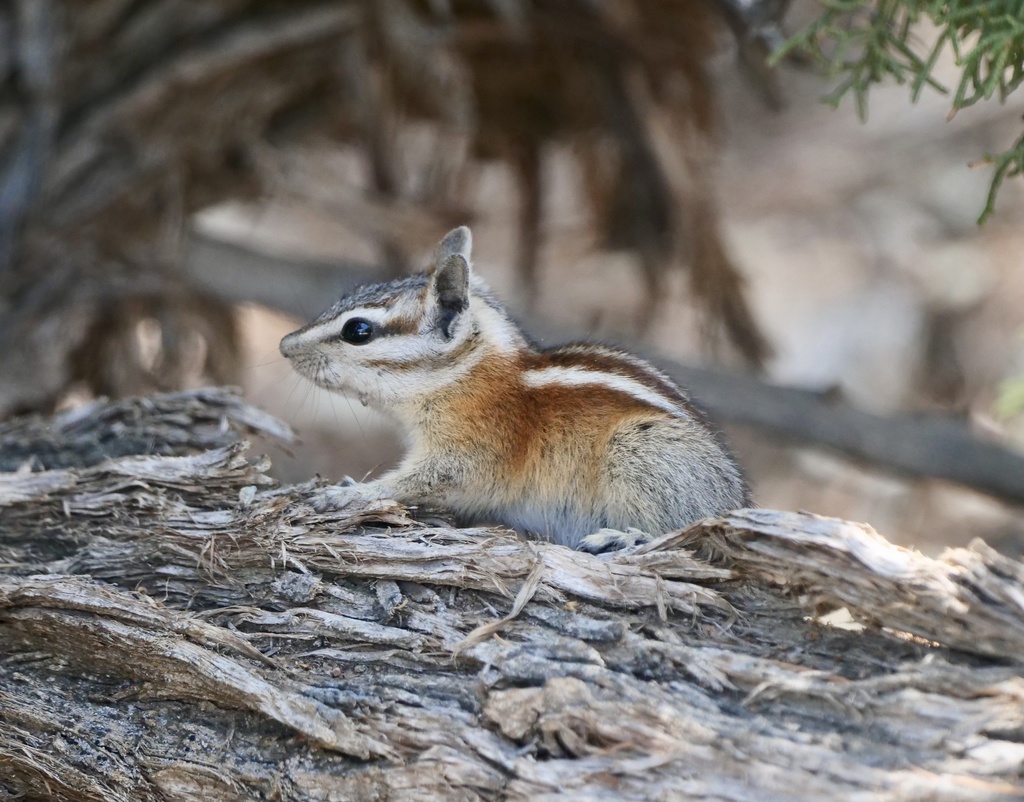
Panamint Chipmunk
Neotamias panamintinus
The Panamint chipmunk (Neotamias panamintinus) is a species of rodent in the squirrel family, Sciuridae. It is endemic to desert mountain areas of southeast California and southwest Nevada in the United States.
It is considered a species of least concern on the IUCN Red List due to its broad range, prevalence, and no known major threats. The Panamint chipmunk occurs in pinyon pine-juniper woodlands in bushes, boulders, and on cliffs.
From the article Panamint chipmunk on Wikipedia (CC BY-SA), quoted section by section
Description
Panamint chipmunks are medium-sized chipmunks with a head-and-body length of about 11–12 cm (4.5 in) and a tail length of roughly 9–10 cm (3.5–4 in). Adults weigh between 74 and 105 g, with females on average somewhat larger than males (a kind of sexual dimorphism common in chipmunks). In summer, their fur is a bright golden or reddish-brown on the shoulders and sides with a grayish tinge on the anterior back. They have characteristic dark and light stripes on the back and face: five dark dorsal stripes divided by lighter stripes, which are bold on the upper back and diminish toward the rump. The core dorsal stripe is normally brown, while the peripheral stripes mix with the body coloration. The flanks are grayish, and the top of the head is a light gray with less dark facial striping. In winter, the coat becomes longer, silkier, and more yellowish, with overall paler patterns. The pelage coloration and pattern assist hide the animal against the rocky outcrops and scrub of its habitat (a cryptic coloration).
Range & habitat
The Panamint chipmunk is exclusively located in southwestern North America, particularly in regions of eastern California and western Nevada. Its distribution is sporadic, limited to hilly regions. In California, it is found in the eastern slopes of the southern Sierra Nevada and in other desert mountain ranges, including the Panamint, Argus, Inyo, White, Clark, Granite, Kingston, Providence, and Mescal ranges. The species was initially identified in the Panamint Range, currently part of Death Valley National Park, and it also resides in the Mojave National Preserve and other elevated desert regions. People live in the mountainous parts of Nevada's southwestern part, such as the Spring Mountains (close to Mt. Charleston), the Sweetwater, Wassuk, Grapevine, Silver Peak, and Excelsior ranges. The height varies from roughly 1,300 to 2,700 meters (about 4,500 to 9,000 feet) above sea level. The Panamint chipmunk has a strong preference for pinyon-juniper woods that grow in rocky areas throughout this range. It is usually found on dry, rocky slopes with lots of granite formations, boulder groups, and cliff ledges. The soil is thin, and the plants are mostly scrub and scattered pinyon pine (Pinus monophylla) and juniper (Juniperus) trees. This species thrives in conditions that are too hot and dry for many other chipmunks. …
Wikipedia: “Distribution and habitat”
What it does
Panamint chipmunks are diurnal, engaging in foraging and navigating among rocks and plants throughout the daylight hours. They often stay close to protection, such as rocky outcrops and trees, and rarely enter open, exposed regions. Individuals are frequently seen positioned on boulders or logs while consuming seeds or monitoring for threats. This chipmunk is predominantly solitary outside the breeding season, although exhibits social interactions within family groups, especially in terms of maternal care for the young. It demonstrates territorial behavior: adults establish and protect home territories, possibly measuring approximately one hectare or fewer, similar to related chipmunks. Intraspecific aggressiveness, characterized by fights or chases among Panamint chipmunks, has been observed in all seasons, with heightened frequency during the spring breeding time. Male individuals may vie for access to females, while both genders may safeguard optimal feeding or nesting territories. Although Panamint chipmunks can endure elevated temperatures, they limit their activity during the most severe conditions. They are classified as facultative hibernators; on extremely cold winter days or periods of snow cover, they remain in their burrows in a state of torpor. …
Wikipedia: “Behavior”
Listen
Looking for field recordings…
Where it lives
Recorded sightings
—
geo-referenced records in GBIF, from museums, herbaria and field observers.
Drag the globe to turn it. Dots are where records exist, not a range map; darker means more records.
In the stacks
Searching the stacks…
Every page naming Neotamias panamintinus in the Biodiversity Heritage Library →
This page is assembled live from iNaturalist, GBIF, Wikipedia, the Source Library and the Internet Archive. It is not yet part of the hand-edited codex. iNaturalist taxon 225747.