- Animals
- ›Chordates
- ›Vertebrates
- ›Amphibians
- ›Frogs and Toads
- ›Terraranas
- ›Rain Frogs
- ›Eleutherodactylinae
- ›Eleutherodactylus
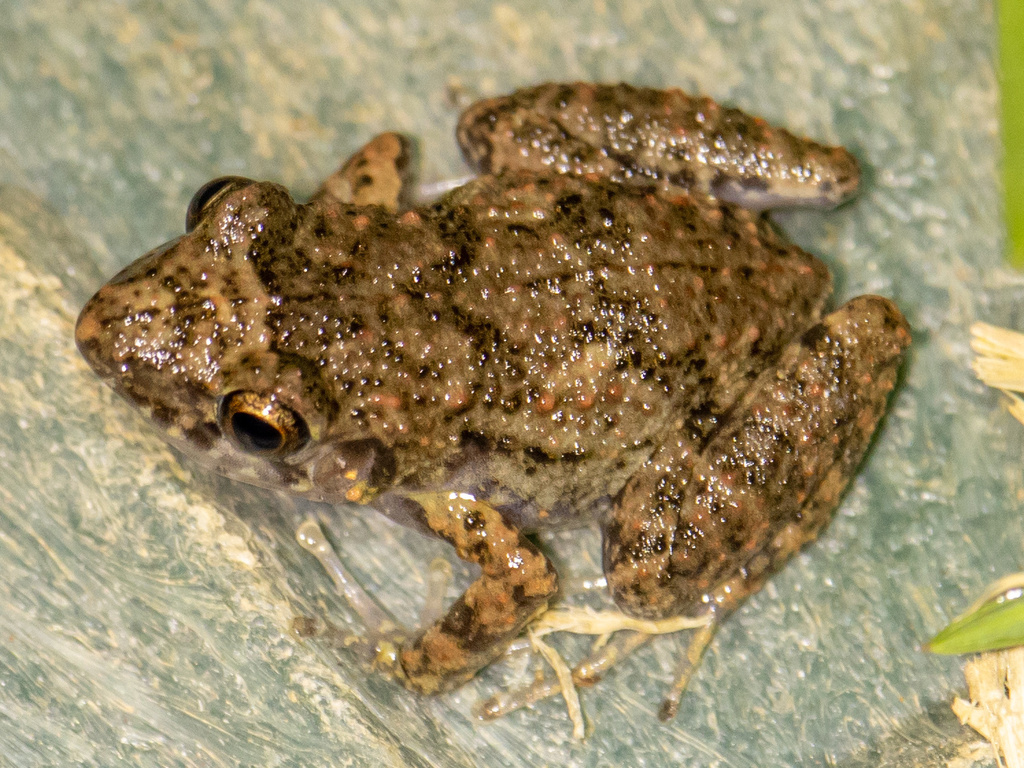
Greenhouse Frog
Eleutherodactylus planirostris
The greenhouse frog (Eleutherodactylus planirostris) is a species of frog in the family Eleutherodactylidae, native to Cuba, the Bahamas, and the Cayman Islands, and it has been introduced to other areas, such as Florida, Hawaii, Guam, Hong Kong and Shenzhen.
From the article Greenhouse frog on Wikipedia (CC BY-SA), quoted section by section
Description
The greenhouse frog is a very small species, ranging from 17 to 31 mm (0.67 to 1.22 in) in length. These frogs are usually drab or olive-brown in colour, and occur in two forms; one has two broad stripes running longitudinally down the back, and the other is mottled. The undersides of both are a paler colour than the back, and the eyes are red.
Range & habitat
The greenhouse frog is native to Cuba and some other islands in the West Indies. It has been introduced to Hawaii and Florida, where it has become common. It has been sporadically found in southern Georgia, southern Alabama and eastern Louisiana. It is an introduced species in Jamaica, Guam and Shenzhen, China. It lives in moist leaf litter, often near human habitations, but is seldom seen because it is nocturnal. It sometimes emerges on warm, rainy days in summer, and in Florida, it has been found hibernating in March under the flaking bark of a wild tamarind (Lysiloma) tree.
Wikipedia: “Distribution and habitat”
What it does
The diet of the greenhouse frog consists of small invertebrates, such as ants, beetles, mites, spiders, and roaches.
Wikipedia: “Diet”
Listen
Looking for field recordings…
Where it lives
Recorded sightings
—
geo-referenced records in GBIF, from museums, herbaria and field observers.
Drag the globe to turn it. Dots are where records exist, not a range map; darker means more records.
In the stacks
This page is assembled live from iNaturalist, GBIF, Wikipedia, the Source Library and the Internet Archive. It is not yet part of the hand-edited codex. iNaturalist taxon 22631.