- Animals
- ›Chordates
- ›Vertebrates
- ›Ray-finned Fishes
- ›Carps, Characins, Catfishes and Allies
- ›Catfishes
- ›Siluroidei
- ›Thorny Catfishes
- ›Doradinae
- ›Platydoras
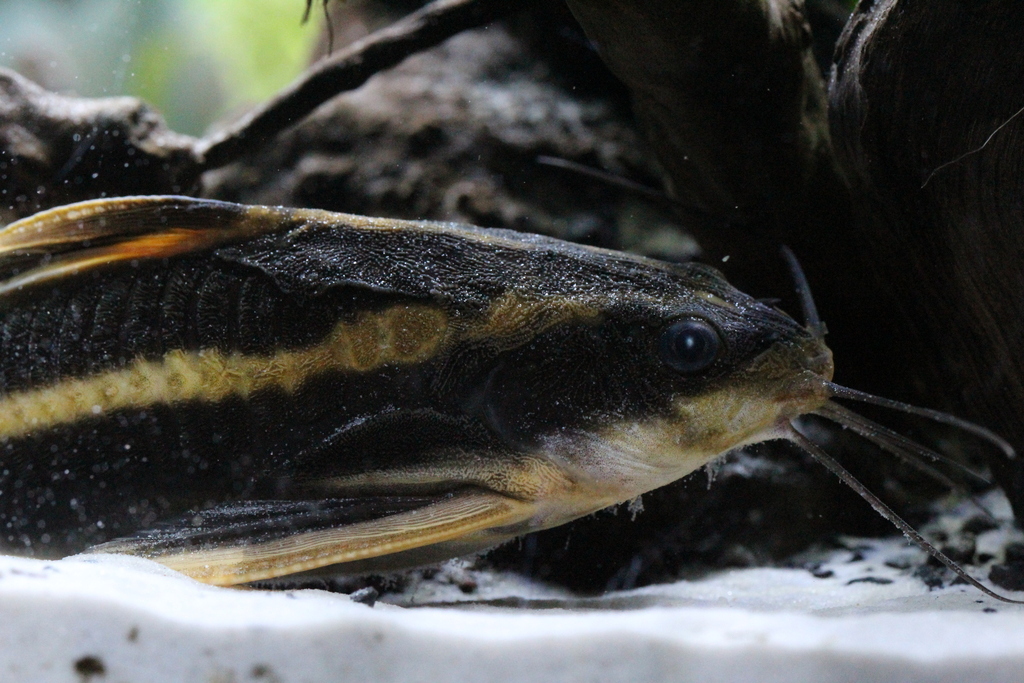
Striped Raphael
Platydoras armatulus
The striped Raphael catfish (Platydoras armatulus) is a catfish of the family Doradidae. It may also be called Southern striped Raphael, talking catfish, chocolate doradid, chocolate catfish or thorny catfish. It is native to the Amazon, Paraguay–Paraná and lower Orinoco basins in South America. This peaceful, nocturnal species is a popular aquarium fish due to its pleasant temperament and curious nature.
This catfish has long been confused with Platydoras costatus of Suriname and French Guiana, where the pale stripe on the body does not extend onto the head.
From the article Striped Raphael catfish on Wikipedia (CC BY-SA), quoted section by section
Description
These fish burrow in the soft river bottoms and frequently occurs on sandy bottoms. These fish feed on mollusks, crustaceans and organic debris. They have rigid pectoral fin spines. The striped Raphael catfish also has tiny and curved protective spines running along its body. The typically reported maximum standard length of this species is 20–24 cm (7.9–9.4 in). Considerably larger individuals, up to 43 cm (17 in) long, have been reported from the Tocantins–Araguaia basin, but this population, together with those from the Tapajós and Xingu, likely represent an undescribed species (not to be confused with P. birindellii, a species from the Xingu basin that was described in 2018). Juvenile striped raphael catfish have been recorded cleaning piscivorous fish such as Hoplias malabaricus. The stripe pattern in the young may serve as a signal that allows for its recognition as a cleaner. It is noted that the striping pattern is not as strong in adults, and so the cleaning behavior is probably only seen in juveniles.
Wikipedia: “Description and behavior”
Where it lives
Recorded sightings
—
geo-referenced records in GBIF, from museums, herbaria and field observers.
Drag the globe to turn it. Dots are where records exist, not a range map; darker means more records.
In the stacks
Searching the stacks…
Every page naming Platydoras armatulus in the Biodiversity Heritage Library →
This page is assembled live from iNaturalist, GBIF, Wikipedia, the Source Library and the Internet Archive. It is not yet part of the hand-edited codex. iNaturalist taxon 228318.