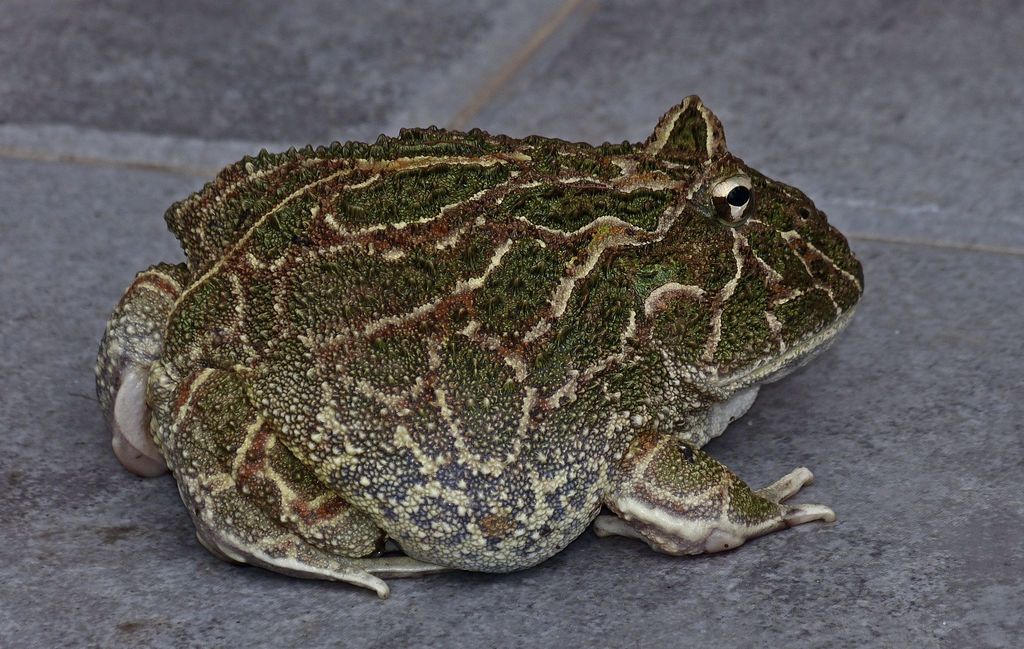
Chacoan Horned Frog
Ceratophrys cranwelli
Cranwell's horned frog (Ceratophrys cranwelli), also called commonly the Chacoan horned frog, is a terrestrial frog in the family Ceratophryidae. The species is endemic to the dry Gran Chaco region of Argentina, Bolivia, Paraguay and Brazil. It, like other members of its genus, Ceratophrys, is commonly called the Pac-man frog, because of its resemblance to the video game character of the same name. Most adult specimens range from 8–13 cm (3.1–5.1 in) long and can weigh up to 0.5 kg (1.1 lb).
From the article Cranwell's horned frog on Wikipedia (CC BY-SA), quoted section by section
Description
The back of C. cranwelli usually has dark green and brown coloration, although albino variants with orange and yellow coloration also exist and are popular in the pet trade. The dark color scheme aids in camouflaging the animal as it burrows and waits for its prey. Though generally inactive, it is an aggressive eater and is capable of leaping for several body lengths to capture prey. It uses its sticky tongue to latch onto prey and its heavy body to remain anchored while consuming prey.
What it does
Cranwell's horned frog is nocturnal and rests with its eyelids open. It is ordinarily carnivorous, feeding mostly on insects and like-sized animals such as rodents, and is known to cannibalize other frogs. Large individuals have bite forces comparable to those of mammalian predators. Although it is capable of eating animals almost half its size, Cranwell's horned frog sometimes eat things larger than itself. Its bite force is able to immobilize its prey, despite its being half the size of the prey. However, due to a row of teeth along the upper jaw, it is unable to release prey from its mouth, potentially causing it to die by choking.
Wikipedia: “Diet and behavior”
In human culture
The specific name, cranwelli, is in honor of Argentinian herpetologist Jorge A. Cranwell.
Wikipedia: “Etymology”
Listen
Looking for field recordings…
Where it lives
Recorded sightings
—
geo-referenced records in GBIF, from museums, herbaria and field observers.
Drag the globe to turn it. Dots are where records exist, not a range map; darker means more records.
In the stacks
Searching the stacks…
Every page naming Ceratophrys cranwelli in the Biodiversity Heritage Library →
This page is assembled live from iNaturalist, GBIF, Wikipedia, the Source Library and the Internet Archive. It is not yet part of the hand-edited codex. iNaturalist taxon 22844.