- Animals
- ›Chordates
- ›Vertebrates
- ›Amphibians
- ›Frogs and Toads
- ›Escuerzos and Smooth-horned Frogs
- ›Odontophrynus
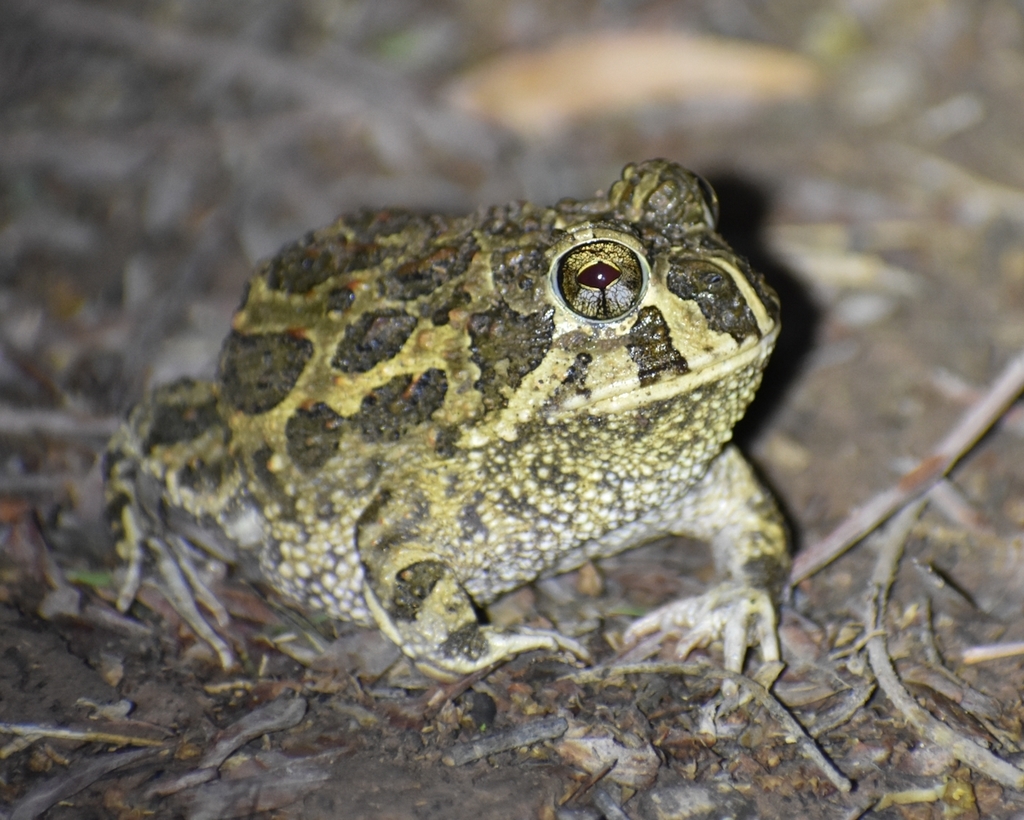
Common Lesser Escuerzo
Odontophrynus americanus
Odontophrynus americanus (common names: common lesser escuercito, American ground frog) is a species of frog in the family Odontophrynidae.
It is found in central and northern Argentina, Uruguay, southern Brazil, and southern Paraguay. It is tetraploid; diploid populations have been described as a new species, Odontophrynus cordobae.
From the article Odontophrynus americanus on Wikipedia (CC BY-SA), quoted section by section
Description
The adult male frog measures 42.2 mm in snout-vent length and the adult female frog 44.6 mm. The head is wider than it is long. It has claws on its forefeet and webbed skin on its hind feet. The skin of the dorsum is light brown with darker brown marks surrounded in black. Sometimes there is some red coloration. The belly is off-white with some brown mottling. The adult male frog has a dark gray throat.
Range & habitat
Scientists observed this frog in grassy areas, Atlantic forest, Cerrado biomes, and Pampa biomes. It seems to tolerate human disturbance well and has been found near farms and towns. Scientists observed the frog between 0 and 2000 meters above sea level. Scientists have seen the frog in many protected parks, uncluding Parque Estadual do Turvo, Área de Proteção Ambiental Sapucai-Mirim, Área de Proteção Ambiental Campos do Jordão, and Floresta Estadual de Assis in Brazil.
Wikipedia: “Habitat”
What it does
During the breeding season, these frogs are found at shallow, temporary ponds and flooded areas. This frog is an explosive breeder. Males can be heard calling at night from the edge of, or from within the water. The female frog deposits her eggs in the mud at the bottom of the pool. The tadpole has a globular body with eyes located dorsally. It has complex mouthparts, including papillae and a beak. The top and sides of the body are brown in color and its ventral area is translucent. The tadpoles are benthic and feed on algae and plant detritus. The tadpoles develop into frogs in 7-9 months.
Wikipedia: “Reproduction”
Listen
Looking for field recordings…
Where it lives
Recorded sightings
—
geo-referenced records in GBIF, from museums, herbaria and field observers.
Drag the globe to turn it. Dots are where records exist, not a range map; darker means more records.
In the stacks
Searching the stacks…
Every page naming Odontophrynus americanus in the Biodiversity Heritage Library →
This page is assembled live from iNaturalist, GBIF, Wikipedia, the Source Library and the Internet Archive. It is not yet part of the hand-edited codex. iNaturalist taxon 22859.