- Animals
- ›Chordates
- ›Vertebrates
- ›Amphibians
- ›Frogs and Toads
- ›Southern Frogs
- ›Paratelmatobiinae
- ›Paratelmatobius
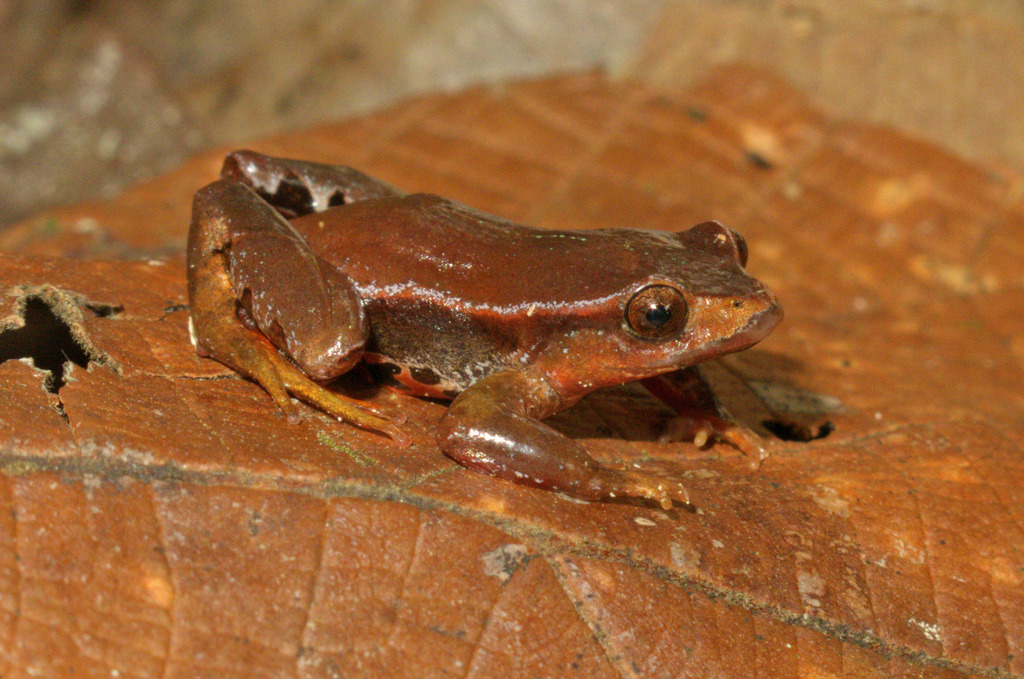
San Andre Rapids Frog
Paratelmatobius poecilogaster
Paratelmatobius poecilogaster is a species of frog in the family Leptodactylidae. It is endemic to the Serra do Mar range, Brazil. It is a terrestrial frog found near small temporary streams inside primary forest. The eggs are laid in small ponds at the edges of the temporary streams. Though the known populations are known from inside protected areas, it is likely to be threatened by habitat loss outside those areas.
From the article Paratelmatobius poecilogaster on Wikipedia (CC BY-SA), quoted section by section
Description
This is the largest frog in Paratelmatobius. The adult male measures 20 to 26 mm (0.79 to 1.02 in) in snout-vent length and the adult female 25.2 to 30.1 mm (0.99 to 1.19 in). The skin of the back and legs is brown and green with green spots. In some individuals, these spots form a line on the backbone. There are brown bars on the hind legs. There is a pink line from each eye to the groin. There is a gray stripe from each eye down the flank. There is a dark stripe from the eye to the mouth. The throat is black in the middle and orange on the sides. The belly is orange and red with black and white marks. The undersides of the forelegs are red.
Range & habitat
People have observed this frog on the leaf litter in primary and secondary rainforest. Scientists have seen this frog between 500 and 800 metres (1,640 and 2,620 ft) above sea level. Scientists found this frog in one protected park, Parque Estadual da Serra do Mar.
Wikipedia: “Habitat”
What it does
The male frogs go to temporary pools of water and call to the female frogs. The female frogs deposit eggs, 5-13 per clutch on rocks above the pools. The tadpoles hatch and go into the water. The tadpoles can be 25.8 mm (1.02 in) long, including the tail.
Wikipedia: “Reproduction”
Listen
Looking for field recordings…
Where it lives
Recorded sightings
—
geo-referenced records in GBIF, from museums, herbaria and field observers.
Drag the globe to turn it. Dots are where records exist, not a range map; darker means more records.
In the stacks
This page is assembled live from iNaturalist, GBIF, Wikipedia, the Source Library and the Internet Archive. It is not yet part of the hand-edited codex. iNaturalist taxon 23017.