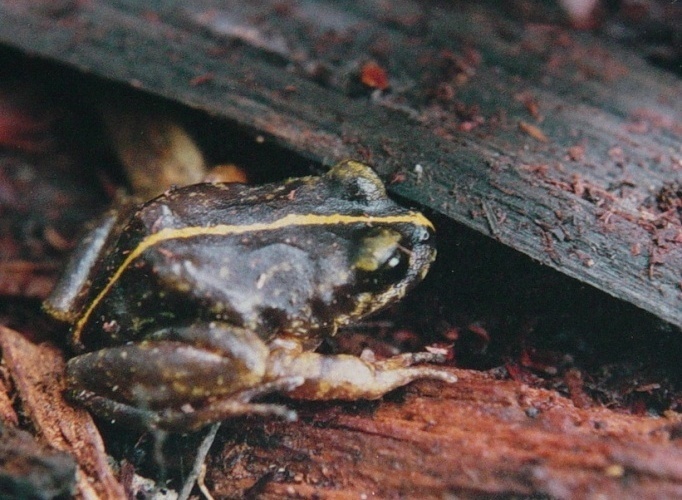
Emilio's Ground Frog
Eupsophus emiliopugini
Eupsophus emiliopugini is a species of frog in the family Alsodidae. It is found in the temperate Nothofagus forests of Chile between 40°50'S and 45°20'S, and in the Lago Puelo National Park, Chubut Province, Argentina. The specific name emiliopugini honors Professor Emilio Pugín, for "his contribution to knowledge of the reproductive biology and development of the Chilean frogs". Common name Emilio's ground frog has been coined for the species.
From the article Eupsophus emiliopugini on Wikipedia (CC BY-SA), quoted section by section
Description
Adult males measure 43–50 mm (1.7–2.0 in) and females 41–65 mm (1.6–2.6 in) in snout–vent length. Newly metamorphosed froglets measure 10–11 mm (0.39–0.43 in). The head is wider than it is long. The tympanum is distinct, and there is a well-developed supra-tympanic fold. The limbs are slender. Webbing is absent. Skin is smooth. The dorsal ground color is grayish brown to leaden. There is a lemon-yellow vertebral line and an olive-green band between the eyes. Sometimes there are bright yellowish reticulations on the thighs. The belly is whitish; mature males have bright orange gular area.
Range & habitat
Its natural habitats are humid forests near cold streams from near sea level to 1,500 m (4,900 ft) above sea level. Adults can be found under logs or in small holes at the edges of streams. Males call from small holes at day. Females lay their eggs inside the holes; the free-swimming tadpoles develop in these water-filled cavities on the ground. The tadpoles spend considerable time in the nest, during which they do not eat. Scientists suspect parental care. It is threatened by habitat loss caused by fires and plantation of exotic trees for forestry. It occurs in the Lago Puelo National Park in Argentina and at least six other protected parks in Chile.
== References ==
Wikipedia: “Habitat and conservation”
Listen
Looking for field recordings…
Where it lives
Recorded sightings
—
geo-referenced records in GBIF, from museums, herbaria and field observers.
Drag the globe to turn it. Dots are where records exist, not a range map; darker means more records.
In the stacks
Searching the stacks…
Every page naming Eupsophus emiliopugini in the Biodiversity Heritage Library →
This page is assembled live from iNaturalist, GBIF, Wikipedia, the Source Library and the Internet Archive. It is not yet part of the hand-edited codex. iNaturalist taxon 23106.