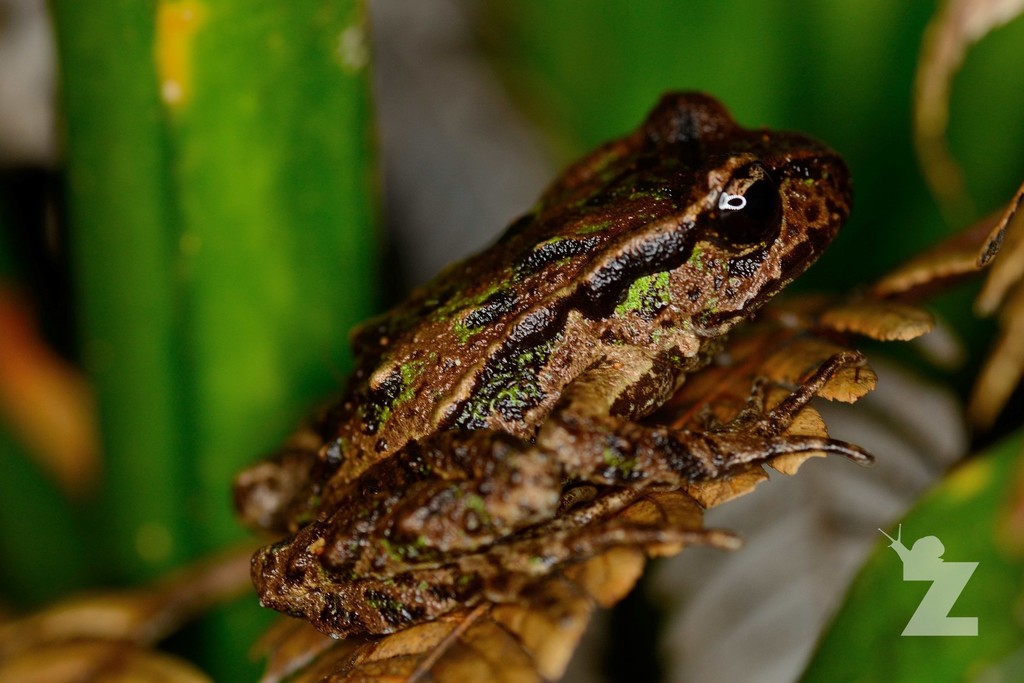
Archey's Frog
Leiopelma archeyi
Archey's frog, Leiopelma archeyi, is an archaic, rare frog native to New Zealand, one of only three extant species belonging to the taxonomic family Leiopelmatidae. It is named after Sir Gilbert Archey, the former director of the Auckland Institute. The holotype is held at the Auckland War Memorial Museum. It is found only in the Coromandel Peninsula and near Te Kuiti in the North Island of New Zealand. This species, along with others in the family,...
From the article Archey's frog on Wikipedia (CC BY-SA), quoted section by section
Description
Females of the species grow up to 37 mm (1.5 in) in length, while males grow to 31 mm (1.2 in). The frogs have variable colours and patterns, often with a light to dark brown dorsal surface with scattered dark blotches, pink/orange-brown lateral surface, and a black or dark brown ventral surface. The species lacks webbing on their hind feet, they have primarily smooth skin and mostly black eyes. The species can be distinguished from Hochstetter's frog due to its smoother skin, longer digits, typically smaller size and lack of webbed toes on their hind feet. Colour variation exists between the two populations of Archey's frog: with the Whareorino Forest populations, typically being more colourful than their counterparts on the Coromandel Peninsula, with pink or orange-brown patches on body.
Range & habitat
The species is found in two locations: the Coromandel Peninsula, and the Whareorino Forest near Te Kūiti, both areas of the Waikato Region of the North Island, New Zealand. The species typically lives in higher elevations, on ridges away from creeks in high moisture areas of native forest, although in the mid-20th century the species had previously been found at lower elevations.
Wikipedia: “Distribution and habitat”
What it does
Archey's frog is primarily nocturnal, hiding under rocks in the daytime. The species is terrestrial, occasionally spending time in the lower branches of trees, and can live up to 35 years. Reproduction occurs between September and November, with females lay clutches of translucent eggs, varying between four and 15 eggs and 8–11 mm (0.31–0.43 in) in size between December and February. Reproduction is fully terrestrial; tadpoles develop within gelatinous egg capsules, and upon hatching, tailed froglets crawl onto the male's back and are carried around, and take several weeks to complete metamorphosis. Males are believed to be the primary care providers, and may prepare "nests" they guard for the eggs, secreting antimicrobial peptides onto them, to ensure successful embryonic development. Froglets remain with males for between three and four years. Adult frogs do not give advertisement vocalisations, but may communicate by chemical signalling. However, frogs sometimes give startle calls when threatened by a predator.
Wikipedia: “Behaviour”
Listen
Looking for field recordings…
Where it lives
Recorded sightings
—
geo-referenced records in GBIF, from museums, herbaria and field observers.
Drag the globe to turn it. Dots are where records exist, not a range map; darker means more records.
In the stacks
Searching the stacks…
Every page naming Leiopelma archeyi in the Biodiversity Heritage Library →
This page is assembled live from iNaturalist, GBIF, Wikipedia, the Source Library and the Internet Archive. It is not yet part of the hand-edited codex. iNaturalist taxon 23274.