- Animals
- ›Chordates
- ›Vertebrates
- ›Amphibians
- ›Frogs and Toads
- ›African Reed Frogs
- ›Typical Reed Frogs
- ›Hyperolius
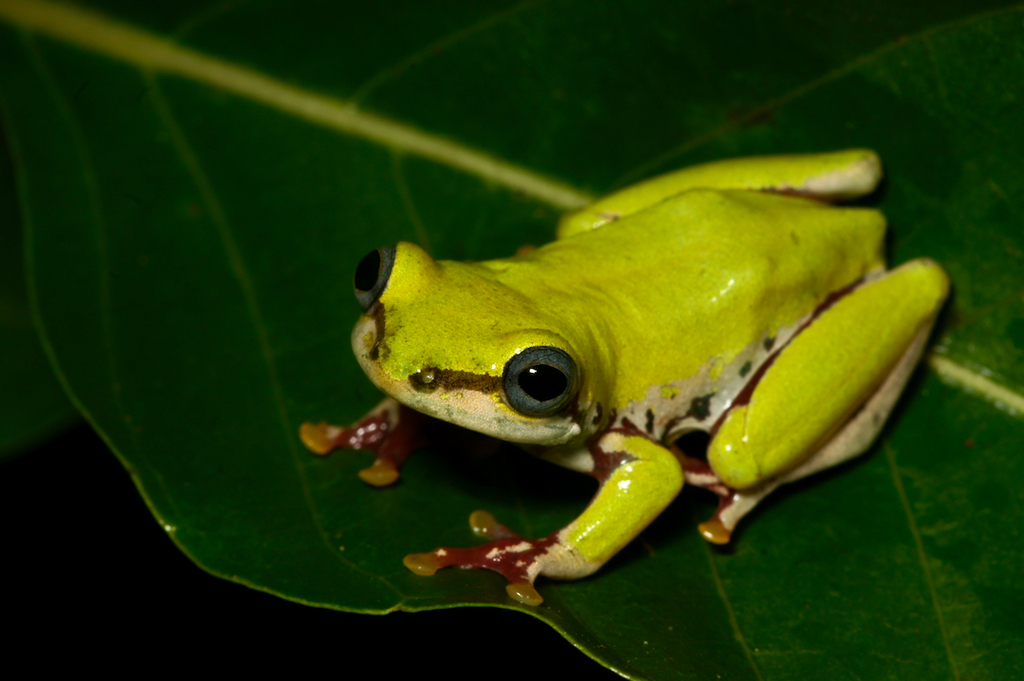
Lime Reed Frog
Hyperolius fusciventris
Hyperolius fusciventris is a species of frog in the family Hyperoliidae. It occurs in West and Middle Africa between Sierra Leone in the west and western Cameroon in the east. Common name lime reed frog has been coined for this species.
From the article Hyperolius fusciventris on Wikipedia (CC BY-SA), quoted section by section
Description
Hyperolius guttulatus is a relatively small member of its genus, with males measuring 18–25 mm (0.71–0.98 in) and females 23–28 mm (0.91–1.10 in) in snout–vent length. The pupil is horizontal. There are two colour phases. All juveniles and many mature males display phase "J", which is light green with conspicuous light dorsolateral stripes; there is often a dark vertebral line. All females, and some males, develop into phase "F" prior to the first breeding season. This phase has a green dorsum. Male advertisement call consists of two parts, an initial "creak" followed by a small number of "clicks" in rapid succession.
Range & habitat
The species is found, from west to east, in Sierra Leone, Guinea, Liberia, Ivory Coast, Ghana, Togo, Benin, Nigeria, and Cameroon. The record from Guinea-Bissau requires confirmation.
Wikipedia: “Distribution”
Listen
Looking for field recordings…
Where it lives
Recorded sightings
—
geo-referenced records in GBIF, from museums, herbaria and field observers.
Drag the globe to turn it. Dots are where records exist, not a range map; darker means more records.
In the stacks
Searching the stacks…
Every page naming Hyperolius fusciventris in the Biodiversity Heritage Library →
This page is assembled live from iNaturalist, GBIF, Wikipedia, the Source Library and the Internet Archive. It is not yet part of the hand-edited codex. iNaturalist taxon 23328.