- Animals
- ›Chordates
- ›Vertebrates
- ›Reptiles
- ›Snakes and Lizards
- ›Snakes
- ›Colubrid Snakes
- ›Colubrine Snakes
- ›Lampropeltis
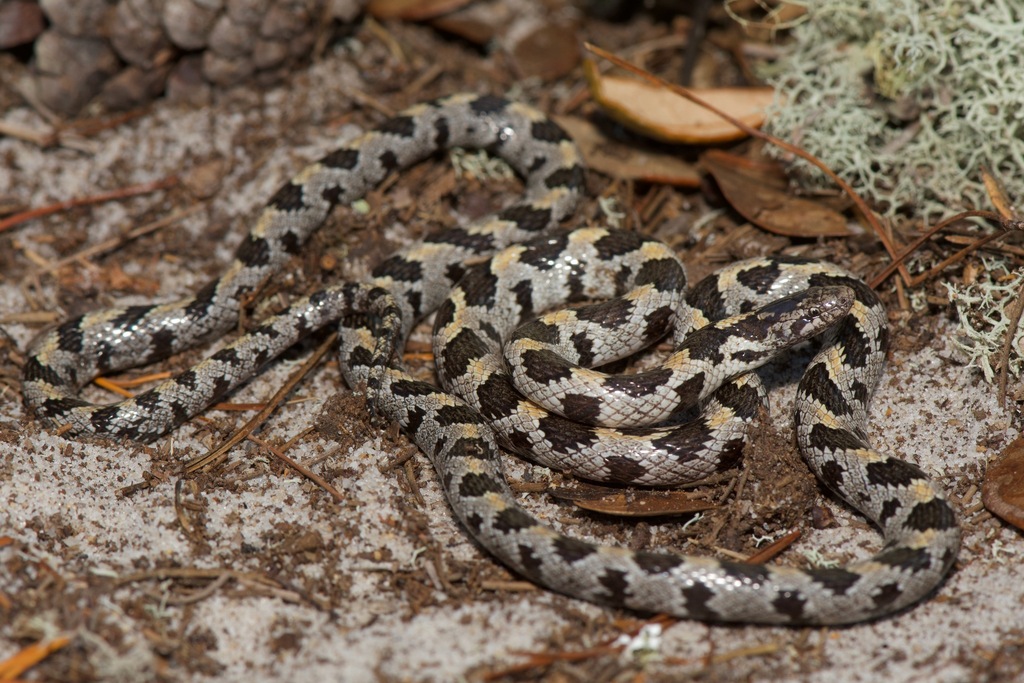
Short-tailed Snake
Lampropeltis extenuata
The short-tailed snake (Lampropeltis extenuata) is a species of small harmless snake in the family Colubridae. Fossorial and seldom seen, the short-tailed snake is found only in sandy, upland parts of Florida where it is listed as "Threatened" and is protected by state law.
From the article Short-tailed snake on Wikipedia (CC BY-SA), quoted section by section
Description
The short-tailed snake is a small serpent averaging 36–51 cm (14–20 in) in total length (tail included), with a record total length measurement of 65.4 cm (25+3⁄4 in), and is perhaps as thin as a pencil. It is gray above with 50 to 80 dark blotches and may or may not have a yellow stripe running down the spine. The underside is white with dark brown blotches. It bears a more-than-superficial resemblance to other kingsnakes, especially the mole kingsnake (Lampropeltis calligaster rhombomaculata), but can be distinguished by its smaller size and much more slender build. Also, Lampropeltis extenuatua has six upper labials, whereas other kingsnakes of the genus Lampropeltis have seven upper labials.
Range & habitat
The short-tailed snake is found only in a handful of counties in central Florida.
Wikipedia: “Geographic range”
What it does
The short-tailed snake is as poorly understood as it is seldom-seen, rare and geographically limited. It is a burrowing snake that rarely appears above ground and does so even more rarely during the day. Like other snakes of the tribe Lampropeltini, it vibrates its tail when startled by predators or people but can be distinguished from a rattlesnake by its slender build and lack of a rattle. An excitable snake, it makes a poor captive and is protected against harassment or captivity by Florida law. Despite this, much of what little we know about the short-tailed snake has been based on observations of captive specimens.
Wikipedia: “Behavior”
In human culture
The short-tailed snake's tail comprises less than ten percent of the snake's total length, hence the common name. Originally described and named by A. Erwin Brown in 1890 as Stilosoma extenuatum, its generic name was derived from the Greek stylos for "pillar" and soma for "body". This refers to the stiffness of the short-tailed snake's body, which is caused by its wide and inflexible column of unusually short vertebrae. The specific name, extenuata, is Latin for "thin" or "slender".
Wikipedia: “Etymology”
Where it lives
Recorded sightings
—
geo-referenced records in GBIF, from museums, herbaria and field observers.
Drag the globe to turn it. Dots are where records exist, not a range map; darker means more records.
In the stacks
Searching the stacks…
Every page naming Lampropeltis extenuata in the Biodiversity Heritage Library →
This page is assembled live from iNaturalist, GBIF, Wikipedia, the Source Library and the Internet Archive. It is not yet part of the hand-edited codex. iNaturalist taxon 236840.