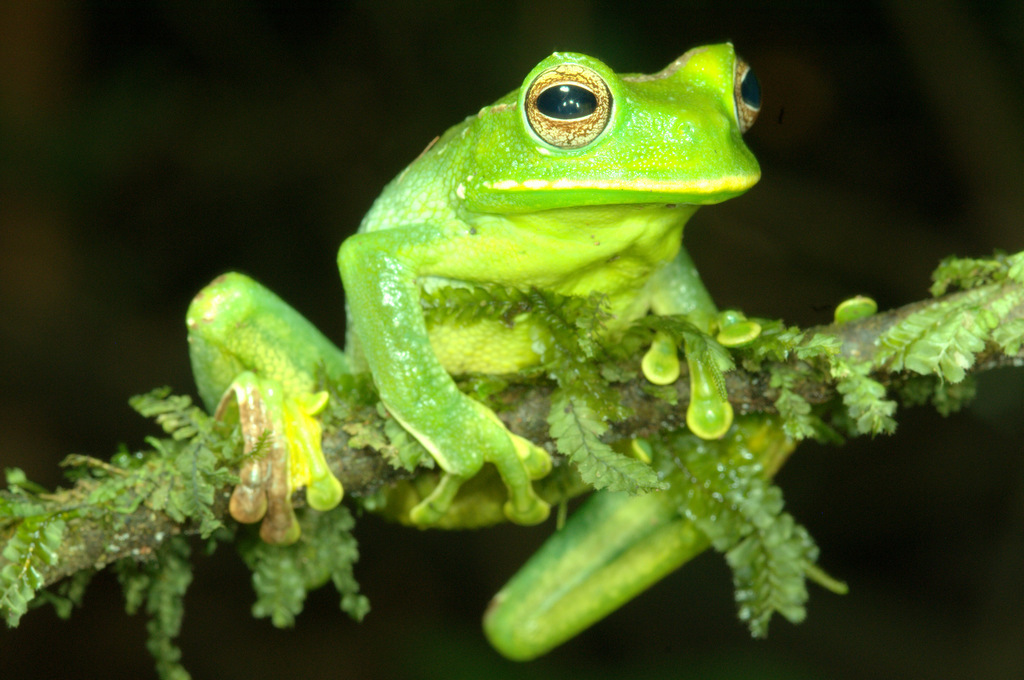
Pastaza Marsupial Frog
Gastrotheca longipes
The Gastrotheca longipes (also known as the Pastaza Marsupial Frog or Rana Marsupial) is a species of frog in the Hemiphractidae family. It is found in Ecuador and Peru. Its natural habitats are subtropical or tropical moist lowland forests and subtropical or tropical moist montane forests.
From the article Gastrotheca longipes on Wikipedia (CC BY-SA), quoted section by section
Description
This frog has a large, robust body. The adult male frog measures 61.2–70.8 mm in snout-vent length and the adult female frog 70.0–88.3 mm. The skin of the dorsum and flanks is green with some white marks. Some frogs have brown or white color near the eyes and jaw. The upper lip is white and the lower lip is green. The legs are green with white marks. The bottoms of the feet are green in color. The frog's leg bones are green in color. The knees have brown marks on them. The throat and chest are cream-yellow in color. The belly is cream-white or green with cream-white marks. The iris of the eye is white with brown reticulations.
Range & habitat
This canopy-dwelling frog has been seen night on bushes and trees. It has not shown tolerance to habitat disturbance. Scientists have seen the frog between 185 and 954 m (607 and 3,130 ft) above sea level. Scientists have seen the frog in protected places: Santiago-Comaina Reserved Zone of Peru and Ecuador, Tiputini Biodiversity Station, and Yasuní National Park.
Wikipedia: “Habitat”
What it does
The female frog carries her eggs in a pouch on her back. Scientists observed one female with 15 eggs in her pouch and another with 17. The eggs are large for frogs this size, 10.9 mm in diameter. Scientists believe that this frog's tendency toward fewer, larger eggs is related to its direct development reproductive strategy. This frog hatches into a froglet with no free-swimming tadpole stage.
Wikipedia: “Reproduction”
Listen
Looking for field recordings…
Where it lives
Recorded sightings
—
geo-referenced records in GBIF, from museums, herbaria and field observers.
Drag the globe to turn it. Dots are where records exist, not a range map; darker means more records.
In the stacks
Searching the stacks…
Every page naming Gastrotheca longipes in the Biodiversity Heritage Library →
This page is assembled live from iNaturalist, GBIF, Wikipedia, the Source Library and the Internet Archive. It is not yet part of the hand-edited codex. iNaturalist taxon 24129.