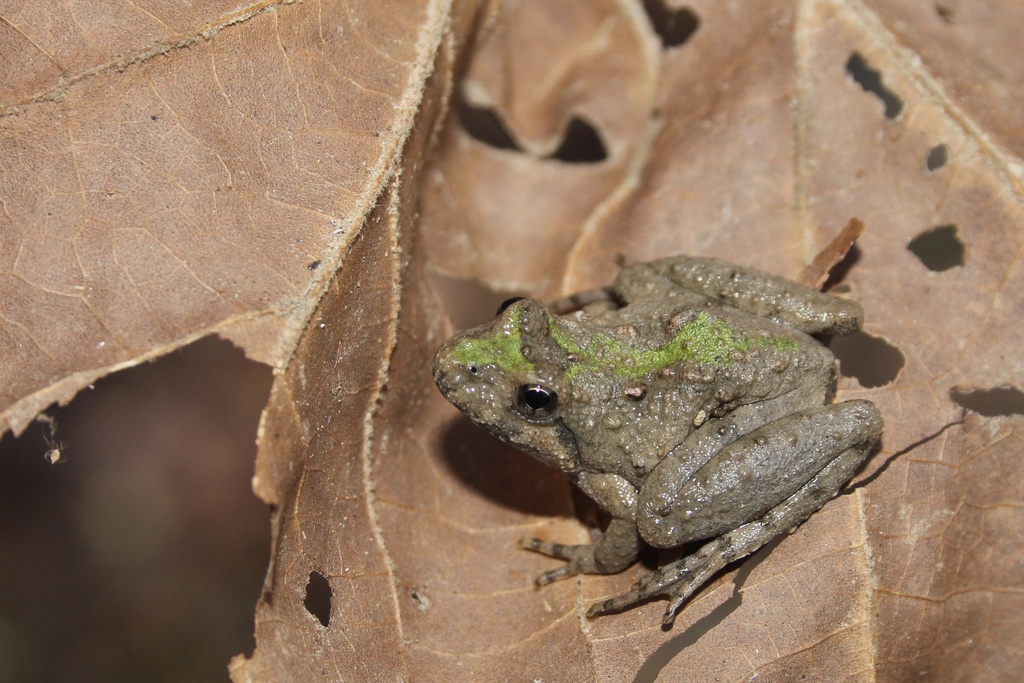
Northern Cricket Frog
Acris crepitans
The northern cricket frog (Acris crepitans) is a species of small hylid frog native to the United States and northeastern Mexico. These frogs are majorly in grey, green, and brown color with blotching patterns. Many have a brown or orange stripe down the center of their back and a triangular marking on the top of their head. Despite being members of the tree frog family, they are not arboreal. These frogs prefer habitats near the edges of slow-moving bodies of water, and in close proximity to shelter items, like rocks. It has two recognized subspecies, A. c. crepitans and A. c. paludicola.
From the article Northern cricket frog on Wikipedia (CC BY-SA), quoted section by section
Description
The northern cricket frog is one of the three smallest vertebrates in North America, ranging from 19–38 mm (0.75–1.50 in) long. They have a prominent blunt snout. Its dorsal coloration varies widely, and includes greys, greens, and browns, often in irregular blotching patterns. There is usually a distinct triangular mark on their head between their eyes.
The dorsal stripes vary in brightness and hue and are not present until metamorphosis occurs. One New York biologist has identified six distinct color morphs and four pattern morphs, and several intergrades between these. Typically there is dark banding on the legs and a white bar from the eye to the base of the foreleg. The skin has a bumpy texture. It is very similar to the southern cricket frog, Acris gryllus, found in the US Southeastern Coastal Plain, but with some overlap along the Fall Line. The southern cricket frog has longer legs, with less webbing on the hind feet, and a more pointed snout, though northern cricket frogs have been observed with snouts indistinguishable from those of the southern species, and the markings on the back of the thigh are typically more sharply defined than that of the northern cricket frog, though biologists have recorded northern cricket frogs in the northern fringes of their range with extremely sharp posterior leg stripes. Northern cricket frogs do not have toe pads. …
Range & habitat
Cricket frogs prefer the edges of slow-moving, permanent bodies of water. They prefer open, shallow waters with an abundance of aquatic vegetation. Some studies have found that cricket frogs may prefer sites that have some form of potential shelter, rocks for example, rather than be completely out in the open. Adults live in temperate environments while tadpoles live in shallow freshwater habitats with varying temperatures. Large groups of them can often be found together along the muddy banks of shallow streams, especially during pre-migratory clustering. The northern cricket frog has been observed to hibernate upland, often at considerable distances from water. There are various factors that influence microhabitat site selection for this species: temperature, proximity to water, shelter accessibility, etc.
Geographic distribution. A. c. crepitans is found from New York, south to Florida, and west along the Gulf Coast states to Texas. A. c. paludicola occurs in southwestern Louisiana to East Texas.
Wikipedia: “Habitat and distribution”
What it does
The diet of Northern cricket frogs is strongly correlated with what is abundant and available. The most abundant above-ground invertebrates are dipterans, homopterans and spiders. Cricket frogs consume more ground-dwelling prey but such prey account for less volume of food consumed. Bigger frogs consume prey of longer length: less ants, springtails, mites and more leafhoppers, damselflies, butterflies, moths, grasshoppers, crickets. Cricket frogs generally feed little on aquatic species. A study of 279 A. crepitan stomach contents showed that ground prey composed of 45.6% of prey and 20.7% of the stomach volume, above ground prey composed of 33% prey and 38.7% volume, and aquatic prey composed of 3.2% prey and 5.0% volume, with the remaining being unidentified prey and non-prey items.
Wikipedia: “Diet”
Listen
Looking for field recordings…
Where it lives
Recorded sightings
—
geo-referenced records in GBIF, from museums, herbaria and field observers.
Drag the globe to turn it. Dots are where records exist, not a range map; darker means more records.
In the stacks
Searching the stacks…
Every page naming Acris crepitans in the Biodiversity Heritage Library →
This page is assembled live from iNaturalist, GBIF, Wikipedia, the Source Library and the Internet Archive. It is not yet part of the hand-edited codex. iNaturalist taxon 24230.