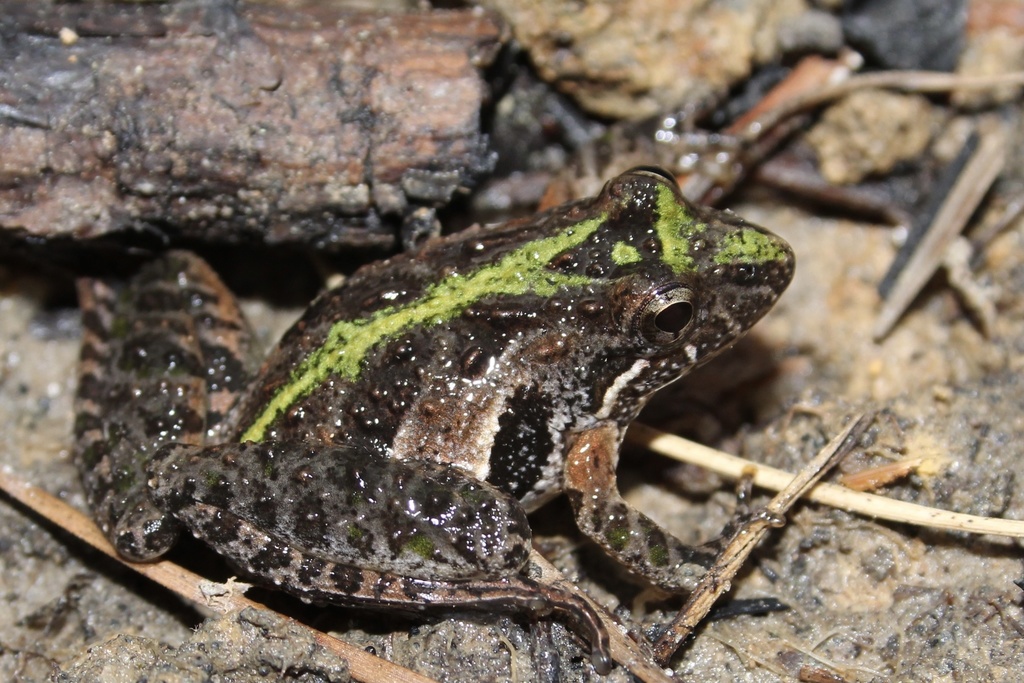
Southern Cricket Frog
Acris gryllus
The southern cricket frog or southeastern cricket frog (Acris gryllus) is a small hylid frog native to the Southeastern United States. It is very similar in appearance and habits to the northern cricket frog, Acris crepitans, and was considered formerly conspecific (Dickerson 1906). The scientific name Acris is from the Greek word for locust, and the species name gryllus is Latin for cricket (Georgia Wildlife).
From the article Southern cricket frog on Wikipedia (CC BY-SA), quoted section by section
Description
At 0.75–1.5 inches (16–32 mm) in length, Acris gryllus is even smaller than A. crepitans. Other characters that differentiate the southern species are:
More pointed snout--A. crepitans more blunt. Hind leg is more than half length of the body when folded—that of A. crepitans is less than one half body length. When rear leg is extended forward, the heel of A. gryllus usually reaches beyond the snout—does not reach snout in A. crepitans. A. gryllus can jump longer distances than A. crepitans. A. gryllus has a sharply defined black stripe on the back of the thigh--A. crepitans has a ragged stripe. Webbing on rear feet of A. gryllus is sparse, more extensive in A. crepitans. There is evidence that the color of the vertebral stripe on southern cricket frogs can vary temporally and can change within one frog's lifetime.
Range & habitat
The southern cricket frog is characteristic of coastal plain bogs, bottomland swamps, ponds, and ditches. It prefers sunny areas, and is usually not found in woodlands. Subspecies Acris gryllus gryllus is found in the Atlantic Coastal Plain from southeastern Virginia through the Carolinas, Georgia, Alabama, and Mississippi, west to the Mississippi River. It is found mostly east of the Fall Line, but extends into more upland areas of the Piedmont along river valleys. Subspecies Acris gryllus dorsalis is found throughout the Florida peninsula.
Wikipedia: “Range and habitat”
What it does
Breeding is in late spring and summer. The advertisement call of the males is a loud rapid gick, gick, gick. Up to 150 eggs are laid at a time, and more than one mass may be produced in a season (Martof et al. 1980).
Wikipedia: “Reproduction”
Listen
Looking for field recordings…
Where it lives
Recorded sightings
—
geo-referenced records in GBIF, from museums, herbaria and field observers.
Drag the globe to turn it. Dots are where records exist, not a range map; darker means more records.
In the stacks
Searching the stacks…
Every page naming Acris gryllus in the Biodiversity Heritage Library →
This page is assembled live from iNaturalist, GBIF, Wikipedia, the Source Library and the Internet Archive. It is not yet part of the hand-edited codex. iNaturalist taxon 24233.