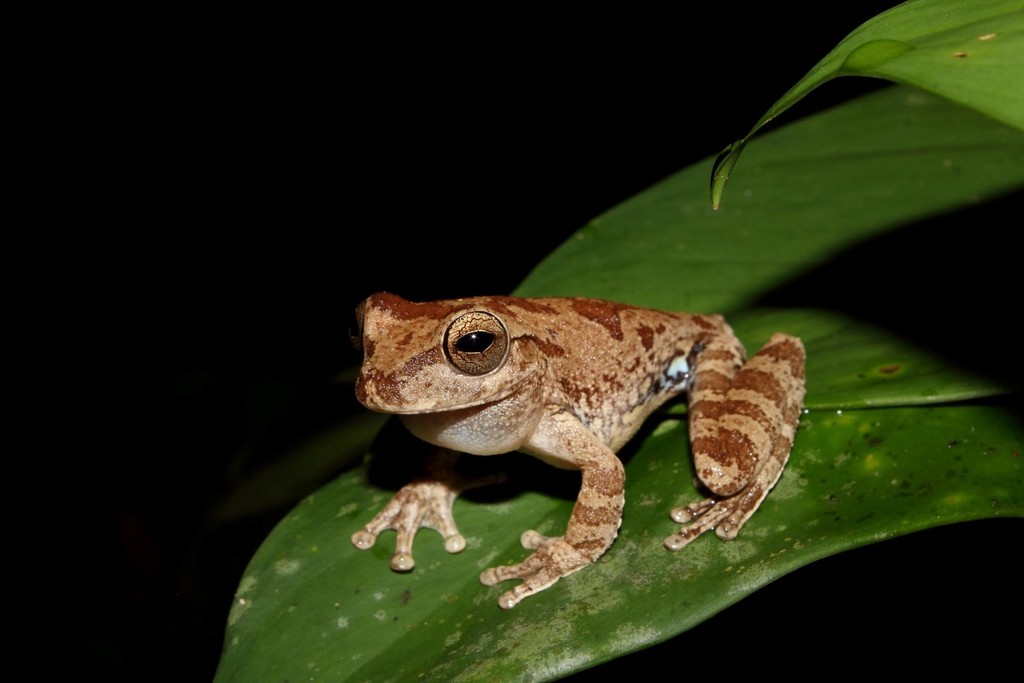
Pugnosed Tree Frog
Smilisca sila
The Panama cross-banded tree frog or pug-nosed tree frog (Smilisca sila) is a species of frog in the family Hylidae found in the humid Pacific lowlands of southwestern Costa Rica to eastern Panama and in the Caribbean lowlands of Panama and northern Colombia. Males of the species utilize synchronous calling to hide their position from predators. Females create basins during amplexus and deposit fertilized eggs onto the surface of the water.
From the article Panama cross-banded tree frog on Wikipedia (CC BY-SA), quoted section by section
Description
Males grow to 45 mm (1.8 in) and females to 62 mm (2.4 in) in snout–vent length. They are gray, tan or reddish brown in dorsal colouration, with tuberculate skin. White or green flecks as well as darker blotches and markings may be present. Ventral surface is creamy white. The males possess a grey, paired vocal sac used to participate in their characteristic choruses, while the females have a singular white vocal sac flecked with brown. The underside of the thighs and groin are brown with blue spots, while the underside of the arm has yellow spots. The irises of the frog's eyes are brown with a black netted pattern. Toes are webbed on front and back legs with large pads at the tip. Adult S. sila individuals are morphologically very similar to their sister species S. sordida, but possess a flatter snout and bumpier skin. Tadpoles are relatively round, with weak muscles and broad, short tails adapted for small ponds. They possess mouthparts used for scraping and chewing.
Range & habitat
S. sila is found in the lowlands of southwest Costa Rica, Panama, and Northern Colombia and prefers transitional zones between wet and dry lowland tropical forests close to shallow rocky pools and stream banks. It can also occur in secondary forest, and sometimes in relatively open areas. These frogs are found between the elevations of 10–970 m. They breed during the dry season from January to April at low elevations and may breed during the rainy season at high elevations. S. sila females prefer gravel islands or banks alongside first-order streams for breeding and laying eggs. Males of the species tend to call alongside streams with ambient noise and overhanging vegetation to mask calls from predators and hide if needed. Tadpoles live in clear pools and slow-moving water near the bottom.
Wikipedia: “Habitat and distribution”
What it does
S. sila tadpoles possess scraping mouthparts and are substrate feeders of algae and plant matter within their ponds. Although S. sila breeds during the dry season, periods of rain may connect small ponds and allow the tadpoles to travel between them, expanding their access to food resources.
Wikipedia: “Diet”
Listen
Looking for field recordings…
Where it lives
Recorded sightings
—
geo-referenced records in GBIF, from museums, herbaria and field observers.
Drag the globe to turn it. Dots are where records exist, not a range map; darker means more records.
In the stacks
Searching the stacks…
Every page naming Smilisca sila in the Biodiversity Heritage Library →
This page is assembled live from iNaturalist, GBIF, Wikipedia, the Source Library and the Internet Archive. It is not yet part of the hand-edited codex. iNaturalist taxon 24275.