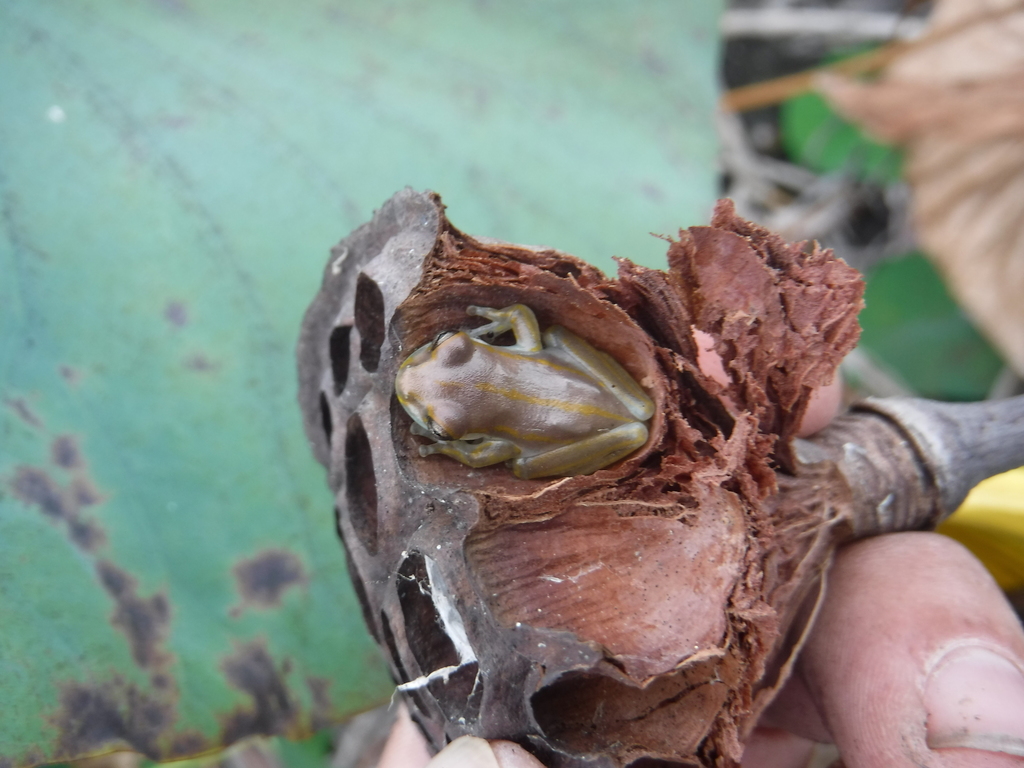
Hispaniolan Yellow Tree Frog
Osteopilus pulchrilineatus
The Hispaniolan yellow tree frog or common treefrog (Osteopilus pulchrilineatus) is a species of frog in the family Hylidae endemic to Hispaniola, where it is found in both the Dominican Republic and Haiti. Its natural habitats are mesic broadleaf forests, riparian forests (including forest remnants), mangrove forests, grasslands, and marshes. It can also be found in agricultural landscapes (e.g., rice plantations, coffee and cacao plantations, and in the presence of livestock). Males call in flooded pools...
From the article Hispaniolan yellow tree frog on Wikipedia (CC BY-SA), quoted section by section
Description
Adult Hispaniola yellow tree frogs can grow to be about 43 mm for females, while the males tend to be slightly smaller and only grow to be about 39 mm. They have 3 dorsal lines that can be yellow, tan, green, or brown that are used to most easily identify the species. The lower sides of the frog are usually yellow in color as well. They can be active during the night when temperatures range from 24 to 27 °C. The Osteopilus genus tend to follow a generalist diet and usually choose prey based on their size
Range & habitat
Osteopilus pulchrilineatus is one of four endemic species to Hispaniola and can only survive in a specific set of environmental conditions. Its natural habitats are mesic broadleaf forests, riparian forests (including forest remnants), mangrove forests, grasslands, and marshes. It can also be found in agricultural landscapes (e.g., rice plantations, coffee and cacao plantations, and in the presence of livestock). Osteopilus pulchrilineatus is known to have at least six different breeding habitats, most of which are marine like habitats. These include vegetative ponds with nearby open grassland, ponds in mountainous areas that have a small area, streams in mountain forests, ephemeral pools in forested areas, pools found within rice fields, and rivers and streams of forested areas. Males are known to call in flooded pools after heavy rains. The estimated area that Osteopilus pulchrilineatus is said to inhabit ranges from 1,3000 km2 to 2,000 km2 and elevations up to almost 1,700 km2.
Wikipedia: “Habitat”
Listen
Looking for field recordings…
Where it lives
Recorded sightings
—
geo-referenced records in GBIF, from museums, herbaria and field observers.
Drag the globe to turn it. Dots are where records exist, not a range map; darker means more records.
In the stacks
Searching the stacks…
Every page naming Osteopilus pulchrilineatus in the Biodiversity Heritage Library →
This page is assembled live from iNaturalist, GBIF, Wikipedia, the Source Library and the Internet Archive. It is not yet part of the hand-edited codex. iNaturalist taxon 24376.