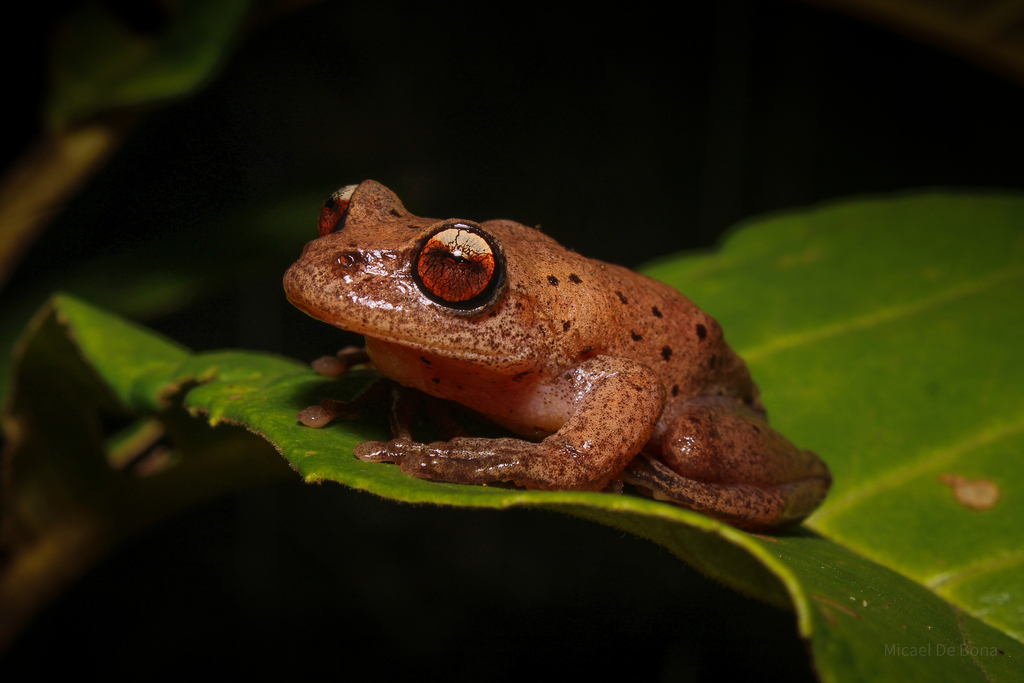
Canebreak Tree Frog
Aplastodiscus cochranae
Aplastodiscus cochranae is a species of frog in the family Hylidae. It is endemic to the coastal mountains of Santa Catarina, Brazil. The specific name cochranae honors Doris Mable Cochran, an American herpetologist. Common name canebrake treefrog has been coined for this species.
From the article Aplastodiscus cochranae on Wikipedia (CC BY-SA), quoted section by section
Description
Adult males measure 41–46 mm (1.6–1.8 in) and adult females, based on only two specimens, 45–50 mm (1.8–2.0 in) in snout–vent length. The overall appearance is robust. The snout is rounded, but may be truncated in lateral view. The tympanum is covered by skin but is visible in most specimens. The supra-tympanic fold is well-developed. The fingers have large discs and webbing between fingers II to IV. The toe discs are smaller than those on the fingers; there is basal webbing between the toes II to V. The dorsal coloration is cream-rosy to reddish-brown with scattered melanophores. A black line passes from the nostril along the canthus rostralis to the eye. The lower parts have light pink color, and flanks and joints show violet tones. Males have single subgular vocal sac. Late-stage tadpoles (Gosner stage 36) are dorsally grayish brown and ventrally grayish. They measure 62–64 mm (2.4–2.5 in) in total length, of which the body makes one third.
Range & habitat
Aplastodiscus cochranae live in understorey vegetation of the edge of rainforest at elevations of 500–800 m (1,600–2,600 ft) above sea level. Breeding takes place in small water-filled holes in the ground. Aplastodiscus cochranae is an abundant species, and the overall population is considered to be stable. The major threat to this species is cattle that trample vegetation and cause water pollution. It occurs in the Serra do Tabuleiro State Park as well as in several private reserves.
== References ==
Wikipedia: “Habitat and conservation”
Listen
Looking for field recordings…
Where it lives
Recorded sightings
—
geo-referenced records in GBIF, from museums, herbaria and field observers.
Drag the globe to turn it. Dots are where records exist, not a range map; darker means more records.
In the stacks
Searching the stacks…
Every page naming Aplastodiscus cochranae in the Biodiversity Heritage Library →
This page is assembled live from iNaturalist, GBIF, Wikipedia, the Source Library and the Internet Archive. It is not yet part of the hand-edited codex. iNaturalist taxon 24444.