- Animals
- ›Chordates
- ›Vertebrates
- ›Birds
- ›Rollers, Kingfishers, and Allies
- ›Kingfishers
- ›Tree Kingfishers
- ›Todiramphus
On eBird ↗
Chattering Kingfisher
Live sightings near you, the range map, bar charts of when it is seen, and Macaulay Library photos and recordings.
Chattering Kingfisher
Todiramphus tutus
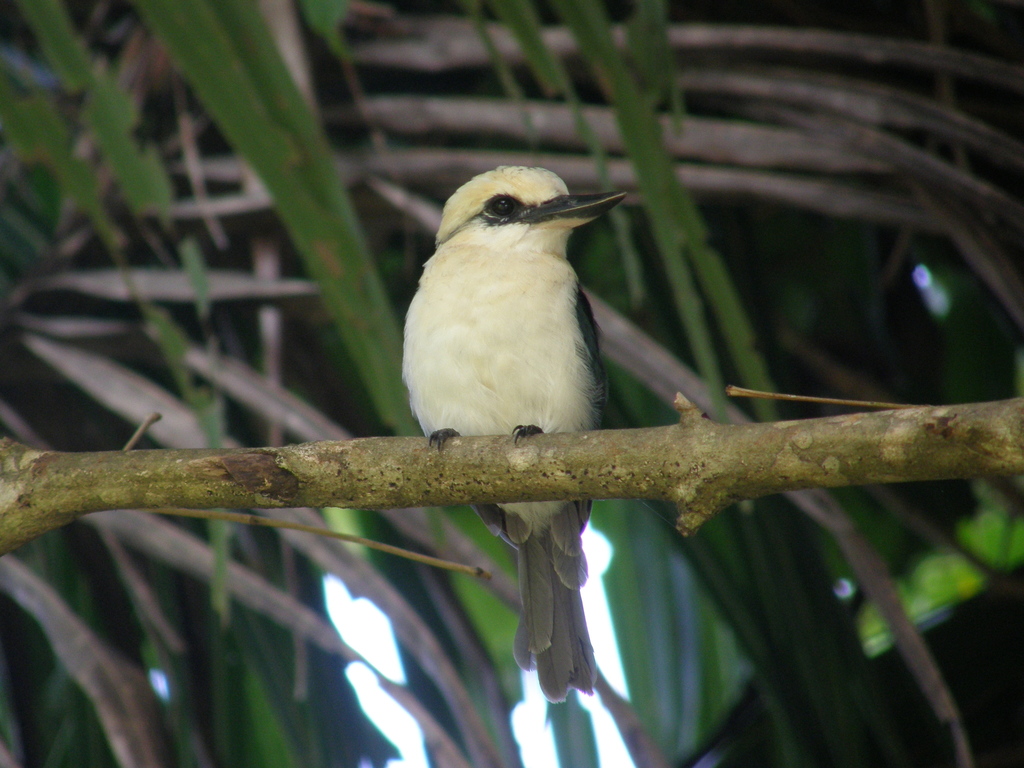
The chattering kingfisher (Todiramphus tutus) is a species of bird in the kingfisher family Alcedinidae. The species is found in the Cook Islands and the Society Islands in French Polynesia. The species is probably closely related to the white-bellied collared kingfishers of Fiji, Tonga and Samoa.
From the article Chattering kingfisher on Wikipedia (CC BY-SA), quoted section by section
Description
It resembles the collared kingfisher but is smaller and lacks any rust colour in the plumage. The breast and throat is white, and the back, wings and crown are blue-green (although the crown of the Atiu subspecies is almost entirely white). It can be told from the Tahiti kingfisher by the complete white collar.
Range & habitat
Its natural habitats are tropical moist lowland forests and tropical moist montane forest. The species prefers primary forest in montane valleys, but will move into secondary growth and old plantations. The species has an uneven distribution. Nevertheless, it is not considered threatened with extinction by the IUCN.
Wikipedia: “Habitat”
What it does
The chattering kingfisher lives singly or in pairs and feeds on insects and lizards taken on the wing or from the ground. The species nests in tree cavities.
== References ==
Wikipedia: “Behaviour”
Listen
Looking for field recordings…
Where it lives
Recorded sightings
—
geo-referenced records in GBIF, from museums, herbaria and field observers.
Drag the globe to turn it. Dots are where records exist, not a range map; darker means more records.
In the stacks
Searching the stacks…
Every page naming Todiramphus tutus in the Biodiversity Heritage Library →
This page is assembled live from iNaturalist, GBIF, Wikipedia, the Source Library and the Internet Archive. It is not yet part of the hand-edited codex. iNaturalist taxon 2445.