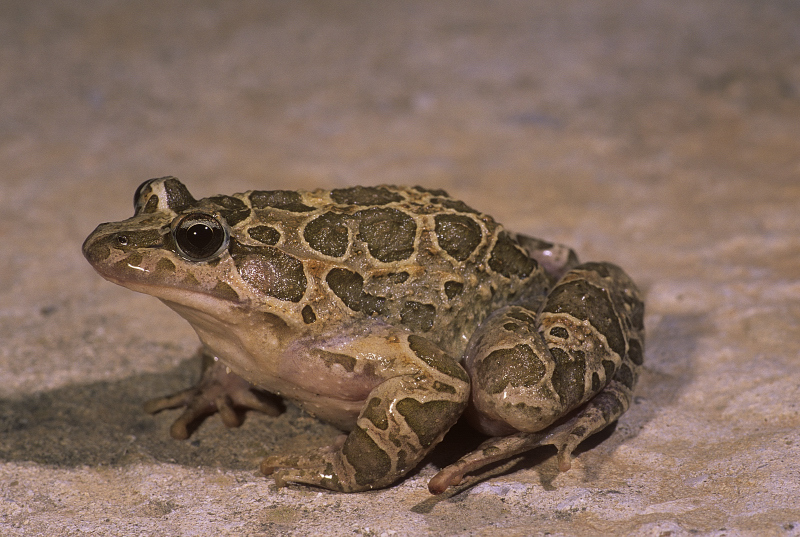
Mediterranean Painted Frog
Discoglossus pictus
The Mediterranean painted frog or simply painted frog, Discoglossus pictus, is a species of frog in the Alytidae family (formerly Discoglossidae).
From the article Discoglossus pictus on Wikipedia (CC BY-SA), quoted section by section
Description
As the common name implies, these frogs can have colorful markings. Three pattern variations occur in this species - almost uniformly colored animals, animals with large, dark spots with bright edges, and animals with two dark brown longitudinal bands, one bright band along the back, and two bright bands along the sides. The belly is whitish. The body is stout with a flat head that is wider than it is long. The dorsal glands are arranged in longitudinal patterns along the back, or can be absent. The pupils are shaped like an upside-down droplet. Mating in North Morocco takes place from January to early November. Copulation, in which the male clasps the female in the lumbar region, lasts about two hours. Copulation in the Spanish specimens lasts only 35 seconds to 2 minutes. Females lay 500 to 1000 eggs in one night. The females copulate with various males and after each copulation, a small clump of about 20 to 50 eggs is laid. The ovum diameter is usually 1.0 to 1.5 mm; the gelatinous envelope is 3.7 mm. The eggs have no common envelope and form a loose mass on the water surface or may sink to the bottom. Eggs usually hatch in 2–6 days. Upon hatching, tadpoles are about 3 mm in length. In 1–3 months, they grow to about 33 mm and metamorphose into froglets of 10 mm. …
Range & habitat
Discoglossus pictus is found Mediterranean Africa in northeast Morocco, northern Algeria, and Tunisia, in the islands of Sicily (Italy) and Malta; introduced populations exist in northeastern Spain and southwestern France. Discoglossus scovazzi from Morocco was previously considered a subspecies of D. pictus. Initially, only the former was thought to occur in Morocco, but later research has shown that also D. pictus is present there.
Wikipedia: “Distribution”
Listen
Looking for field recordings…
Where it lives
Recorded sightings
—
geo-referenced records in GBIF, from museums, herbaria and field observers.
Drag the globe to turn it. Dots are where records exist, not a range map; darker means more records.
In the stacks
Searching the stacks…
Every page naming Discoglossus pictus in the Biodiversity Heritage Library →
This page is assembled live from iNaturalist, GBIF, Wikipedia, the Source Library and the Internet Archive. It is not yet part of the hand-edited codex. iNaturalist taxon 24479.