- Animals
- ›Chordates
- ›Vertebrates
- ›Birds
- ›Rollers, Kingfishers, and Allies
- ›Kingfishers
- ›Tree Kingfishers
- ›Todiramphus
On eBird ↗
Red-backed Kingfisher
Live sightings near you, the range map, bar charts of when it is seen, and Macaulay Library photos and recordings.
Red-backed Kingfisher
Todiramphus pyrrhopygius
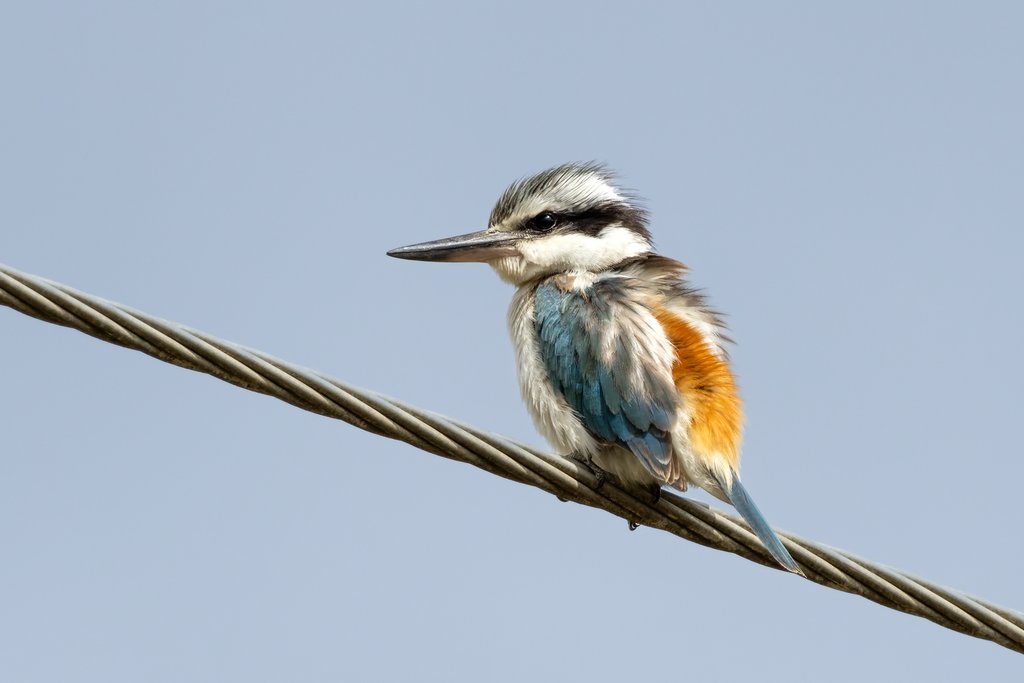
The red-backed kingfisher (Todiramphus pyrrhopygius) is a species of kingfisher in the subfamily Halcyoninae, also known as tree kingfishers. It is a predominantly blue-green and white bird with a chestnut rump. It is found across the continent of Australia, mainly inhabiting the drier regions.
From the article Red-backed kingfisher on Wikipedia (CC BY-SA), quoted section by section
Description
The red-backed kingfisher measures 20 to 24 cm (7.9 to 9.4 in); the male weighs 45–70 g (1.6–2.5 oz) and the female 41–62 g (1.4–2.2 oz). It has a streaked green and white crown, bluish-green wings and tail, and lower back, rump and upper tail coverts chestnut with white breast, abdomen, and nape. It has a black band stretching from the bill, through the eyes and to the ear coverts. The female is duller overall in coloration, with the crown more heavily streaked, dull turquoise in wings, and more buff in areas of white. The iris is dark brown and the legs and feet dark grey. Immature birds are like female, but with dull green back and mantle and speckling on their breasts.
Voice. The call is a descending, mournful whistle "kee-ip", repeated every few seconds in a long series from a tree-top or telephone wire. The red-backed kingfisher is noisy when mating with a harsh alarm calls and parrot-like chatter given by birds near the nest.
Range & habitat
The red-backed kingfisher is native to most of Australia, except Tasmania and the extreme southwest and southeast of the mainland. It is a summer visitor to the southeast of the country; elsewhere it is resident all year round. It inhabits dry forests, mulga and mallee country, to spinifex and almost treeless country, often far from water. During breeding season, the red-backed kingfisher will move to river courses to make use of the earthy banks to dig nesting burrows. It appears to be partly migratory to the south of the continent for the breeding season, returning north in winter. It is moderately common to uncommon, due to its irregular nomadic movements, probably depending on the occurrence of erratic rainfall.
Wikipedia: “Distribution and habitat”
What it does
The red-backed kingfisher observes from a conspicuous perch in a tree or on overhead wires, then swoops to the ground to take its prey and return directly to its perch . Its diet consists of various insects (including locusts and grasshoppers, beetles, leaf-insects, ants and caterpillars), spiders, small crustaceans, centipedes, and scorpions. It also takes vertebrates, such as fish, frogs and tadpoles, lizards, snakes, and occasionally mouse-sized mammals.
Wikipedia: “Feeding”
Listen
Looking for field recordings…
Where it lives
Recorded sightings
—
geo-referenced records in GBIF, from museums, herbaria and field observers.
Drag the globe to turn it. Dots are where records exist, not a range map; darker means more records.
In the stacks
Searching the stacks…
Every page naming Todiramphus pyrrhopygius in the Biodiversity Heritage Library →
This page is assembled live from iNaturalist, GBIF, Wikipedia, the Source Library and the Internet Archive. It is not yet part of the hand-edited codex. iNaturalist taxon 2453.