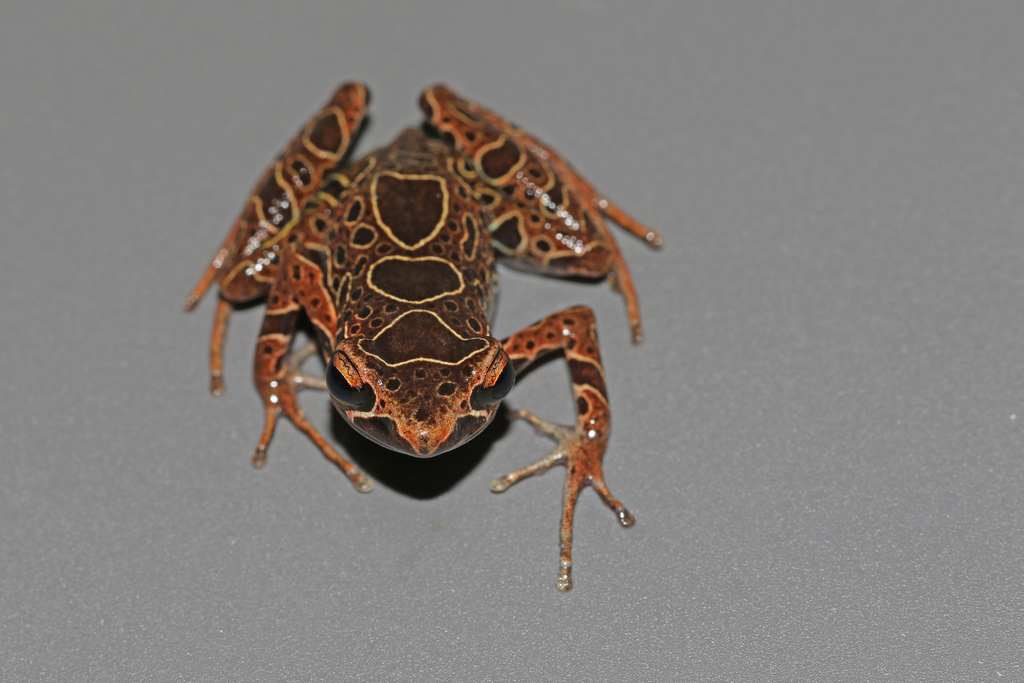
Cardioglossa elegans
Cardioglossa elegans is a species of frog in the family Arthroleptidae. It is found in southwestern Cameroon, Equatorial Guinea, and south to central Gabon. Common name elegant long-fingered frog has been coined for it.
From the article Cardioglossa elegans on Wikipedia (CC BY-SA), quoted section by section
Description
Adult males measure 23–29 mm (0.9–1.1 in) and adult females 28–37 mm (1.1–1.5 in) in snout–vent length. Males have extremely long third fingers. The tympanum is visible. The dorsum is greyish brown and bears small and large symmetrical dark brown blotches with a pale outline. There are three large blotches; the first one is triangular and starts between the eyes, pointing backwards. Another two blotches follow immediately behind.
Range & habitat
Cardioglossa elegans occur in moist lowland and degraded forests at elevations below 1,000 m (3,300 ft). Breeding takes place in small streams, and males call from rocky areas or from under bridges. Cardioglossa elegans is a common species where it occurs, especially when aggregating for breeding. It can probably suffer locally from habitat loss. It is likely to occur in several protected areas.
== References ==
Wikipedia: “Habitat and conservation”
Listen
Looking for field recordings…
Where it lives
Recorded sightings
—
geo-referenced records in GBIF, from museums, herbaria and field observers.
Drag the globe to turn it. Dots are where records exist, not a range map; darker means more records.
In the stacks
Searching the stacks…
Every page naming Cardioglossa elegans in the Biodiversity Heritage Library →
This page is assembled live from iNaturalist, GBIF, Wikipedia, the Source Library and the Internet Archive. It is not yet part of the hand-edited codex. iNaturalist taxon 24552.