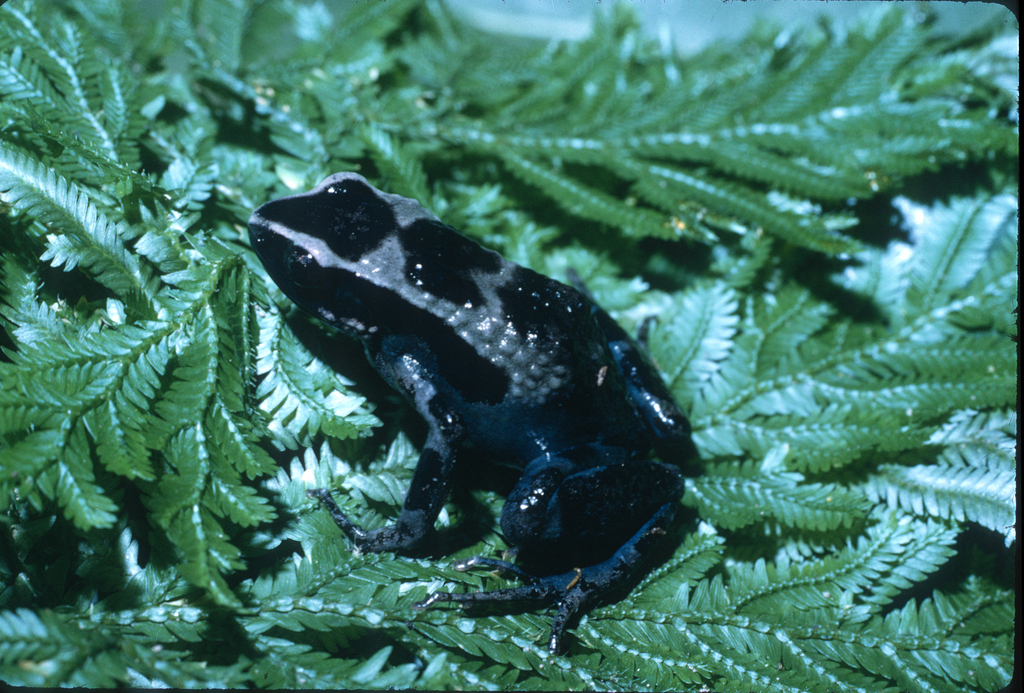
Nsoung Long-fingered Frog
Cardioglossa trifasciata
Cardioglossa trifasciata is a species of frog in the Arthroleptidae family. It is endemic to Cameroon. Its natural habitats are subtropical or tropical moist montane forests, rivers, and heavily degraded former forest. It is threatened by habitat loss. It is labeled as critically endangered. This animal is known to hide under large rocks and among small stones as to avoid predators.
From the article Cardioglossa trifasciata on Wikipedia (CC BY-SA), quoted section by section
Description
Males measure 24–31 mm (0.9–1.2 in) and females 30–41 mm (1.2–1.6 in) in snout–vent length. Males have extremely long third fingers and spines in the fingers and in the groin; females lack these characteristics. Dorsal markings typical for the genus Cardioglossa are present, whereas the white line running under the tympanum is absent.
Range & habitat
Cardioglossa trifasciata occurs in dense secondary bush and montane forest at elevations of 1,750–2,000 m (5,740–6,560 ft) above sea level; it has not been recorded from primary forest because no such habitat remains. Individuals have been found in and around a small stream, hiding under large rocks and small stones. Breeding probably takes place in the stream. Cardioglossa trifasciata occurs in an area that is well surveyed. There is no good quantitative data on its abundance, but it is believed to be declining. The species is threatened by habitat loss caused by agricultural encroachment (including plantations of tree crops), expanding human settlements, and extraction of wood for firewood and building materials. It is not known from any protected area. Suitable habitat might exist on the Rumpi Hills, a site relatively close to Mount Manengouba. However, the area has not been well investigated in recent years, and it is not known whether the species might be found in the Rumpi Hills.
== References ==
Wikipedia: “Habitat and conservation”
Listen
Looking for field recordings…
Where it lives
Recorded sightings
—
geo-referenced records in GBIF, from museums, herbaria and field observers.
Drag the globe to turn it. Dots are where records exist, not a range map; darker means more records.
In the stacks
Searching the stacks…
Every page naming Cardioglossa trifasciata in the Biodiversity Heritage Library →
This page is assembled live from iNaturalist, GBIF, Wikipedia, the Source Library and the Internet Archive. It is not yet part of the hand-edited codex. iNaturalist taxon 24556.