- Animals
- ›Chordates
- ›Vertebrates
- ›Amphibians
- ›Frogs and Toads
- ›Asian Toads
- ›Pseudomoustache Toads
- ›Leptobrachium
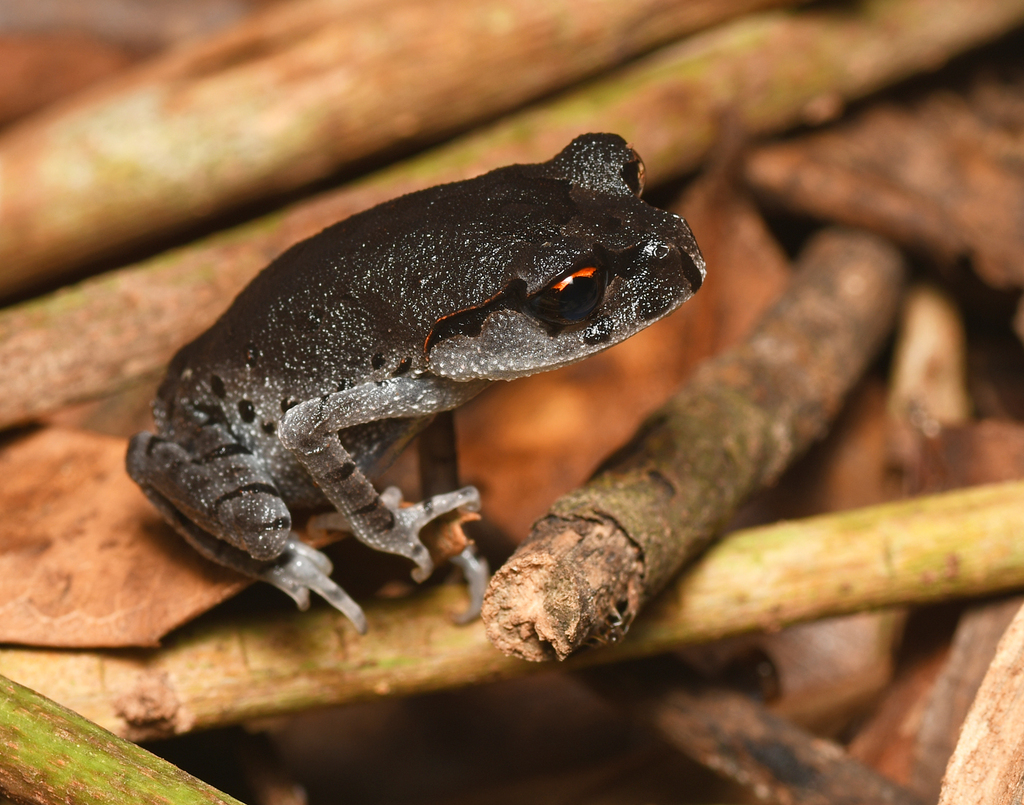
Smith's Litter Frog
Leptobrachium smithi
Leptobrachium smithi (common name Smith's litter frog) is a species of frog found in Southeast Asia. Its specific name honours Malcolm Arthur Smith, one of the early herpetologists to study the amphibians of Thailand.
From the article Leptobrachium smithi on Wikipedia (CC BY-SA), quoted section by section
Description
Leptobrachium smithi is a moderate-sized Leptobrachium, with males measuring 36–68 mm (1.4–2.7 in) snout-vent length and females 50–78 mm (2.0–3.1 in) SVL. They have a relatively big, depressed head with striking eyes with upper half of iris scarlet or yellow. Skin above is nearly smooth but with minute granules scattered behind, especially around vent; ventrally granular.
Range & habitat
Its type locality is Ton Nam Plu Waterfall, Khao Chong, in Trang Province, southern Thailand. It is also known from adjacent southern Myanmar and from Laos. It may also occur in northeastern India and Bangladesh and in Peninsular Malaysia (Pulau Langkawi). Prior to its description, it was confused with Leptobrachium hasseltii and Leptobrachium pullum. Leptobrachium smithi is a locally common species that is found on the ground in evergreen forest in monsoon and rainforest climatic regions, as well as dense mixed deciduous forest. Tadpoles are found in deep sections of forest streams with little current.
Wikipedia: “Distribution”
Listen
Looking for field recordings…
Where it lives
Recorded sightings
—
geo-referenced records in GBIF, from museums, herbaria and field observers.
Drag the globe to turn it. Dots are where records exist, not a range map; darker means more records.
In the stacks
Searching the stacks…
Every page naming Leptobrachium smithi in the Biodiversity Heritage Library →
This page is assembled live from iNaturalist, GBIF, Wikipedia, the Source Library and the Internet Archive. It is not yet part of the hand-edited codex. iNaturalist taxon 24715.