- Animals
- ›Chordates
- ›Vertebrates
- ›Birds
- ›Rollers, Kingfishers, and Allies
- ›Kingfishers
- ›Tree Kingfishers
- ›Todiramphus
On eBird ↗
Rufous-lored Kingfisher
Live sightings near you, the range map, bar charts of when it is seen, and Macaulay Library photos and recordings.
Rufous-lored Kingfisher
Todiramphus winchelli
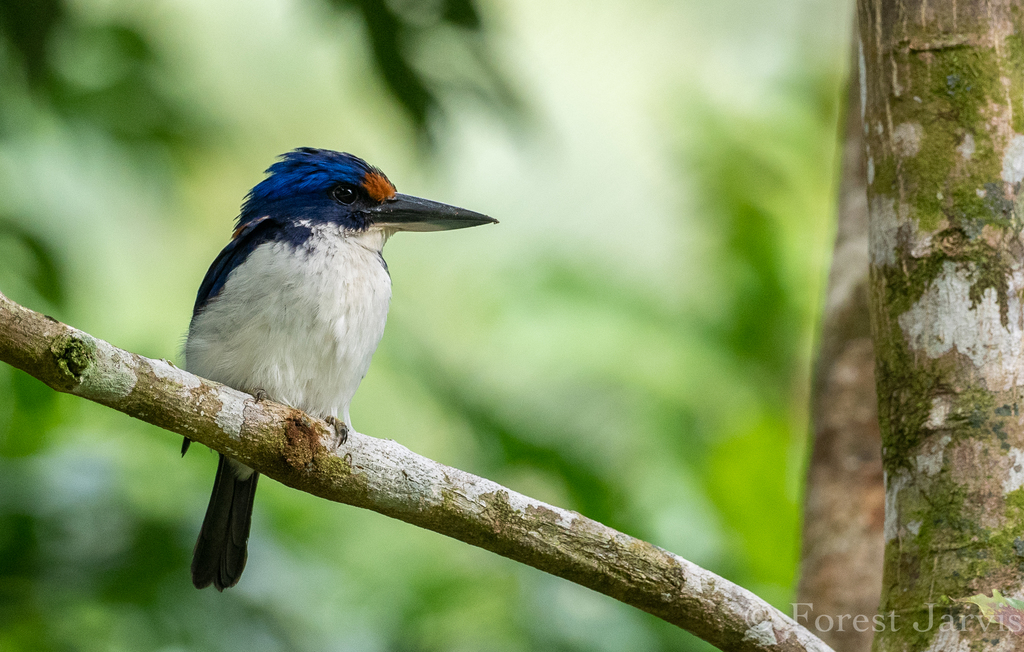
The rufous-lored kingfisher (Todiramphus winchelli), also known as Winchell's kingfisher, is a species of bird in the kingfisher family Alcedinidae. It is endemic to the Philippines, its natural habitat consists of tropical moist lowland forests. It is threatened by deforestation, and the International Union for Conservation of Nature (IUCN) has assessed it as a vulnerable species.
From the article Rufous-lored kingfisher on Wikipedia (CC BY-SA), quoted section by section
Description
The rufous-lored kingfisher is about 25 cm (9.8 in) long. The crown is blackish-blue, with cobalt-blue edges, and the lores and neck-collar are rufous. The upperparts are mostly blackish and dark blue, with a bright azure-blue rump. The underparts are white in the male, and buff in the female. The eyes are dark brown, the beak is black, and the legs are greyish. The juvenile bird is similar to the female, but with duller plumage. The subspecies are coloured different shades of blue. A black patch on the sides of the male's breast is conspicuous in subspecies nigrorum and concealed in others, and in nesydrionetes, the female has an orange breast forming a band between the whitish throat and belly.
Range & habitat
This species is endemic to the Philippines, ranging from Samar and Tablas south to Mindanao, Basilan and the Sulu Archipelago. It appears to be locally common on some islands, but it is rare in other localities. It lives in forest below 1,000 m (3,300 ft) in elevation, being found in coastal lowlands and foothills. Its tolerance of degraded forest is uncertain. The population size is estimated at 2,500–9,999 mature individuals, or 3,500–15,000 individuals in total. Forest clearance and illegal logging are causing habitat loss and a fast population decline, so the IUCN has assessed it as a vulnerable species. This species has been recorded in some protected areas, such as Mount Guiting-Guiting and Rajah Sikatuna Protected Landscape.
Wikipedia: “Habitat and Conservation status”
What it does
This kingfisher often perches in the canopy and sometimes descends to lower perches and to the ground, probably to feed. One of its calls is an ascending series of harsh chup and chep notes, and another consists of three rising notes and then a long descending series chu chu chu chu. Loud squawking has also been heard. It batters its prey, which consists of large insects, spiders and small vertebrates. Little is known about its breeding. Nesting in a used arboreal termite nest has been recorded.
Wikipedia: “Behaviour and ecology”
Listen
Looking for field recordings…
Where it lives
Recorded sightings
—
geo-referenced records in GBIF, from museums, herbaria and field observers.
Drag the globe to turn it. Dots are where records exist, not a range map; darker means more records.
In the stacks
Searching the stacks…
Every page naming Todiramphus winchelli in the Biodiversity Heritage Library →
This page is assembled live from iNaturalist, GBIF, Wikipedia, the Source Library and the Internet Archive. It is not yet part of the hand-edited codex. iNaturalist taxon 2475.